Jack Rankin is the Member of Parliament for Windsor.
As ConservativeHome readers will know better than most, party fundraisers are run to rather unsurprising schedules.
You tuck into dinner. You listen to an MP you may or may not have heard of (not a problem since the Chairman usually helps by reading out their Wikipedia biography as an intro) and you clutch your raffle ticket with cautious optimism that you might just walk away with that ‘Kemi-signed bottle of champers’.
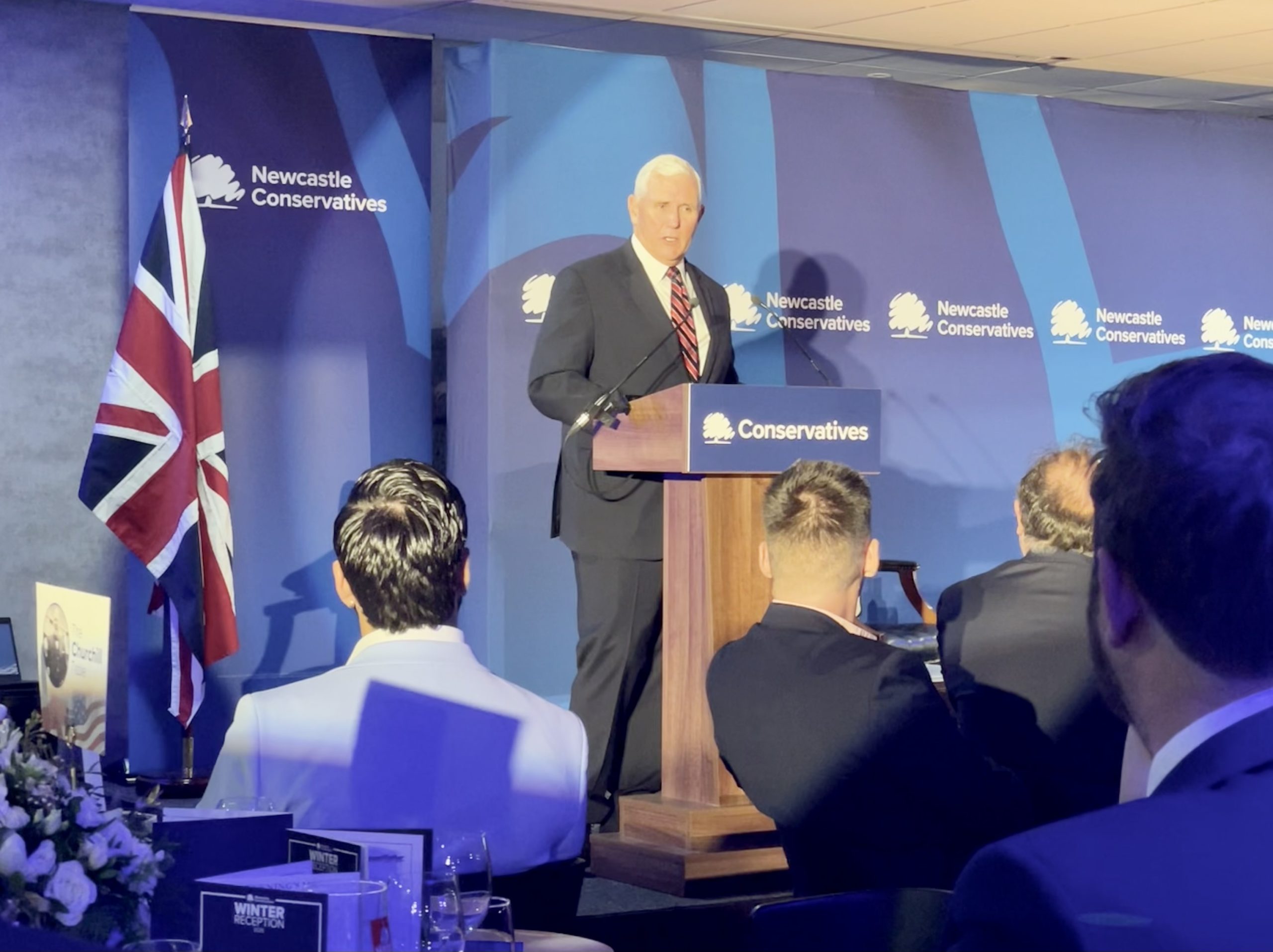
Pondering ‘the future of conservatism’ is clearly one of the moment’s hot topics at these sorts of do, but Vice Presidents of the United States of America leading that discussion are in pretty short supply. Nevertheless, that’s what we were treated to at a Newcastle Conservatives event last week: the 48th Vice President of the United States, Mike Pence.
The Vice President spoke movingly and with a sturdy and impeccable vigour: Mr Pence has a phenomenal weight of presence.
The evening was introduced by David Starkey CBE, with the substantive part of the night an ‘in conversation with’ chaired by the Rt Hon Esther McVey MP. Esther was an inspired choice, because as we explored what motivated the Vice President’s politics, he often leaned on what we might call an authentic blue-collar conservatism, rooted in family, industry, and, of course, his Christian faith. He described himself as a ‘Christian, a conservative and a Republican (in that order)’, explained just how tightly he worked with President Trump in office, his views on China (hawkish), trade (‘free trade with free nations’) and the love and support of his wife, who kindly joined us.
Naturally, he was pressed on his relationship today with President Trump, particularly in context of the Vice President’s role in the certification of the 2020 United States presidential election. Mr Pence talked passionately about the successes of the Trump/Pence administration (as he called it) and President Trump’s ability as a dealmaker, but there was implied criticism certainly in both remarks on trade, but, more meaningfully, on constitutional government.
The Vice President has a book out in the spring: ‘What Conservatives Believe’, intended to be penned as a twenty-first century version of Barry Goldwater’s ‘The Conscience of a Conservative’, as the Republican Party and conservatism across the West is at a crossroads. It is clear that the Vice President sees adherence to constitutional government to be at the principle of that philosophy: ‘I made an oath to defend and protect the Constitution of the United States of America, and finished with a prayer, ‘So help me God’.’
Listening, it felt difficult to overstate how important that last element is to the Vice President.
I was honoured to give the vote of thanks and reflected that the United States was crafted from centuries-old English principles, talking of the Magna Carta which was sealed in my constituency and was first meaningfully marked in this country by the American Bar Association; shared principles which continue to bind us. Limited government, the rule of law, individual rights that became foundational for the U.S. Constitution and Bill of Rights were inculcated on this island; common law, trial by jury, habeas corpus: all concepts that have helped the Americans to become the greatest, most prosperous nation in the world. Moreover, they have kept that light of liberty aflame when it has threatened to flicker out, and we have joined together at great cost to defend it.
In closing the event (after a very successful auction), Dr Starkey echoed my thoughts. In many ways, as they have an actual document to cling to, it is easier for an American constitutionalist (which as a conservative, I agree with Mr Pence, must be first and foremost). But what is the ‘read across’ for a British conservative? What analogies can we draw and what is very different this side of the pond?
Every country’s constitutional conservatism is different, because it is founded in different historical stories and national perspectives. In the United States it means upholding a textualist interpretation of the US Constitution, in the United Kingdom it must mean upholding the sovereignty of the King-in-Parliament in response to the popular vote at a General Election. And I am afraid to be a good constitutionalist in the British context, conservatives must start by recognising just how much of a number has been done on them: The last thirty years have been nothing short of revolutionary, we junked our ancient constitutional settlement, and it has led to most of this country’s foundational problems.
We need to wake up to the reality that during the last Conservative Government we were, in many ways, in office but not in power, because we let the Blairite constitutional settlement stand. A constitutional settlement which was a massive departure from our tried and tested, over centuries, political constitutionalism, replaced with a legal constitutionalism, entirely foreign to our historical understanding.
Whether that’s the writing of legislation which asks judges to make value-decisions on wide-ranging matters of public policy properly of the political arena or the proliferation of arms-length bodies and quangos, often appealing to principles above and beyond the Commons.
Just a glance at the Supreme Court rulings of late and the problem is abundantly clear. Just this week, it ruled that Christian-focused religious education taught in Northern Ireland schools is unlawful. A classic example of imposition by judges of progressive secularism on an issue that Parliament has never legislated for. It highlights the extent to which we’ve upended the British constitution as it has been traditionally understood. It’s as if too much West Wing has been watched, in this country we do not have a ‘separation of powers’, but rather a fusion. The culture shift of moving from Law Lords in Parliament interpretating its law to Supreme Court judges who think they are the referee of political decision-making, with the Lord Chancellor’s historic role rendered redundant, has led to judges making education policy, immigration policy, energy policy – all the proper purview of Parliament.
Moreover, fetishising of international law has bled directly into a more activist definition of the rule of law. We Conservatives have been bewildered these past weeks at the Government’s attempts to pass bills of monumental self-harm; whether the surrender of the Chagos Islands for no good reason whatsoever, or the prosecution of our Northern Irish veterans. But stem from these new-fangled principles so it can hardly come as much of a surprise. And while Mr Starkey did not touch on Lord Bingham’s legacy last week, he has written about its influence.
A renewed Conservatism under Kemi Badenoch is redressing this downward spiral in full force.
We will scrap the Climate Change Act that has constrained Ministers of the Crown, imploring them to adopt policies that are making Britons poorer, set binding targets on net zero and seen the courts interfere endlessly on its procedural duties. We will repeal the Human Rights Act and shut down immigration tribunals, ending the ability of activist judges to effectively snub Parliament in the rubber-stamping of spurious asylum appeals, setting dangerous judicial precedent in the process. And we will scrap the Sentencing Council – perhaps the archetype of the problem – that used “guidelines” to try and alter the very principle of fairness in our judicial system. Where accountability to legislators falls away, tangled in a web of quangos and judges, public institutions get out of control, enforcing decisions that stray far from the spirit of what Parliament intended.
For the next Conservative government to succeed, we must make the intellectual case for a restoration of the British constitution. We can’t just apologise; we need to develop a serious plan to unwind this. With that we can control our immigration system again, make our energy cheaper, protect our servicemen and women, defend meritocracy.
Mike Pence reminded us that a constitutional order survives only when those entrusted with it are willing to defend it without hesitation or apology. It is that same clarity of purpose that Britain must now rediscover. If the United States can remain anchored to its founding principles through political storms, then surely, we the nation that invented Western parliamentary democracy, can reclaim ours and save our country.







![Trump, Hegseth to Get Troops Paid Despite Dems Voting Against it Eight Times [WATCH]](https://www.right2024.com/wp-content/uploads/2025/10/Trump-Hegseth-to-Get-Troops-Paid-Despite-Dems-Voting-Against-350x250.jpg)