Dr Stephen Curran is an education expert who advised on the 2014 syllabus.
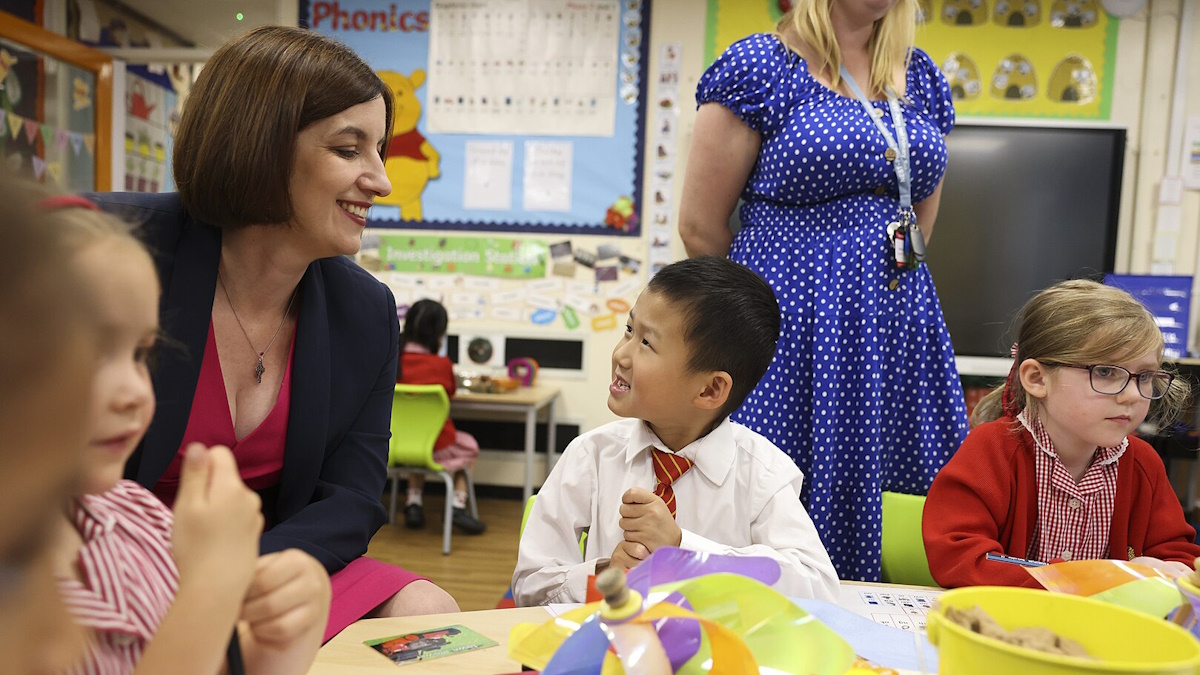
The government’s education review – led by Professor Becky Francis CBE – was published earlier this month, and if it were an exam paper I’d’ve told the student to retake it.
The ‘expert panel’ didn’t contain a single teacher and despite some encouraging-sounding assertions, the progressive instincts of its author shine through.
Between the fashionable buzz words of ‘diversity’ and ‘inclusivity’ she does accept the importance of exams – especially with the emergence of AI making coursework largely pointless – but comes to the wrong conclusions.
The review acknowledges that the ‘socio-economic gap in relation to educational attainment remains stubbornly wide’ – but the panel stubbornly ignored the remarkable Michaela Community School.
Its inspirational headteacher Katharine Birbalsingh has created an educational environment that is the best in the country (according to its Progress 8 score) and whose pupils come from an area of high poverty.
But this must be the wrong sort of diversity and inclusivity because the panel never sought Birbalsingh’s opinion, as far as I am aware.
While the last Conservative administration did plenty wrong, its education policies actually improved things.
I advised on the 2014 education changes, which toughened the curriculum and made it more ‘knowledge rich’.
It focused more on traditional methods – which work – and moved away from progressive methods, which don’t.
English grammar became more central and maths more demanding. These are the fundamental building blocks of education and without them no student can make progress.
If a child comes out of primary education both literate and numerate their education pathway is much easier to negotiate and their life chances will be improved.
Grammar and arithmetic are crucial and the teaching of them should not be dumbed down, as the review suggests.
It is important for children to know what a fronted adverbial is if they are going to use it in their writing.
Children do need to learn about tenses and the subjunctive; they also need to learn their times tables, the four rules of number, decimals and fractions and how to calculate percentages.
The SATs tests should be demanding and there is no need to simplify them or water them down.
What the review ought to have recommended is the sorting out of the grading system – away from ‘working towards’, ‘working at’ and ‘working above’.
These descriptors are far too broad. The system it replaced needs to be brought back.
This gave 18 staging points for literacy and 18 staging points for numeracy; levels 1 to 6 in both with further breakdowns in a, b, and c gradings.
In other words, a child could be at 5a in maths and 4c in English. This grading system was more precise and gave important information to the primary school, the parents, the secondary school on transfer, the child and also the government.
This was championed under a previous Labour government, but it seems the current Labour administration is more wedded to ideology than what makes educational sense.
The review wants to test reading in Year 8, but this is largely pointless. Problems in literacy need to be sorted out at primary level.
Why not introduce a statutory reading test in Year 5? This would make far more sense.
And more emphasis on the grading of Year 6 SATs would give information about children’s difficulties much earlier.
Some of the recommendations in the review seem to have political objectives – foisting left-wing ideas onto children in the classroom.
Where are the other voices? Schools are supposed to educate children in the main subject disciplines of literacy and numeracy.
They are not there to indoctrinate children with an ideology about race, class and gender politics.
Buzz phrases such as ‘climate change denial’ and a focus on diversity and ethnicity suggest a politicisation of the curriculum and a move that creates divisions in the classroom.
Of course children should learn about the climate change debate but not in a way that just carries the political ideology of the ruling party and labels sceptics of anthropogenic global warming as ‘deniers’.
The review also recommends the abolition of the English Baccalaureate (EBacc).
This qualification includes a combination of seven or eight GCSEs with students able to study additional subjects such as music, art, economics – or a third language.
Since it was introduced far more children learn a language – surely an ‘inclusive’ skill if ever there was one.
The review says the EBacc limits choice. It doesn’t, but removing it does.
We should be demanding excellence from our children and as the Michaela Community School has proven, it is utterly achievable.
But rather than focus on how to achieve excellence by developing the things that work, the review’s authors I fear have started to take us backwards




![Donald Trump Slams Chicago Leaders After Train Attack Leaves Woman Critically Burned [WATCH]](https://www.right2024.com/wp-content/uploads/2025/11/Trump-Torches-Powell-at-Investment-Forum-Presses-Scott-Bessent-to-350x250.jpg)

![Kamala Comes Unglued, Makes Bogus Claim About Her Landslide Loss to Trump [WATCH]](https://www.right2024.com/wp-content/uploads/2025/10/Kamala-Comes-Unglued-Makes-Bogus-Claim-About-Her-Landslide-Loss-350x250.jpg)