Lord Ashcroft KCMG PC is an international businessman, philanthropist, author and pollster. For more information on his work, visit lordashcroft.com
BBC bias, the licence fee, the two-child benefit cap, do we spend too much or tax too little, and do people feel they’re ‘doing their bit’?
My latest poll looks at BBC bias, how the corporation should be funded, whether the parties are united or divided, and whether people would rather have a government led by Labour or Reform. And, of course, the Budget: whether we spend too much or tax too little, the two-child benefit cap, whether further tax rises are down to Labour’s decisions or factors outside its control, whether people feel they are (in the Chancellor’s words) “doing their bit”, and whether Rachel Reeves resigning would damage investors’ confidence in Britain or increase it.
We also analyse the differences between 2024 Conservative defectors to Labour, Reform, the Lib Dems and those who stayed at home, and the relative importance of different issues in their likelihood of returning to the Tories at the next election.
What have people noticed? And who noticed what?

Budget speculation dominated voters’ recall of recent political news. It was mentioned more than twice as often as the next most mentioned story, which was President Trump’s threat to sue the BBC over its editing of his speech of January 6, 2021. The Downing Street briefings about Wes Streeting and the subsequent fallout was recalled slightly more often than the government’s proposed changes to migration rules.

Our political map shows what kind of voters were most likely to recall which news. Stories about the Budget, the BBC, Wes Streeting and proposed immigration reforms all appear near the centre of the map, showing they were recalled fairly evenly throughout the electorate. Stories about income tax, prisoner releases and the controversy over Rachel Reeves’s house rental were most likely to be recalled in Conservative and Reform-leaning territory, while news about striking doctors, the Epstein files, the Green party, Gaza and Reform’s minimum wage plans were most likely to be mentioned on the Labour, Lib Dem and Green-leaning left-hand side of the map.
Rachel Reeves, the Budget and the two-child benefit cap

Nearly 7 in 10 said they expected the Budget to make their personal financial situation worse, while slightly fewer said they thought it would make things worse in the country as a whole. Current Labour supporters account for most of the difference: while only 7 per cent of them expect the Budget to make them better off, 35 per cent say it will make things better for the country. Nearly 8 in 10 of those who switched from the Conservatives to Labour in 2024 say they expect the Budget to make them worse off, and more than two thirds of them think it will make things worse for the country.

Current Labour and SNP voters were the most likely to say the government currently doesn’t tax enough for all the things it needs to do (though only half thought this). Overall, more than 6 in 10 of all voters thought the government currently spends more than we can afford. Labour voters were evenly divided, while Green and SNP voters thought the problem was that we didn’t tax enough.
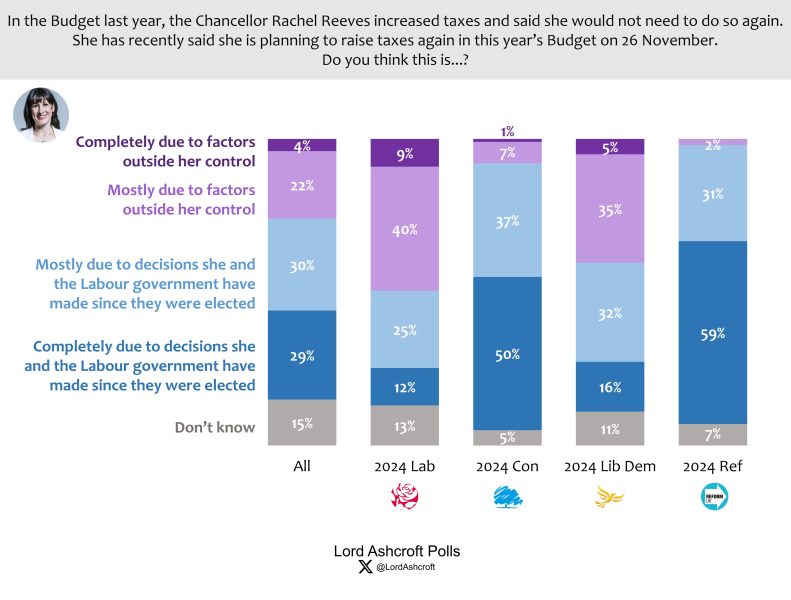
A clear majority of all voters thought Rachel Reeves’s plans to increase tax again in this year’s Budget are mostly or completely due to decisions she and the Labour government have made since they were elected. Only just over a quarter say the situation is mostly or completely due to factors outside her control. Two thirds of those who switched from the Conservatives to Labour in 2024 say further tax rises would be mostly or completely due to the Labour government’s decisions.
Two-child benefit cap

More than 6 in 10 – including majorities of all four main parties’ voters – supported the current policy of limiting child-related benefits to two children per family. Fewer than a quarter overall, and only one third of Labour voters, thought larger families should be able to claim benefits for all their children.
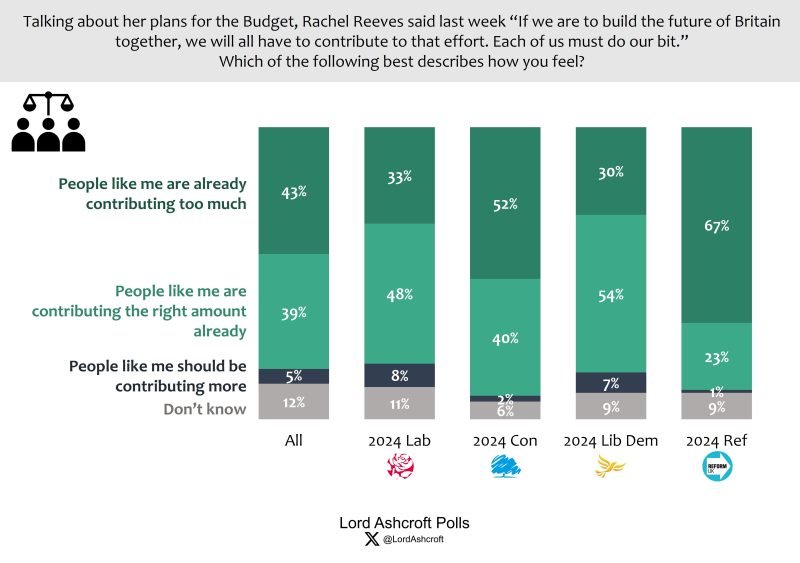
In response to the Chancellor’s admonition that “each of us must do our bit”, the vast majority of all voters said they felt they were either already contributing too much or the right amount. Only 1 in 20 said they thought they should be contributing more. More than 8 in 10 of those who voted Labour last year felt they were already contributing enough or too much.
Asked in a recent LBC interview if she would resign if she broke a Labour manifesto pledge, Reeves replied “What do you think would happen in financial markets?”

We found that voters were nearly as likely to think that Reeves resigning would increase investors’ confidence in the UK as to think confidence would be damaged. They were more likely to think it would make no difference. Only 3 in 10 Labour voters from 2024 thought it would damage confidence in the UK if Reeves were to resign.

Asked who would do the better job running the economy, voters chose Kemi Badenoch and Mel Stride over Keir Starmer and Rachel Reeves by a 5-point margin, although with just under half saying, “don’t know”. Only 53 per cent of 2024 Labour voters named the Labour team; 7 in 10 Conservative voters from 2024 chose the Tory team.
BBC bias and the licence fee
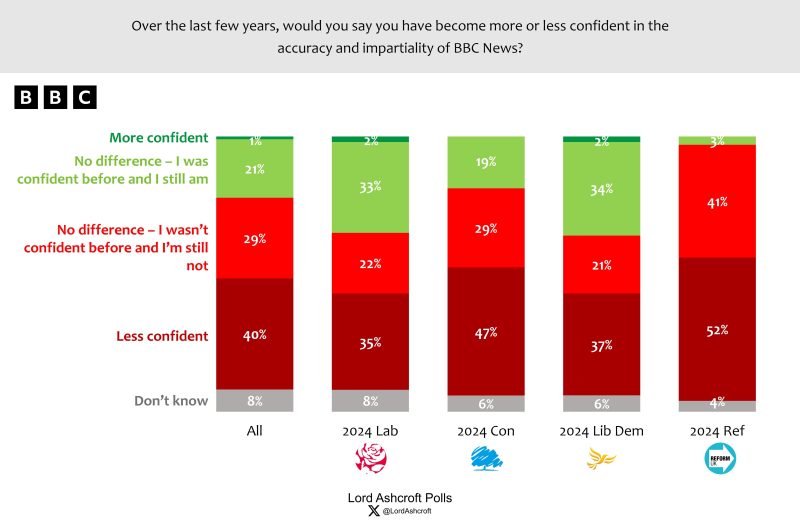
Four in ten said they had become less confident in the accuracy and impartiality of BBC News in the last few years, while a further 29 per cent said they were not confident before and are still not. Only just over 1 in 5 said they remained confident or had become more so. Supporters of all parties were more likely to say they were not confident or had lost confidence than to say they remained confident or that their confidence had risen.

A majority thought BBC News was biased. These were about twice as likely to think it was biased towards left-wing causes and against Israel, Donald Trump and Reform than towards right-wing causes and in favour of Israel, Trump and Reform. Only just over 1 in 5 thought BBC News tends to be objective and impartial. All parties’ 2024 voters were more likely to think the BBC was biased in one direction or another than to think it was objective and impartial.
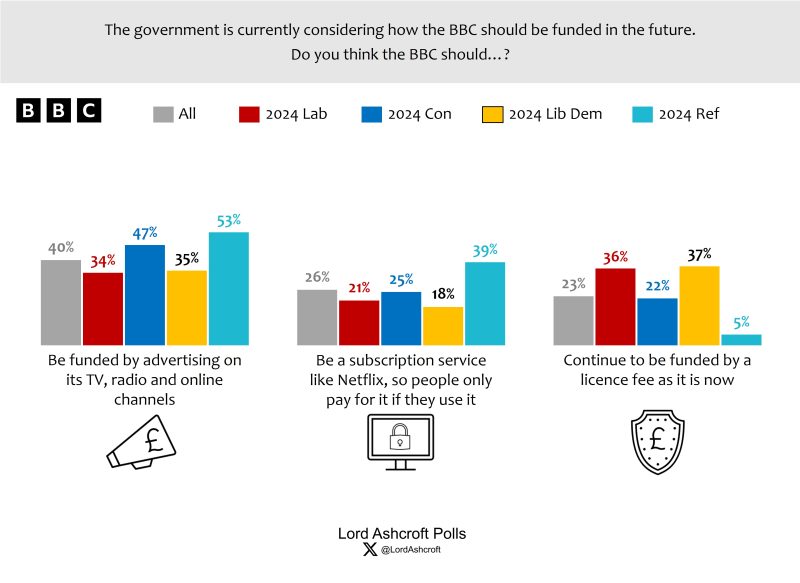
Just under a quarter of all voters (rising to 46 per cent of those who currently intend to vote Labour) thought the BBC should continue to be funded by a licence fee. Just over a quarter thought it should become a subscription service so people only pay for it if they use it, while 4 in 10 favoured advertising on BBC TV, radio and online channels.
Party unity
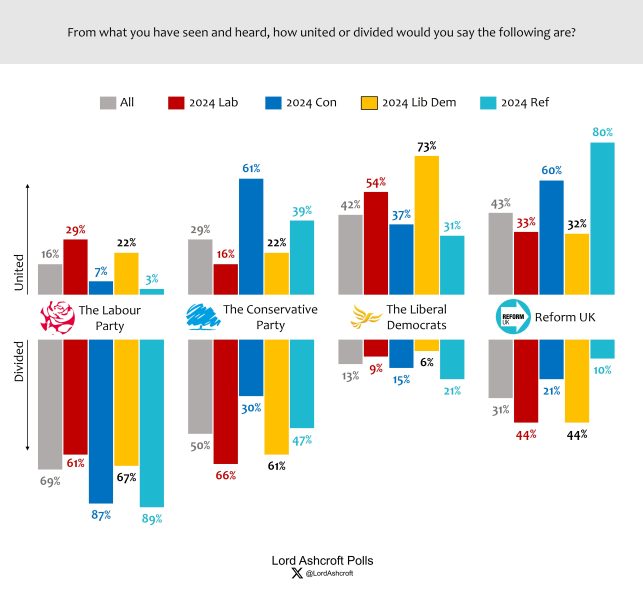
Nearly 7 in 10 voters (including 61% of 2024 Labour voters) said the Labour Party seemed divided, compared to 50 per cent who said the same of the Conservatives. Reform UK and the Lib Dems were more likely to be seen as united than divided.
Best prime minister
Given a choice between Starmer and Badenoch, voters overall say Starmer would make the better PM by a 5-point margin. Those who voted Reform UK in 2024 said they preferred Badenoch to Starmer by a 53-point margin.
Given a choice between Starmer and Farage, voters as a whole chose Starmer by a 9-point margin, with 29 per cent saying, “don’t know”. 2024 Conservatives chose Farage over Starmer by 51 per cent to 17 per cent.
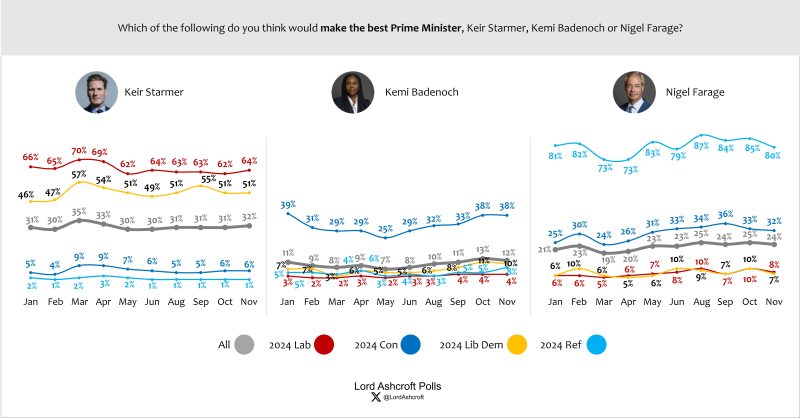
Offered a choice between Starmer, Badenoch and Farage, voters chose Starmer over Farage by an 8-point margin, with Badenoch in third place on 12 per cent. 2024 Conservative voters preferred Badenoch over Farage by 38 per cent to 32 per cent.
The political map
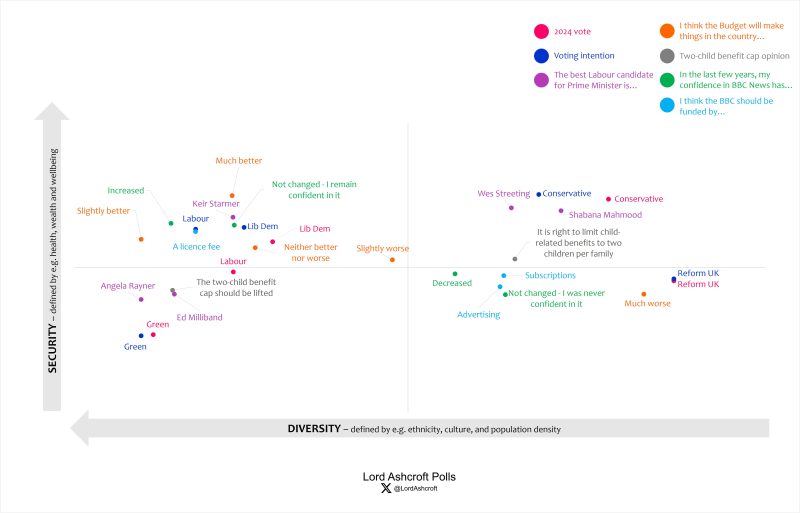
As above, our political map shows how different issues, attributes, personalities and opinions interact with one another. Each point shows where we are most likely to find people with that characteristic or opinion; the closer the plot points are to each other the more closely related they are. Here we can see that confidence in the BBC is at its highest in the Labour and Lib Dem-leaning top-left quadrant of the map, while those saying their confidence has fallen in recent years are closer to the centre, suggesting it is an opinion held more widely throughout the electorate. The same is true of those who expect the Budget to make things better for the country as a whole, with those thinking it will make things slightly worse closer to the centre. Notably, those who favour Wes Streeting or Shabana Mahmood as a replacement for Keir Starmer are most likely to be found in the Conservative-leaning top-right quadrant of our electoral map.
The next election
When we ask people how likely it is that they will end up voting for each party at the next election, those who voted Labour in 2024 put their chances of doing so again at an average of 44/100. Switchers to Labour in 2024 put their chances of voting for the party again next time at 34/100, and those who switched from the Conservatives to Labour in 2024 put their chances of voting Labour again next time at an average of 28/100. Those leaning towards voting Reform were the most intense supporters – they gave themselves a higher mean likelihood of doing so (90/100) than those leaning Conservative (85), Labour (82) or Lib Dem (81).
Looking at those more likely than not to vote for a particular party (those whose highest likelihood of voting for one party was at least 50/100), this implies current vote shares of Reform UK 27 per cent, Conservative 20 per cent, Green 18 per cent, Labour 18 per cent, Lib Dems 10 per cent, Others 6 per cent.
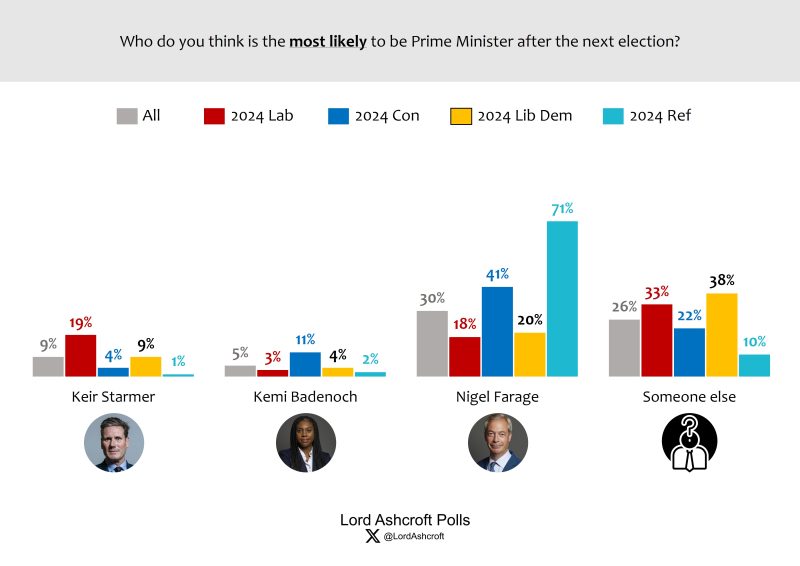
Nigel Farage was thought the most likely person to be PM after the next election, with 30% naming him as the most likely candidate. Only 9 per cent thought Starmer would still be in the job and 5 per cent named Badenoch. More than a quarter thought someone else would be PM. Only 1 in 3 current Labour leaners thought Starmer would be PM, and 1 in 5 current Conservative supporters thought Badenoch would have the job.
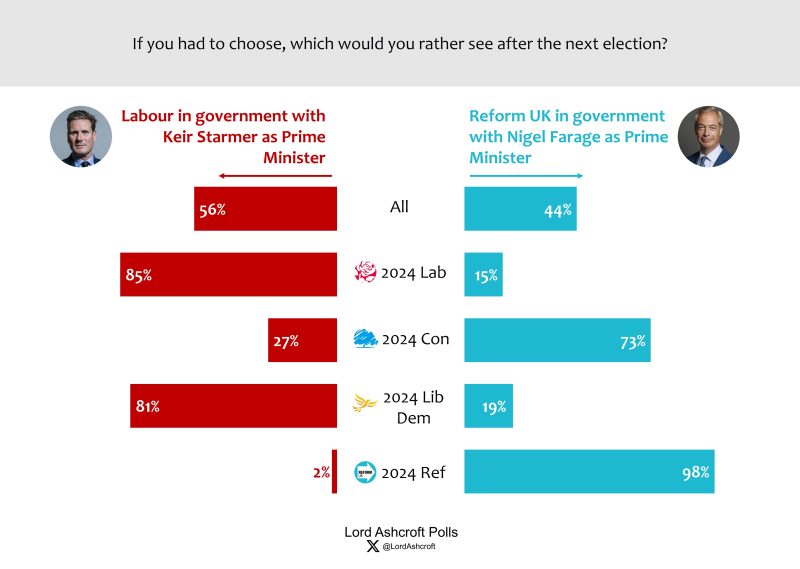
Forced to choose between two options, 56 per cent said that after the next election they would rather see Labour in government with Starmer as PM, while 44 per cent said they would rather see Reform in government with Nigel Farage as PM. Fifteen per cent of 2024 Labour voters said they would rather see Farage and Reform in government. Nearly three quarters of 2024 Conservatives said they would prefer Farage and Reform, while more than 8 in 10 of those who voted Lib Dem preferred Starmer and Labour.
Conservative defectors – and their routes back
We regularly ask a series of “mini referendum” questions – on issues including immigration, tax and public spending, climate change and economic growth, the parties and leaders, and optimism for Britain – in order to help us understand more about particular types of voters and what is driving them to support one party or another.
This time we have looked at four different groups of Conservative defectors – those who voted Tory in 2019 but switched to Labour, Reform, the Lib Dems, or stayed at home. For each group, we looked at their answers to the mini-referendum questions and analysed how important each issue was to their likelihood of going back to the Conservatives at the next general election.
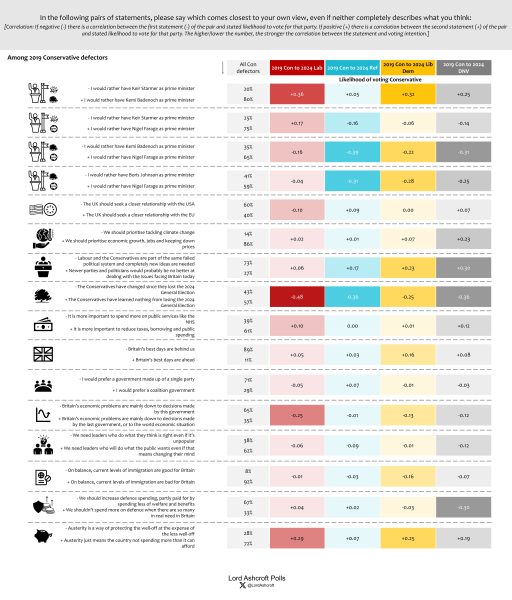
For 2019 Tories who switched to Labour (and indeed for the population as a whole), the three most important trade-offs when it comes to weighing up voting for the Conservatives are whether the Conservatives have learned anything from their election defeat; whether Badenoch would be a better Prime Minister than Starmer, and whether austerity is the country living within its means.
Among Conservative switchers to Reform, the top three are whether Badenoch or Farage would make the better Prime Minister; whether the Conservatives have learned anything, and whether Farage or Johnson would make the better Prime Minister.
For those who went to the Lib Dems, the three most telling factor are whether they think Starmer or Badenoch would make a better Prime Minister; whether Farage or Johnson would make a better Prime Minister; and whether the Conservatives have learned from their defeat.
Looking at 2019 Conservative voters who sat out 2024, we see the most important trade-offs are whether the Conservatives have learned anything; whether Badenoch or Farage would make a better Prime Minister; and whether established parties have failed or new ones would do no better.
This analysis suggests a number of things that need to be part of any roadmap for recovery for the Conservatives over the course of this parliament:
- Persuading people that the party has changed is unsurprisingly important in all groups. Conservative defectors to Reform and not voting are split about 50-50 on whether the party has learned from its defeat, and over the months these numbers are moving slowly in the Tories’ favour.
- The choice between Badenoch and Farage is highly salient among the two biggest groups of Conservative defectors: to non-voting and to Reform, and the balance of opinion is currently strongly in Nigel Farage’s favour. Even if the Conservatives don’t attack Nigel Farage’s values, they need to persuade more of these voters that Kemi Badenoch is a more credible Prime Minister. Unless there is movement on this factor, the best the Conservatives can hope for is to be junior partners in a Reform-led coalition.
- Economic issues, such as the growing public debt and the government’s inability to make any significant spending cuts, are crucial. As our survey found, the Conservatives have a lead over Labour on their ability to manage the economy. Reform’s line on the two-child benefit cap and raising the tax-free personal allowance, together with the absence of an economic spokesperson and the attendant suggest that the economy is not a serious priority for them, could also be fruitful. Switchers to the Lib Dems tend to be more open than most to the message that Britain can’t spend more than it can afford.
Full data tables are at LordAshcroftPolls.com

![Florida Officer Shot Twice in the Face During Service Call; Suspect Killed [WATCH]](https://www.right2024.com/wp-content/uploads/2025/12/Inmate-Escapes-Atlanta-Hospital-After-Suicide-Attempt-Steals-SUV-Handgun-350x250.jpg)