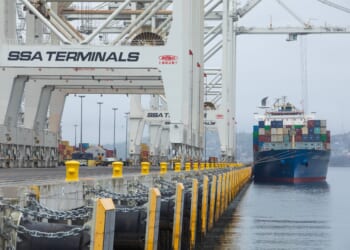
Washington is sleepwalking into a strategic defeat in Africa. While U.S. officials debate talking points about “supply-chain resilience,” China is moving with speed, discipline, and enormous capital to lock down the world’s most important mineral corridors.
The Lobito Corridor — the only major transport and export route in Sub-Saharan Africa not already under Chinese control—is the last serious opportunity the United States has to prevent Beijing from dominating cobalt, copper, manganese, and virtually every mineral required for the next generation of U.S. defense and energy technologies.
Most Americans have never heard of the Lobito Corridor. Beijing has. And unless Washington wakes up, this rare exception to China’s Belt and Road dominance will follow the same fate as so many African infrastructure projects that drifted from Western influence into near-total dependence on Beijing. (RELATED: Trump Admin To Dish Out $355 Million And Loosen China’s Critical Mineral Vice Grip)
The Lobito Corridor is the backbone of the Central African mineral belt. It connects the Atlantic port of Lobito to Zambia and the Democratic Republic of Congo — home to 70 percent of the world’s cobalt and some of the richest copper deposits ever discovered. Whoever controls the flow of these minerals will control the future of global manufacturing, semiconductors, EV batteries, grid storage, and advanced weapons systems.
Today, China controls 75 to 80 percent of global cobalt and copper processing. It dominates refining capacity and the downstream components essential to everything from drones to transformers. And with Guinea’s Simandou megaproject now fully aligned with Beijing’s Belt and Road Initiative, China is building an unbroken chain of strategic corridors spanning the African continent.
Lobito is the only major gap in that chain. And the United States is not moving fast enough to secure it.
Sadly, China has a playbook. The U.S. does not.
Beijing’s strategy is ruthlessly consistent: Move first. Deploy capital. Lock in long-term concessions. Build dependence.
Washington’s approach is the opposite: Announce “intentions.” Form committees. Debate feasibility. Miss the window.
Sigh.
Angola, Zambia, and the DRC — three reform-oriented governments eager for transparent, rules-based partnership with the United States — are still giving Washington a chance. But political leaders in all three capitals are under pressure to deliver real infrastructure, real jobs, and real investment. If the U.S. cannot move quickly, China’s state-linked firms will. Beijing always offers the same package: fast financing, bundled construction, and guaranteed offtake. Speed wins, even in countries that prefer American standards.
The cost of failure would be enormous. If China becomes the dominant force along the Lobito Corridor, the consequences will reverberate across the U.S. economy and national security base:
- U.S. defense manufacturing will become more vulnerable.
- EV and battery supply chains will become fully dependent on Chinese processing.
- American miners and refiners will lose access to cobalt and copper supplies.
- African partners will conclude that Washington cannot fulfill its commitments.
- The last U.S.-aligned mineral corridor in the region will become another Belt and Road stronghold.
Losing the Lobito Corridor would be the 21st-century equivalent of surrendering the Panama Canal of critical minerals.
To avoid certain catastrophe, the Trump administration must:
- Deploy real capital—not press releases. The U.S. International Development Finance Corporation and the Export-Import Bank of the United States should commit upwards of $3 billion for rail upgrades, port modernization, and energy connectivity.
- Embed U.S. companies directly into the corridor. Firms like Bechtel, Fluor, IBM, and major logistics and cybersecurity companies need clear, sustained pathways for participation.
- Create a Minerals Security Partnership Zone in Angola and Zambia. Build co-located processing with guaranteed U.S. offtake to break China’s refinery monopoly.
- Lock the corridor behind transparent procurement safeguards. Without U.S. assistance on anticorruption systems and investment screening, the corridor will remain vulnerable to state-backed Chinese firms.
In short, Washington must treat this like the strategic race it is.
China treats the Lobito Corridor as a national security priority; the United States treats it as a development program. The U.S. mindset must change—and quickly. Otherwise, Washington will lose access to the minerals that power the American arsenal, the American grid, and the American industrial base.
Africa is shifting fast. Beijing is moving fast. The question is whether the United States will move at all.
Jacob Choe is a member of the Bretton Woods Committee and serves as the Eurasia Center’s Asia Program Director. James Carter is a Principal with Navigators Global. He previously served as Deputy Undersecretary for International Affairs at the U.S. Department of Labor (2006-07) and as the Director of the America First Policy Institute’s Center for American Prosperity (2021-23).
The views and opinions expressed in this commentary are those of the author and do not reflect the official position of the Daily Caller News Foundation.
All content created by the Daily Caller News Foundation, an independent and nonpartisan newswire service, is available without charge to any legitimate news publisher that can provide a large audience. All republished articles must include our logo, our reporter’s byline and their DCNF affiliation. For any questions about our guidelines or partnering with us, please contact licensing@dailycallernewsfoundation.org.





![Keith Ellison Caught Promising to Fight State Agencies for Somali Fraudsters [WATCH]](https://www.right2024.com/wp-content/uploads/2026/01/Keith-Ellison-Caught-Promising-to-Fight-State-Agencies-for-Somali-350x250.jpg)