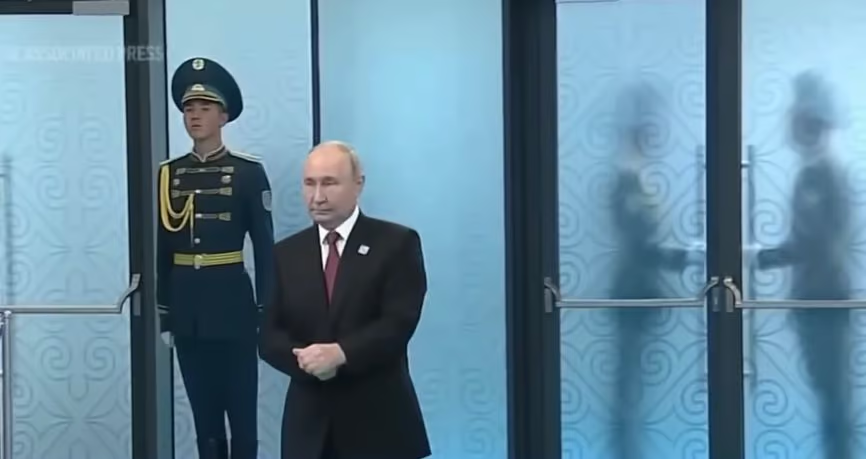
Donald Trump seems eager to end the war in Ukraine before opening a new front in Venezuela, while Vladimir Putin is linking the two as a way to pressure Trump. Putin senses the U.S. president is understandably nervous about moving on Nicolas Maduro’s viper’s nest even with the massive U.S. naval and air armada assembled in the Caribbean.
Trump may have to deal double blows in Ukraine and Venezuela to beat Putin at his own game.
Despite Russian moves — or possibly to block further ones — he just announced this weekend that Venezuela’s airspace was closed amidst reports that the U.S. was initiating electronic warfare to blind Venezuelan radar and communications.
Russia’s widely announced re-assignment this week of its top commander in Ukraine, Colonel General Oleg Makarevich, to head an apparently growing military mission in Venezuela is clearly meant to highlight support for Maduro. But it could also be part of an elaborate bluff.
Putin may be trying to gain leverage on Trump to keep him committed to the Ukrainian peace plan unveiled last week that many critics consider overly favorable to Moscow. By raising the prospect of an “endless war” in Latin America if Russia can’t secure its own “near abroad,” Putin may even attempt the role of honest broker with Maduro to match Trump’s hold on Ukrainian president Zelensky.
At least one Ilyushin military transport plane landed in Caracas last week to unload armaments, including air defense missiles, according to Pentagon sources. It also reportedly brought in some 100 mercenaries of the Wagner Para Military Company which has been operating under Russia’s ministry of defense to prop up pro-Moscow dictatorships in Africa.
The highly trumpeted dispatch of Col. Gen. Makarevic would signal plans to expand Russia’s military presence, contradicting previous assessments by U.S. intelligence analysts that Moscow was abandoning Maduro. The move was preceded by Russian foreign ministry denunciations of U.S. “threats to Venezuelan sovereignty” and the signing of a “strategic cooperation agreement” between Putin and Maduro similar to those entered between the Kremlin and ruling military juntas in various conflict ridden African states.
According to Pentagon sources, Russian tankers have also been conducting vital deliveries of Venezuelan oil to Cuba, whose special forces and intelligence services provide crucial protection for Maduro. Twenty thousand Cuban “mercenaries” are also fighting in Ukraine, according to Ukrainian intelligence reports, contributing more troops to Putin’s war effort than any other Russian ally, exceeding even North Korea’s more publicized contingent.
The American destroyer USS Stockdale patrolling off Venezuela’s coast tried blocking a Russian tanker from entering Venezuela last week but the vessel eventually managed to evade the U.S. warship and is reported to have pulled safely into the oil port of La Guaira on its third or fourth try.
“Venezuela has surely come up in discussions between the Trump administration and the Russians” says the senior Latin America expert at the U.S. Army War College, Dr. Evan Ellis, “to what extent it will shape outcomes is unclear.”
Russia may be attempting to re-enact Soviet era strategies that led to the 1962 Cuban missile crisis. The potentially apocalyptic standoff between Washington and Moscow was resolved when Russia withdrew nuclear missiles it had placed in Cuba after president Kennedy pledged to withdraw U.S. intermediate range missiles based in Turkey and not to invade Cuba.
According to Pentagon sources, the Ilyushin 76TD cargo aircraft landing in Caracas on October 26 remained there for almost two days to unload BuK M2E and Pantsir SRS1 SAM missiles to protect “high value targets in Venezuela,” as well as parts and missiles for a dozen long range S-300 missile batteries already in the country.
Russia’s reinforcement of Venezuela’s air defenses are hardly sufficient to thwart a full scale U.S. air campaign that would be conducted with strategic bombers. stealth aircraft, and a panoply of electronic warfare systems. But the upgrades in air defenses heighten possibilities of U.S. losses or delays in certain operations that could prove politically embarrassing for president Trump as he approaches midterm elections.
According to Venezuelan podcaster Casto Ocando, based on reports from sources inside Venezuela’s military communicating through dissident officers abroad, the Russian Wagner team assembled 1,200 Venezuelan soldiers and militia members at the headquarters of the Cuban operated military counter intelligence service shortly after arriving in Caracas.
Intelligence reports also indicate that Maduro requested additional Russian supplies of Igla shoulder fired MANPADS, of which he already boasts 5,000, communications equipment, night vision goggles, and GPS blocking devices to interfere with navigational systems of U.S. cruise missiles, drones, and Pave Low helicopters that special forces would use for deep infiltration missions.
The appointment of Makarevich to lead expanded Russian operations in Venezulea could be ominous as he defended Russian held parts of eastern Ukraine against the Ukrainian 2023 counter offensive by destroying a hydroelectric dam which flooded much of the area, destroying entire towns and villages. Venezuela has three major dams.
Maduro has seemed more relaxed and cheerful since the Russians arrived, dancing and singing John Lennon songs in front of clapping supporters while calling for “peace” and inviting Pres. Trump to talk on the phone. Some 400 Russian “advisors” protected him from a U.S. backed coup attempt during Trump’s first term in 2019 that was ultimately dismantled by his still serving defense minister Padrino Lopez, bought by Russia years ago with millionaire kickbacks from arms deals.
The military relationship between Russia and Venezuela runs deep. Maduro’s predecessor Hugo Chavez, initiated billion dollar purchases of Russian weapons soon after taking office in 2000 and the danger is that Putin may get carried away with ideas of creating a Venezuelan quagmire to check Trump as he continues moves on Ukraine and possibly other parts of Europe. He could get backing from China, which is seeking to protect its majority stake in Venezuela’s vast oil reserves and growing sway on Latin America. Beijing has also sold sophisticated armaments and operates surveillance satellites for Venezuela.
Trump may have to deal double blows in Ukraine and Venezuela to beat Putin at his own game. While unleashing “Operation Southern Spear” on Venezuela, he might publicly tell Zelensky to fire off 3,300 U.S. high precision ERAM missiles recently delivered to Ukraine on Russian logistics, command and control networks, and troop assembly points throughout the Donbass region.
This could make Putin think twice about squandering any more of Russia’s overstretched air defenses and other diminishing resources on Maduro as Trump officially declares a naval blockade to cut Venezuelan oil shipments to Cuba which the U.S. might officially designate as a terrorist partner of Cartel de los Soles and cobelligerent. The U.S. Navy could also sever Chinese laid undersea cables connecting Venezuela with Cuba.
READ MORE from Martin Arostegui:
Unmasking Iran’s Hidden Footprint in the Americas
![Donald Trump Slams Chicago Leaders After Train Attack Leaves Woman Critically Burned [WATCH]](https://www.right2024.com/wp-content/uploads/2025/11/Trump-Torches-Powell-at-Investment-Forum-Presses-Scott-Bessent-to-350x250.jpg)