James Crouch is head of policy and public affairs at Opinium.
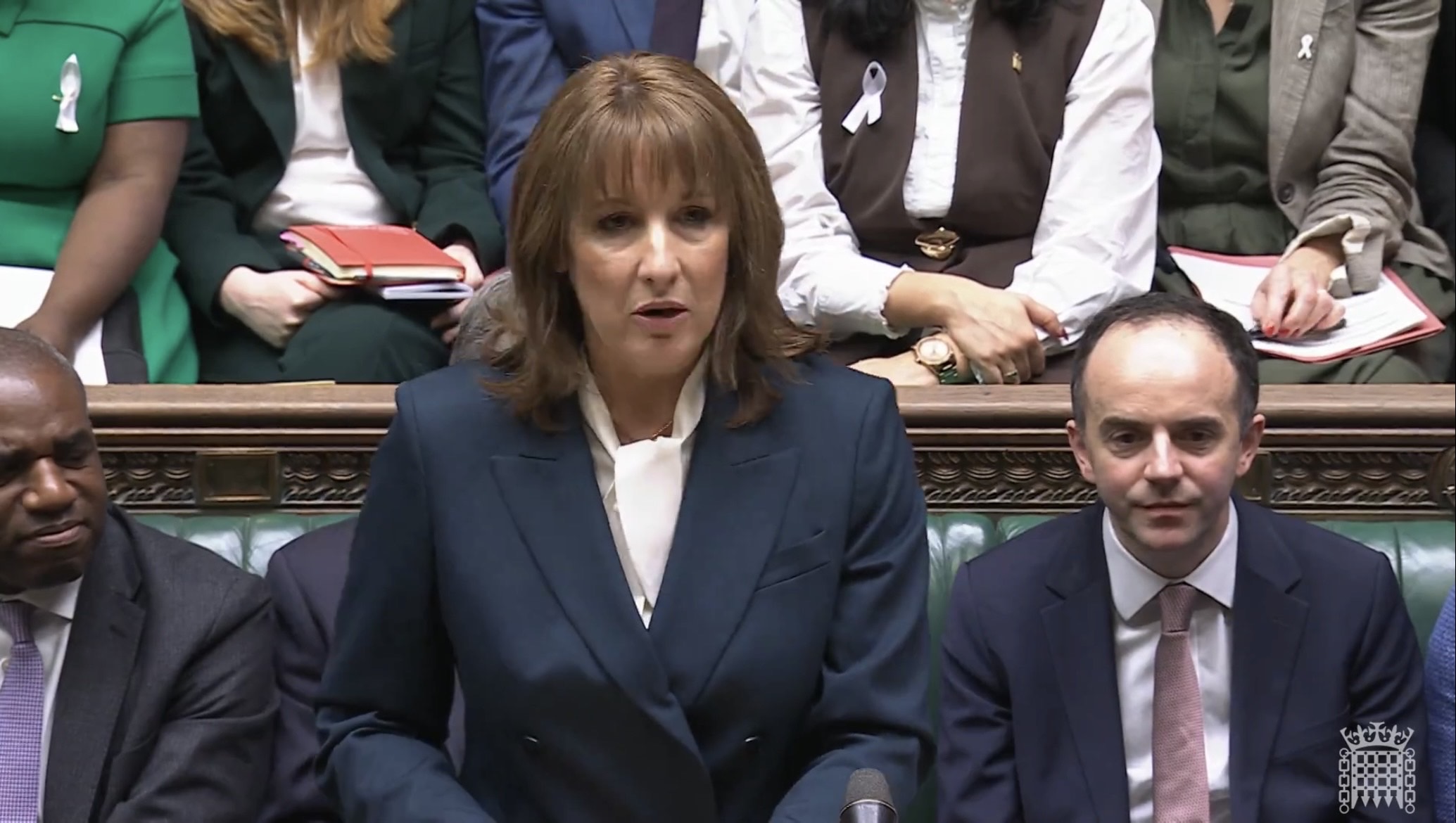
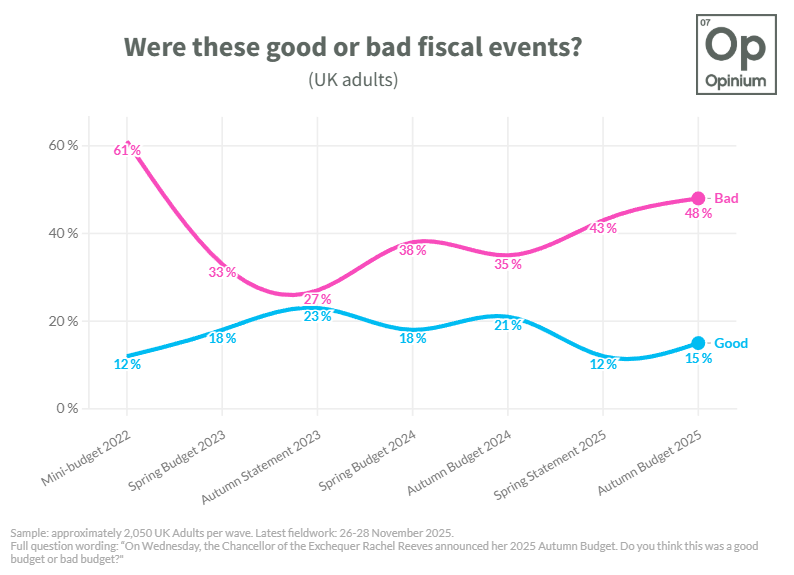
Rachel Reeves has managed to do it again. For the second time, I’m writing that the Chancellor has delivered the worst-received fiscal event since the mini-budget.
I first wrote this in March, when 43 per cent said the Spring Statement she delivered was bad in the immediate post-event polling, while only 12 per cent said it was good. Fast forward to her 2025 Autumn Budget, and almost half (48 per cent) of UK adults think it was a bad Budget, while only 15 per cent think it was good, according to the latest Opinium polling this week for The Observer.
What is remarkable is how this actually represents the Chancellor having rowed things back; over six in ten people before the Budget were expecting it to be bad. In the midst of speculation that the Labour government was about to break its flagship pledge not to raise income tax, and with a string of potentially painful tax rises trailed in the press and on television, it is no surprise expectations were very low.
Nonetheless, while fewer than half now saying it was a bad Budget is technically an improvement on expectations, it remains a strikingly unpopular fiscal event. Even if Reeves will probably get away with the measures she has delivered, there is nothing in the Budget that looks likely to rescue the government’s fortunes or turn around the standing of the occupants of No. 10 and No. 11 Downing Street.
First, we know it hasn’t: for over 100 days, the Prime Minister has been polling below minus-40 on net approval, and Rachel Reeves isn’t far behind. In our post-Budget polling, 58 per cent of the public now disapprove of the job she is doing as Chancellor, while only 16 per cent approve. As few as three in ten (30 per cent) 2024 Labour voters approve of her performance. So nothing she delivered on Wednesday has provided an immediate boost to their rock-bottom approval ratings.
Second, the negative reaction to the Budget has been driven both by how difficult it was to do what the government was attempting, and by the likely impact people think it will have.
The Chancellor’s unpopularity, especially amongst her own side, meant the government felt compelled to deliver a Budget that raised both taxes and benefits. The abolition of the two-child benefit cap was essential for party management, but it struck the wrong note with the public in the context of a tax hike.
A key driver of the negative reaction has been policies such as the freezing of income tax thresholds (50 per cent think this was a bad idea) and the decision to levy NICs on salary-sacrifice schemes (also 50 per cent say it was a bad idea). The same proportion (50 per cent, again) say abolishing the two-child limit was a bad idea. Taxing more in order to spend more on welfare simply didn’t go down well with many people.
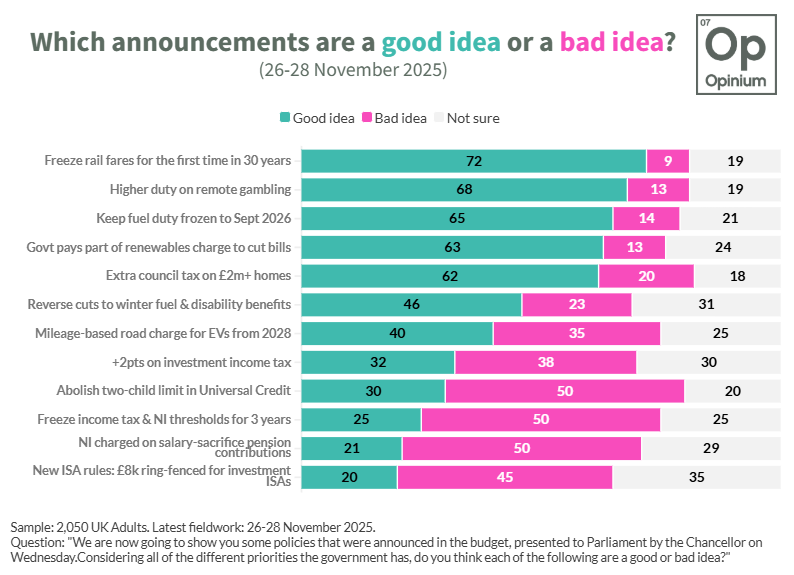
The perceived impact of these measures has added further to the negative reaction. While most people, naturally, are not thrilled about paying extra taxes, it is the wider consequences that have shaped their response. The negative expectations beforehand, followed by the poor reception to the key policy decisions Reeves did end up making, have left many believing the Budget will be damaging for the UK overall.
Two in five (40 per cent) think the Budget will have a negative impact on the economy, while only 19 per cent think it will have a positive one. This is an even worse verdict than the public’s reaction to the measures she introduced in both the Spring Statement and the 2024 Autumn Budget.
It is extremely hard to deliver painful tax rises when people think the measures you are taking are actively damaging. The usual arguments – that these decisions are necessary and fair – simply don’t land when the public believes that the government keeps choosing policies that harm the economy. And this, more than anything else, explains why the Budget is receiving such a negative reaction.

![Keith Ellison Caught Promising to Fight State Agencies for Somali Fraudsters [WATCH]](https://www.right2024.com/wp-content/uploads/2026/01/Keith-Ellison-Caught-Promising-to-Fight-State-Agencies-for-Somali-350x250.jpg)