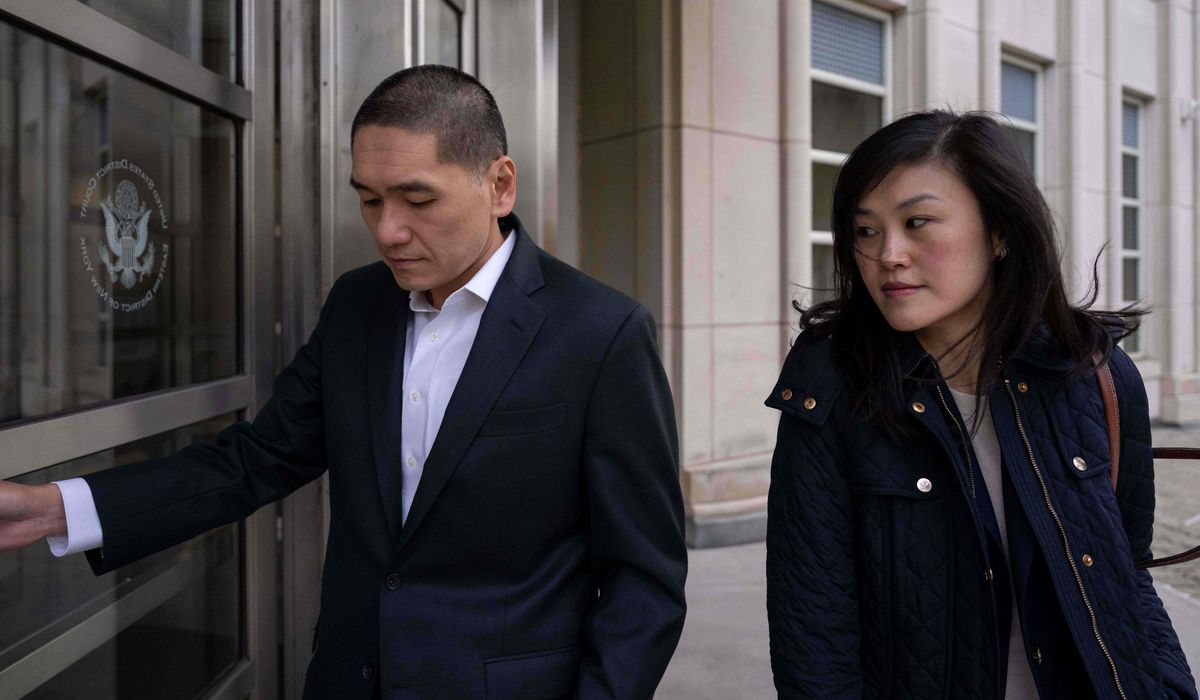
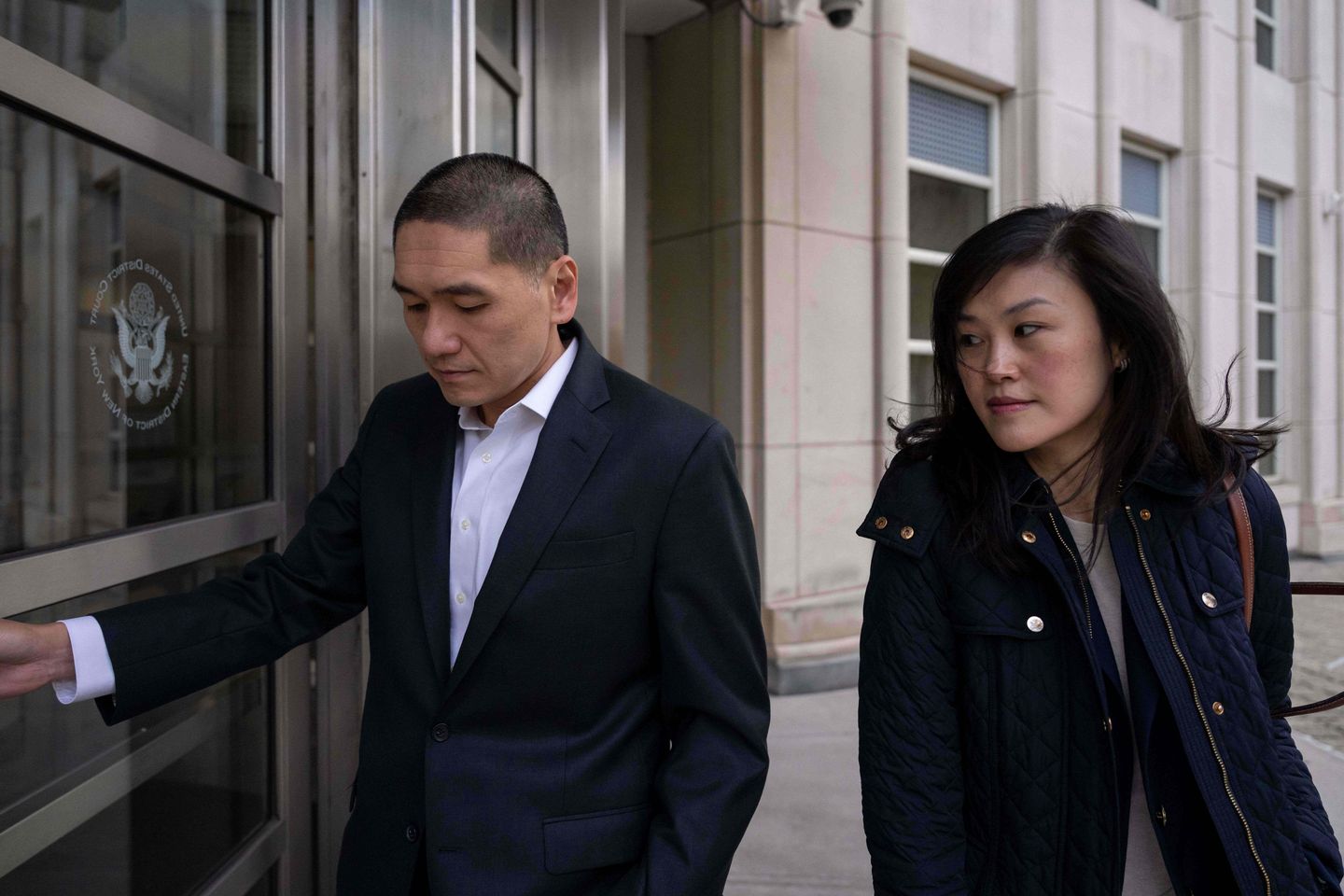
The ongoing criminal trial of Linda Sun, a former aide to two New York governors, on illegal foreign agent charges highlights what prosecutors say is China’s large-scale operations to influence the U.S. government and the public at large to back Chinese Communist Party policies.
What initially began as a case of illegal Chinese influence expanded over the past year as prosecutors added corruption charges against Ms. Sun and her husband, Chris Hu.
Ms. Sun worked for former Democratic Gov. Andrew Cuomo and current Gov. Kathy Hochul and is charged with illegally using her official position to promote China’s interests in blocking officials from Taiwan and curbing statements related to China’s human rights abuses of Uyghur minorities.
Ms. Sun and Mr. Hu have pleaded not guilty to more than 30 federal charges. Those charges include operating as an illegal Chinese agent, visa fraud, wire fraud, money laundering, bribery, conspiracy to defraud the United States and tax evasion.
The trial in Brooklyn federal court is now in its fourth week. It is part of a multi-year Justice Department campaign to crack down on CCP influence peddling and transnational repression.
Amanda Shami, one of the prosecutors, said in her opening statement that the case involves corruption and a betrayal of New York by Ms. Sun.
“Her loyalty was for sale, and the Chinese government, which wanted to influence the New York government, was willing to pay her to do their bidding,” she said. “Linda Sun acted to benefit China.”
Prosecutors say Ms. Sun used her official position in Albany to support Chinese policies in exchange for lucrative business dealings with China for Mr. Hu.
Evidence shown at trial included documents signed by the governors that were allegedly forged by Ms. Sun.
A surprising charge in the Justice Department’s June superseding indictment against the couple states that Ms. Sun used her position to steer state contracts to Chinese companies for purchases of personal protective equipment during the COVID-19 pandemic.
The payoffs from China, according to prosecutors, included enriching Ms. Sun and Mr. Hu through business dealings that allowed the couple to buy a $4.1 million house on Long Island, a $2.1 million condominium in Hawaii and a 2024 Ferrari.
The case is said to be among the FBI’s most important counterintelligence cases seeking to expose Beijing’s large-scale influence operations.
Kevin Vorndran, assistant director of FBI’s Counterintelligence Division, said the charges demonstrate “brazen attempts of the [People’s Republic of China] to corrupt our political processes.”
“As alleged in the indictment, Linda Sun and Chris Hu deceived the highest leadership of New York government to further the political agenda of the government of China,” Mr. Vorndran said.
During the trial Thursday, jurors were shown a message from Ms. Sun to a Chinese consulate official in which the defendant bragged that Ms. Hochul, then Mr. Cuomo’s lieutenant governor, was easier to manipulate.
“She is much more obedient than the governor,” the former aide said in a message to consular official Lihua Li dated Jan. 25, 2021, and entered as evidence.
Kerry Gershaneck, an expert on China’s use of political warfare, said China’s spy agencies are methodically bypassing the federal government to co-opt lower-tier government officials and their staffs to achieve Beijing’s objectives.
“The Linda Sun case highlights the insidious infiltration of America at the sub-national level by Communist China’s intelligence and United Front operatives,” he said.
The trial has been marked by legal wrangling from prosecutors and defense attorneys over evidence and witnesses, including whether to grant immunity to one person in China identified in court papers as “CC-1,” the Chinese-born president of a New York association of people from China’s Henan province and a co-conspirator in the case.
Anonymized video testimony of CC-1 was sought by defense lawyers who say his testimony will help clear Ms. Sun and Mr. Hu.
Analysts say CC-1 and his association provide key clues to the larger New York state influence program launched by China.
The New York nonprofit association is “closely associated with the United Front Work Department (UFWD) and the Chinese Communist Party (CCP),” the indictment said.
“The UFWD was a CCP department that attempted to manage relationships with and generate support for the CCP among elite individuals inside and outside the PRC, including by gathering human intelligence,” the indictment said.
“After 2018, the UFWD reported directly to the CCP’s Central Committee, a national party organization that helped drive political decision making in the PRC.”
The CCP-linked CC-1 traveled frequently to China for UFWD events and was in contact with Beijing officials.
China’s targets go beyond government
The Sun-Hu case is a high-profile example of how the CCP is conducting its influence operations.
Similar CCP influence campaigns targeting state and local governments also have been identified by U.S. officials, in addition to covert influence operations aimed at skewing federal government policies and programs toward China.
Experts on Chinese influence operations say winning a conviction in the Sun-Hu case could be difficult since the range of Beijing’s operations spans both legal and illegal activities.
Grant Newsham, a retired Marine Corps colonel and expert on China security affairs, said the CCP is active in seeking to influence all levels of the United States, including at the town level in “flyover” country and other unexpected places.
“Spotting Chinese influence efforts in the U.S. is like shooting fish in a barrel,” he said. “It’s everywhere. Sometimes you have to step back in awe at the scale of it.”
In August, Rep. John Moolenaar, chairman of the House Select Committee on the CCP, sent a letter to the mayor of Des Moines, Iowa, warning that a local high school gospel choir that visited China recently had traveled at the invitation of and with all expenses paid by a Chinese “friendship association” that is part of the CCP’s United Front Work Department.
Those types of “study tours” are targeting local officials, elected leaders, academics and others and can appear innocuous.
“The Chinese play nicely on that part of the American character that believes if we can just talk to people we can, and will be, friends,” Mr. Newsham said.
China is spending about $10 billion annually on its influence operations with the United Front Work Department, the main unit in charge of the activities, according to congressional investigators.
Influence operations range from legal public diplomacy by diplomats and officials to illegal covert disinformation and recruitment efforts such as those allegedly used in the Sun-Hu case.
In between, Beijing is engaged in aggressive use of American social media platforms such as X, Facebook, Instagram and others.
The Chinese-owned TikTok video-sharing app, which was initially outlawed by Congress yet continues to operate, also plays an important role in shaping Americans’ views of China and seeking to indirectly produce U.S. policies toward China favored by the CCP.
Mr. Newsham said TikTok is nefarious and serves as a key “brainwashing and intelligence collection tool from China.”
“The U.S. government still can’t ban it. Too many influential Americans have been bought off, and too many of TikTok’s targets are conditioned to think they must have it,” he said.
One Chinese influence operation involving Congress is the case of Rep. Eric Swalwell, California Democrat, who was found to have a close relationship with a Chinese agent named Fang Fang who helped his political campaign.
“When he got exposed, he still kept his seat on the House Intelligence Committee until [President] Trump came back, and now he’s in the running for California governor,” Mr. Newsham said.
China’s United Front Work Department, which is modeled after the original Soviet communist organization, drives a CCP policy of eliminating internal and external enemies, neutralizing groups that challenge its authority, developing coalitions around the Party to promote its interests, and projecting influence.
Another element is China’s “three warfares” that are a form of political and non-kinetic warfare that seek to defeat enemies without direct combat. The warfares include propaganda, psychological and legal conflict.
China’s cyber operations work to create fissures within network control systems that run the U.S. electric grid and other critical infrastructure, according to recent congressional testimony from Zachary Tudor, associate director at the Energy Department’s Idaho National Laboratory.
“The PRC favors a strategy denoted by asymmetrical actions, including winning without fighting, or achieving strategic objectives by undermining an adversary’s confidence and capabilities without engaging in direct conflict,” Mr. Tudor said, describing it as irregular warfare used to assure or coerce states or other groups through indirect, non-attributable or asymmetric activities.
The State Department has described Chinese influence activities as posing a threat to free and open speech through propaganda and censorship, promoting “digital authoritarianism,” penetrating and controlling international organizations and systematically using pressure and cooptation to achieve its goals.
During the first Trump administration, then-Secretary of State Mike Pompeo was the first to publicly call out Chinese influence operations targeting state and local governments.
Chinese influence activities are not the same as groups such as the U.S.-based Alliance Francaise or National Italian American Foundation.
“They’re fundamentally different than what the Chinese Communist Party is doing,” Mr. Pompeo said. “The party and its proxies aim to make Americans receptive to Beijing’s form of authoritarianism.”
China expert Alex Joske said most of Beijing’s influence operations are carried out by the UFWD, which is headed by a CCP “leading small group” set up by Chinese President Xi Jinping.
Two main objectives are mainly carried out through intermediaries that seek to appear indirectly linked to the party. The first goal is to seduce and captivate foreign audiences through advancing positive views of China as a model of benevolence and strength. Second, the activities involve infiltration and coercion.
“Infiltration aims at slowly penetrating the opposing societies to hamper the very possibility of an action contrary to the Party’s interests,” Mr. Joske said. “Coercion corresponds to the progressive enlargement of the Chinese ’punitive’ or ’coercive’ diplomacy toward a policy of systematic sanctions against any state, organization, company or individual that threatens the Party’s interests.”
American universities are main targets of the operations.
The schools are influenced into supporting Chinese goals by funding for more than 300,000 Chinese students who attend the universities.
Chinese-controlled Confucius Institutes and Classrooms until recently were used for influence operations. The on-campus facilities were disguised as meant for teaching Chinese language and culture, but they increased dependency and skewed policies in favor of China’s communist system.
Social media plays big propaganda role
One of the most aggressive forms of Chinese influence is the use of fake accounts on social networks. The accounts spread CCP propaganda and troll critics of Beijing in mass responses.
The social media networks are, according to experts, largely controlled by the People’s Liberation Army or the Communist Youth League.
Most of the activity attacks the United States and criticizes its free and open system.
Little has been done by either the U.S. government or the social media companies to counter the activities.
Facebook, X and YouTube have suspended accounts that have been found to be promoting Chinese influence. But analysts say there has been no systematic effort to neutralize the operations.
“The PLA is at the heart of these maneuvers, using social networks to conduct ’open’ influence operations and circulating propaganda on the one hand, often aiming at deterrence and psychological warfare, and to conduct clandestine and hostile operations against foreign targets on the other hand,” Mr. Joske said.
Beijing also operates a network of citizen movements for its influence campaigns. They include separatist advocates for Japan’s Okinawa, where U.S. military forces are based, and pacifist groups such as the leftist Code Pink, whose members have sought to disrupt congressional hearings with shouts of “China is not our enemy.”
Chinese online influencers, including U.S. YouTubers and U.S. academics also play key roles in the influence campaigns.
For decades, U.S. think tank and university China experts were forced to avoid criticizing the CCP by restrictions on visas for those not viewed as “friends of China.”
China’s financial tools
Above all, the CCP uses financial power to buy influence, including providing funds to think tanks and people.
Di Dongsheng, a Chinese official with the School of International Studies at Renmin University in Beijing, revealed in a video online that if a target of influence is reluctant to take Chinese money, “we offer them more.”
Mr. Di, a consultant to the CCP, said in the now-censored video that China influenced American policies for decades through a covert network of “old friends” — sympathizers and agents — who had penetrated the highest levels of the U.S. government and financial institutions.
The academic said President Trump, through his trade policies during his first administration, had upset decades of close ties between Washington and Beijing that were facilitated by the agent network.
He declined to provide details, saying doing so might compromise their identities.
“Now, I’m going to drop a bomb: Because we had people up there inside America’s core circle of power, we had our old friends,” said Mr. Di, adding that he needed to speak carefully because “I can’t sell out these people.”
Mr. Di said he was tasked by the Chinese Propaganda Department with arranging a reading of a book by Mr. Xi. He said he successfully pressured the owner of Washington’s Politics and Prose bookstore in 2015 into permitting a Chinese government official to hold an event unveiling the book by Mr. Xi.
The reading was arranged after a female supporter who worked for a major Wall Street financial institution helped, Mr. Di said.
“I suddenly realized she is one of the Chinese people’s ’old friends,’” Mr. Di said.
“In plain and simple language, during the last three to four decades, we used the core circle inside America’s real power,” he said. “As I said, Wall Street had a very profound influence over America’s domestic and foreign affairs since the 1970s. We used to heavily rely on them.”
Mr. Newsham said countering Chinese influence operations will require the use of U.S. law and fears of personal punishment or disadvantage that alter the behavior of American elites and the “donor” class that has so much influence.
“And until we admit more broadly that China is an enemy that’s been at war with the U.S. for decades, it’s going to be tough to really roll back the [People’s Republic of China] influence operations in the way that is needed — and possible with some effort,” he said.

![Donald Trump Slams Chicago Leaders After Train Attack Leaves Woman Critically Burned [WATCH]](https://www.right2024.com/wp-content/uploads/2025/11/Trump-Torches-Powell-at-Investment-Forum-Presses-Scott-Bessent-to-350x250.jpg)