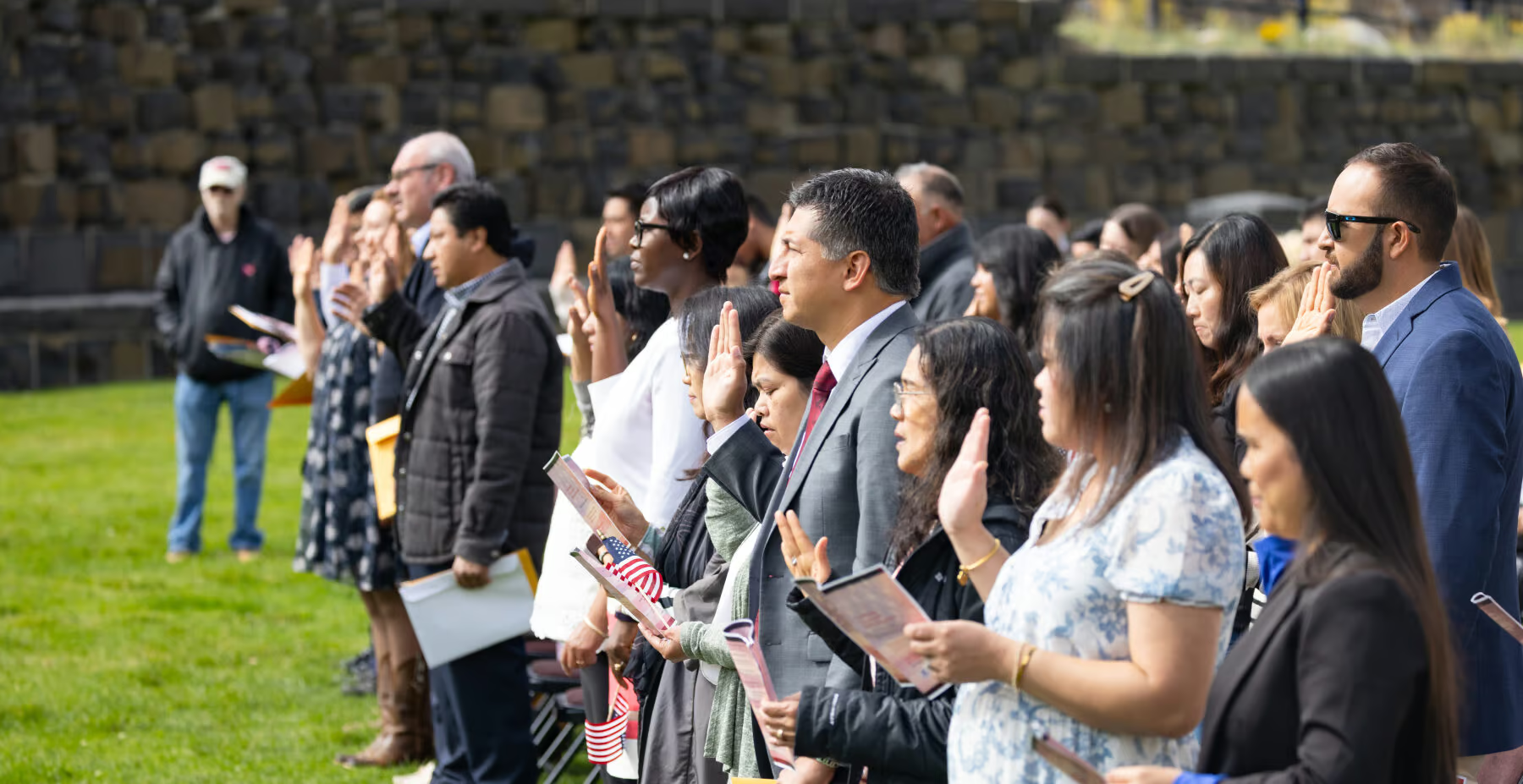
The Supreme Court has just granted certiorari in the case of Barbara v. United States which raises the issue of birthright citizenship.
The case arose because on his first day of resuming the presidency, Mr. Trump signed an executive order that banned birthright citizenship for, among others, the children of illegal aliens.
We know how the liberals on the Supreme Court will vote…. It may well come down to how the weaker conservatives vote.
The 14th Amendment was ratified by the states in 1868 during the aftermath of the Civil War. Its primary intent was to ensure that no states passed laws that would question the citizenship of freed slaves or their children.
The first sentence of Section 1 of the 14th Amendment says, “All persons born or naturalized in the United States and subject to the jurisdiction thereof, are citizens of the United States and the State wherein they reside.”
The president’s order says, in part:
Among the categories of individuals born in the United States and not subject to the jurisdiction thereof, the privilege of United States citizenship does not automatically extend to persons born in the United States: (1) when that person’s mother was unlawfully present in the United States and the father was not a United States citizen or lawful permanent resident at the time of said person’s birth, or (2) when that person’s mother’s presence in the United States at the time of said person’s birth was lawful but temporary (such as, but not limited to, visiting the United States under the auspices of the Visa Waiver Program or visiting on a student, work, or tourist visa) and the father was not a United States citizen or lawful permanent resident at the time of said person’s birth.
Many are critical of Trump’s order, saying it violates the 14th Amendment and federal law. But does it?
The Supreme Court usually grants certiorari only in cases where there is a disagreement among the federal circuit courts, where there is a similar disagreement among the state courts, or where the case is of particular interest. Barbara v. US is of particular interest because of Trump’s executive order.
The last time the Supreme Court squarely addressed the birthright citizenship issue was back in 1898 in the case of US v. Wong Kim Ark.
That case was different from Barbara v. US and the key difference is also the reason the president may win the new case.
Wong Kim Ark was born in California in 1873. At all relevant times, his parents were running a business in California. They were not U.S. citizens and were unable to obtain citizenship because of the Chinese Exclusion Acts of that period. They were never outside the jurisdiction of the U.S.
Moreover, the parents were not diplomatic personnel employed by China’s emperor. Wong Kim Ark was a laborer. He returned to China in 1890 and again in 1895 on visits that would return him to the U.S. those same years.
And there we have the key difference between the Wong Kim Ark and Barbara cases: in Wong Kim Ark, his parents were here legally and in the Barbara case, they were not. And that difference is what the U.S. Solicitor General will hang his hat on.
That should be conclusive but for the language of the 14th Amendment that says, “All persons born or naturalized in the United States and subject to the jurisdiction thereof.” What persons are subject to the jurisdiction of the United States?
As the 14th Amendment implies, and courts have affirmed, anyone who is the child of a person who has diplomatic status in this country, or is part of an invading army, is not subject to our jurisdiction and thus cannot claim American citizenship. But people who are not legally in the U.S. are routinely tried and, if convicted, sent to jail in the U.S. But does this mean such people are subject to the jurisdiction of the United States as that phrase is used in the 14th Amendment?
So the question in Barbara v. US can be resolved either way. A person who is born to illegal aliens should — by virtue of their illegal presence in the U.S. — not be counted as a citizen. It will depend on the justices’ determination of what the word “jurisdiction” means in the 14th Amendment.
We know how the liberals on the Supreme Court will vote. Justices Sotomayor, Kagan and Jackson will seek to affirm that birthright citizenship includes the children of illegal aliens. It may well come down to how the weaker conservatives vote. If Chief Justice Roberts and Justice Barrett vote with the liberals, we will continue to have the children of illegal aliens as U.S. citizens.
READ MORE from Jed Babbin:
William F. Buckley, Jr. and Tucker Carlson




![Donald Trump Slams Chicago Leaders After Train Attack Leaves Woman Critically Burned [WATCH]](https://www.right2024.com/wp-content/uploads/2025/11/Trump-Torches-Powell-at-Investment-Forum-Presses-Scott-Bessent-to-350x250.jpg)