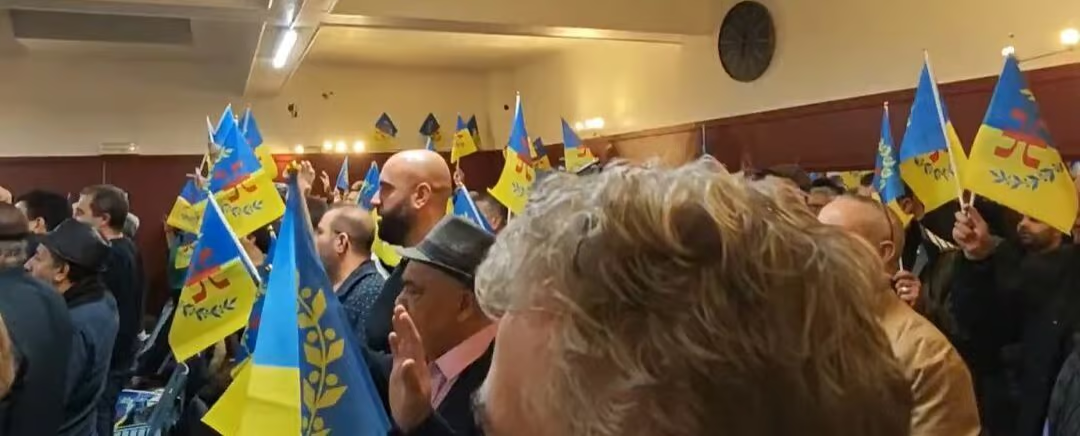
It was what they call a coup de theatre, a moment of absurdity worthy of a play by Claude Feydeau, the master of theatrical farce in belle epoque France — or perhaps of a satire by our own Joseph Heller. French authorities in the department of Yvelines in Paris’s western suburbs blocked at the very last minute a long-announced declaration of independence of the Kabyle region in northeastern Algeria, to take place at a well known convention center in Versailles. Few doubt that the French authorities acted out of fear of offending the government in Algiers, which considers the declaration treasonous.
Prudence is always welcome, and we have sound pragmatic reasons for managing our relations with African nations with tact.
The proclamation went out anyway, communication technology being what it is. Berber autonomists, led by the MAK (Movement for Kabyle self-determination), announced that following decades of repression of their native culture, language, civil and human rights, they want out. They know very well the proclamation remains symbolic.
But still significant. Does issuing a proclamation without any intent — or possibility — of acting on it treason? Or free speech? The Jerusalem Institute for Strategy and Security, a think tank, did not miss the irony. The self-rule movement operates within strict institutional and legal structures, setting it apart from certain other “national liberation movements.”
Not by coincidence, the MAK, following Berber traditions antedating the Arab conquest, are the closest thing to philo-Semites in the Arabo-Muslim world. The Berberist in Kabylie do not hide their support for Israel’s right to exist as a nation state and to defend itself, noting it is one “national liberal movement” that followed up an anti-colonial struggle with the establishment of a free society.
The Algerian state that they helped create in a bitter anti-colonial war with France became a colonial state itself, they argue. All efforts at reform, including the nonviolent hirak protests of a few years ago, were spurned by the government in Algiers and followed by waves of repression.
The government in Algiers gets particularly incensed at complaints by its large (about 25 percent) Berber population, of whom the Kabyles form the largest bloc, regarding cultural rights and local governance. While that is surely its prerogative, it does not follow that the MAK is a “terrorist” organization. Its activists are hounded and jailed, its exiled leaders condemned in absentia on treason charges under Article 87, which allows death sentences.
While there are sound strategic reasons for France, and indeed the U.S., to maintain correct relations with Algiers the JISS notes it is elementary prudence for interested powers to take note of demands for reform in Algeria, given the fraught geopolitics of North Africa and the Sahel, a region stretching from Sudan on the Red Sea to Mauritania on the Atlantic Ocean.
The Arab-Islamic world, far from being a monolith, is no less varied than other geo-cultural areas. In terms of the evolution taking place in the Middle East, and U.S. efforts to clearly differentiate between friends and foes, voices favorable to liberal democracy, freedom of religion, and peaceful political competition ought not be shunned; on the contrary, they are welcome news, the JISS argues. In France, the government’s deference to Algeria is detrimental to both countries, according to knowledgeable observers such as Ivan Rioufol, retired editor of the major daily Figaro.
We have important strategic and commercial relations with the Algerians, and there is no incentive to upset them. But there is no question of going to war for liberty or exacerbating delicate diplomatic relations, but merely of being sober about the kind of world we live in.
It may be noted that the announced public declaration was to be made at a conventions center in Versailles, with attendance by invitation only. The references to wild musical parties causing disturbances, which the authorities evoked to justify their banning order, were something of a stretch.
The MAK’s characterization of the Algerian government as an oppressive Arabo-Islamist regime, while surely open to debate, is not without basis. An African-Mediterranean land of many cultures, ravaged by a cruel anti-colonial war in the 1950s-60s, produced a monolithic state (“Algeria my country, Arabic my language, Islam my religion”) that came with single-party dictatorship and alignment with the Soviet bloc.
Victory over France in 1962 would not have been possible without the enthusiastic support of the Kabyles, who had led the last great revolt against French conquest in the 19th century. They supplied much of the manpower and leadership of the national movement. Many of the Kabyle leaders of this movement were purged — murdered in many cases — following the peace-and-independence treaty, while uncounted thousands of Muslims abandoned by the country they had chosen to serve were massacred. Other thousands made it to France, in the hulls you might say, of the boats ferrying a million Algerians of European stock, as well as Jews whose ancestors had been there since before the Arab conquest in the seventh century, a fact the Kabyles themselves did not forget.
The Kabyles traditionally favor multi-party democracy, separation of religion and state, a liberal approach to education and culture, and, especially in recent years, a pro-West, pro-Israel, indeed even philo-Semitic foreign policy, harking back to the Kabyle princess, Kahina, who died in battle against the seventh century Arab invasion.
Americans of a literary bent will find this background brilliantly explored in Second Sight, a novel based on archeological and historical evidence, by the late, great Charles McCarry. Many Algerians, it may be noted, Berber or Arab or what-all, have inherited from parents and grandparents a positive attitude toward Americans, which goes back to the great invasion of 1942 and its message of liberation. It is expressed in an anecdote about a police official accompanying an American reporter during the Islamist insurrection of the 1990s when the country went through an orgy of terror and counter-terror: “If you die in my country, mister, you may know I will have died just before you.”
Mere anecdote, the story is not without pertinence. As a majority-Muslim region, Kabylie (Kabylia in English) would be a voice in the umma for liberal-democratic governance, support for Israel, and opposition to radical Islam. This would weigh in the resistance to jihadist bands spreading terror throughout North Africa and the Sahel.
Kabyles have felt oppressed under Arabo-Islamist rule that they believe never appreciated or respected Algeria’s multi-national population, composed of Jews, Maltese, Spaniards, French, Italians, Arabs, Turks, and indigenous Berbers, speaking a variety of languages and professing many faiths, including secular humanistic reason.
The two greatest writers of the independence movement years in Algeria were Albert Camus, whose mother was Spanish and who opposed colonial-style discrimination against Muslims while favoring a federal system of governance attached to France, and the Kabyle teacher and writer Mouloud Ferraoun, who favored independence while hoping to retain the pied-noir population and the French connection. He was murdered in the last days of the war by French-Algerian irredentists. Camus and Ferraoun shared a love of their country’s beauty and human wealth, deeply respected each other’s work.
This striving for fraternity, this insistence on the dignity that grows out of respect, is an individual human quality, not the sort of thing one generalizes about while talking about nations and cultures. However, it has been expressed in Kabyle protests, poetry, song, and has carried a suffering people through years of monomaniacal linguistic and religious intolerance that drove the Jews out of Algeria.
It was top-down intolerance, not broadly popular. It was a religious-statist tyranny that drove out the pieds-noirs, losing their entrepreneurial and professional skills along with the passion of the fierce attachment to their native land. It forced the Christians underground, instituted a mukhabarat-style secret police with East German and Soviet details added, stifled development in a country richly endowed in natural resources (one-time breadbasket of the Mediterranean world), and abandoned several generations to despair-driven emigration.
The Kabyles insist it need not be this way, and obviously many of their neighbors in Algeria agree. The Berber Spring of 1980, forerunner of the Arab Springs of decades later, the democracy movement of the late 1980s and the resistance to the blood-soaked Islamist insurgency of the 1990s, were all included substantial Kabyle participation. Finally, perhaps inevitably, reforms including regional autonomy were demanded by activists, which were met by repression, leading inexorably to the idea of secession.
Which of course is met with scorn by the Algiers authorities, though there have been unverified rumors in Algiers that compromises have been offered that might satisfy some self-rule aspirations, linguistic and religious freedom, and the like. The great French-Algerian author Boualem Sansal was recently released following a year in a prison while ill with, reportedly, cancer and cut off from contact with his family and Jewish attorney.
Charged under the notorious Article 87 to punish sedition, a capital crime (he had questioned the exact tracing of the boundary between Algeria and Morocco, an old dispute), he may have benefitted from a p.r. calculation given his world-wide fame as the region’s Solzhenitsyn, something that another French writer, the sports journalist Christophe Gleizes cannot rely on (his crime was to interview a Kabyle soccer star.) Sentenced to seven years for seditious activities and possession of forbidden literary materials, he is jailed while awaiting appeals.
The autonomists of course cheered Boualem’s release while deploring Gleizes’s detention and that of reportedly hundreds of their activists. The habitual response of the Algerian government to peaceful protest, as during the hirak (“movement”) demonstrations of a few years ago, is to arrest people, suppress speech and writing, and blame malevolent foreign powers, which is one reason Kabyle activists are accused of being Zionist or Moroccan agents. Algiers’ position as the regional power and mediator is shaky, as it juggles Russian armaments purchases, American investments in energy (as well as some security cooperation) shock waves from the recent regime changes and Islamist violence in the Sahel, and diplomatic spats with France. Critics of the French government’s appeasement efforts say it would be better to resist unreasonable Algerian demands on migration and dual-citizen issues. They see in the Kabyle cause an instance of why French-Algerian relations should be revisited in depth.
There is a sense in which the Algerian epic represents a concentration of Islam’s confrontation with the West, not least in the role Algerian emigration has played in French domestic politics. Algerian emigration was for a time overwhelmingly Kabyle, and it was assimilationist, broadly successful and beneficial to France, across all fields from medicine to law, business, sports, and culture. But under the influence of Islamization, immigration has become a form of civilizational subversion. Kabyle autonomists recognize this and think their freedom-based initiatives will encourage would-be emigrants to see a bright future at home. In calming the “migration crisis,” this could represent, they say, a lifeboat for both France and Algeria — and for themselves.
And indeed for us. We would rather see both shores of the Mediterranean at peace and in prosperity. We cannot make this happen. John Quincy Adams’ admonition remains foundational, “She [America] is the well-wisher to the freedom and independence of all. She is the champion and vindicator only of her own.”
Prudence is always welcome, and we have sound pragmatic reasons for managing our relations with African nations with tact. However, it may be recalled that the younger Adams’ famous speech insists on our Declaration of Independence as the essential blueprint guiding our foreign policy, in that its claim that “all men are created equal, and endowed with certain unalienable rights.” must be our standard in assessing foreign peoples — and ourselves — though surely not reason to meddle in their affairs. Too, it is worth recalling that the great statesman favored resisting the British Empire on rulership of the waves, as he, in a respectful dissent to the more conciliatory positions of his distinguished father, had favored punishing the pirates of Barbary, who by the way were Turks, Arabs, Berbers and even a few woke Euros, if one may use an anachronism.
No one in Algeria, Kabyle or not, wants a return of Stephen Decatur and William Bainbridge to their beaches. Alexis de Tocqueville’s view when he witnessed the beginning of the French conquest was that imposing one’s rule and will by force, in a scarcely understood foreign land, was likely to end badly.
A famous native son of North Africa, Saint Augustine, counseled saving perfection for heaven. Nobody’s perfect here below, but is it unthinkable that the arbitrary ruling of a French prefet in Versailles, by its very absurdity, could make everyone involved pause and ask whether there is a reasonable solution that they ought to consider? An American can only suggest it, but we are in a deal-oriented time in foreign affairs, and you never know.
READ MORE from Roger Kaplan:
Give (Eternal?) Peace a Chance?
Booing Donald Trump at the U.S. Open?




![Donald Trump Slams Chicago Leaders After Train Attack Leaves Woman Critically Burned [WATCH]](https://www.right2024.com/wp-content/uploads/2025/11/Trump-Torches-Powell-at-Investment-Forum-Presses-Scott-Bessent-to-350x250.jpg)



![Texas Trucker Busted with 23 Illegals Stuffed into the Cab of His Big Rig [WATCH]](https://www.right2024.com/wp-content/uploads/2025/12/Texas-Trucker-Busted-with-23-Illegals-Stuffed-into-the-Cab-350x250.jpg)