
National Catholic Register, Dec 19, 2025 /
12:24 pm
A retired New York bishop has filed for personal bankruptcy protection in federal court after a state jury verdict found him, along with other officials, personally liable for the collapse of a Catholic hospital pension fund that left about 1,100 retirees without the lifetime monthly payments they were expecting.
It’s not clear whether a Catholic bishop in the United States has ever previously filed for personal bankruptcy protection.
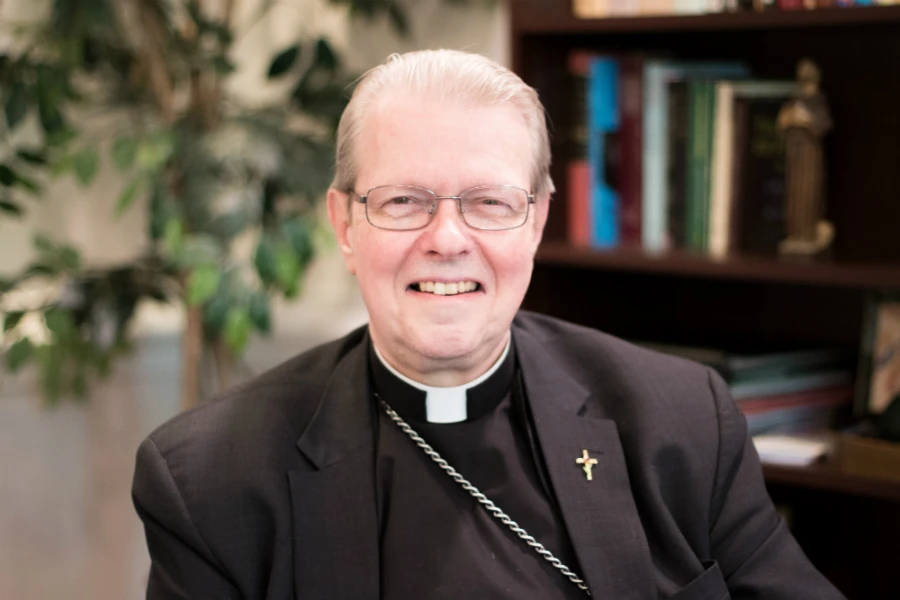
Bishop Edward Scharfenberger, 77, who served as bishop of Albany from April 2014 until his retirement in October, is seeking protection from creditors for his assets valued at between $100,001 and $500,000, according to a filing Tuesday in the U.S. Bankruptcy Court for the Northern District of New York.
The seven-page filing does not list the bishop’s assets but states that he has between 100 and 199 creditors and debts totaling between $1,000,001 and $10 million.
Last week, a jury found Scharfenberger 10% liable in a $54.2 million judgment in a civil lawsuit over the failed pension plan once provided by St. Clare’s Hospital in Schenectady, a Catholic hospital that operated from 1949 until 2008, according to The Evangelist, the diocese’s newspaper.
The verdict and judgment, issued Dec. 12, cover compensatory damages — the amount a court finds is owed to plaintiffs for harm they have suffered — but not punitive damages, which may be added in cases of recklessness, malice, or fraud. The bankruptcy filings by the bishop and another defendant in the state lawsuit over the pension plan failure forced a pause in a punitive damages hearing earlier this week, according to WNYT Channel 13 in Albany.
The National Catholic Register, CNA’s sister news partner, was unable to reach Scharfenberger before the publication of this story. A lawyer representing the bishop acknowledged a request for comment Dec. 17 but did not immediately provide one.
A rare personal bankruptcy
In recent decades, bankruptcies have occurred regularly in the Catholic Church in the United States. Between 2004 and November 2025, 39 of the country’s dioceses have filed for bankruptcy, almost all to protect assets from clergy sex-abuse lawsuits, as the Register reported last month. One of those is the Diocese of Albany, which filed for bankruptcy in March 2023.
But those diocesan cases were filed under Chapter 11 of the U.S. Bankruptcy Code, which allows a corporation, partnership, or sole proprietorship to reorganize and continue operating while developing a court-approved plan to repay creditors.
Scharfenberger filed under Chapter 13, which allows an individual with regular income who cannot pay debts to keep certain assets while working out a repayment plan.
“The rules in Chapter 13 permit a debtor to keep property and confirm a plan with payments to creditors based on the debtor’s ‘disposable income,’” said Marie Reilly, a bankruptcy expert and law professor at Penn State Dickinson Law, in an email. “If the debtor commits his disposable income to paying creditors for the term of a three- to five-year plan, he gets a discharge (forgiveness) of the unpaid balance.”
Reilly, who has researched several dozen diocesan bankruptcies for The Catholic Project, a lay initiative of The Catholic University of America in Washington, D.C., told the Register that the bankruptcy filing does not necessarily solve all of the bishop’s money problems.
“There are exceptions — some debts don’t get discharged. Creditors can object to the plan if it does not meet the statutory requirements,” Reilly said. “And, it is possible that the pension fund creditor may move to dismiss the bishop’s Chapter 13 case as having been filed ‘in bad faith.’”
$50 million shortfall
St. Clare’s Hospital was originally run by the Franciscan Sisters of the Poor. The Diocese of Albany maintains that it never owned the hospital and that the bishop of Albany merely provided “canonical oversight” to make sure the hospital met “its mission to serve all in accord with Catholic moral standards,” according to an August 2025 statement from the diocese.
(Story continues below)
Subscribe to our daily newsletter
Last week, the jury found that the Diocese of Albany has no liability for the pension failure, instead holding the hospital corporation and certain officers and board members accountable.
In addition to Scharfenberger, the jury found two deceased employees of the diocese liable, according to The Evangelist: Former Albany Bishop Howard Hubbard (1938–2023), who led the diocese from 1977 to 2014, was found 20% liable; and Father David LeFort, a former vicar general of the diocese who died in August 2023, was found 5% liable.
Also found liable were St. Clare’s Corporation (20%), St. Clare’s president Joseph Pofit (25%), and former St. Clare’s president Robert Perry (20%), according to The Evangelist.
The judgments stem from a pension plan that operated for about 60 years.
In 1959, the hospital began offering employees a defined-benefit plan that provided a lifetime monthly pension after retirement.
Church plan exempt from ERISA
Like most plans operated by Catholic institutions, the pension plan had a religious exemption from the federal Employee Retirement Income Security Act of 1974 (known as ERISA), which sets minimum funding requirements for most nonreligious pension plans and also enables the federal government to step in and make payments to retirees of failed plans, using a fund financed by covered pension plans.
When the hospital closed in 2008, the officers of St. Clare’s “determined that the corporation would continue to exist for purposes of administering the pension plan,” according to a complaint filed in state court in Schenectady County by the New York attorney general’s office in May 2022.
“They also chose to continue treating the pension plan as a ‘Church plan’ — which it could do only if the corporation’s former employees and pensioners were designated as employees of the Church. This was all in order to avoid the contribution and insurance requirements of ERISA, and the duties imposed by ERISA upon corporation directors and trustees as fiduciaries,” the complaint states.
The bishop of Albany was automatically a member of the hospital’s board and served as its honorary chairman, and had authority to appoint most of the directors on the board, according to the state attorney general’s complaint.
The attorney general’s office alleged that St. Clare’s Corporation failed to make contributions to the pension fund “for all but three years from 2001 to 2019” and concealed from retirees “the insolvency of the pension plan.”
In 2018, the St. Clare’s board terminated the pension plan effective Feb. 1, 2019, because of an approximately $50 million shortfall. More than 1,100 employees lost retirement benefits, including about 650 who lost all pension payments and about 450 who received a lump-sum payment “equal to 70% of the value of their vested pension,” the complaint states. The retired employees include “nurses, lab technicians, social workers, EMTs, orderlies, housekeepers, and other essential workers” who worked at the hospital “between 10 and 50 years,” the complaint states.
Testimony and reaction
On Dec. 9 during the civil trial, Scharfenberger testified that during his tenure no boards he sat on ever discussed the hospital’s pension plan, according to The Times-Union of Albany.
In a written statement issued in August, when Scharfenberger still led the Diocese of Albany, the diocese said the bishop “has actively sought ways to help the pensioners” while denying that the diocese ever “exercised any control over St. Clare’s Hospital operations or its pension.”
“He hosted a listening session with pensioners at Siena College to identify issues and consider ways to help those in need. He also reached out to the Mother Cabrini Foundation to try to secure funding for the pensioners, but that effort was unable to move forward once the pensioners filed the lawsuit,” the statement said.
“The diocese is eager to see the case move forward and promptly resolved,” the August statement continued. “Our prayers continue for all who are struggling in any way, and as we stated previously, our offer to connect those in need with services that can help, stands. No one should walk alone.”
His successor, Bishop Mark O’Connell, who was installed as bishop of Albany on Dec. 5, told reporters shortly before the verdict was announced last week: “I care deeply about their hurt [and] not having their pensions,” according to The Evangelist.
During the Dec. 12 press conference, when a reporter asked O’Connell what the diocese would do if the jury found the diocese liable for the pension fund collapse, the bishop noted that the diocese is already in the midst of a bankruptcy process.
“If we are liable, then we’ll do what we can to make amends, given that they are one creditor as a group among many people accusing the Diocese of Albany,” O’Connell said, according to WAMC Northeast Public Radio. “And that’s what bankruptcy process is. We obviously cannot pay a billion dollars. Right? So that’s what Chapter 11 is all about, to figure out what’s fair. And since you have a bankruptcy judge and mediators, it’s not up to us.”
Later that day, the jury found the diocese not liable in the pension fund collapse lawsuit. The diocese issued a written statement, according to The Evangelist, that said: “As grateful as we are for the jury’s informed decision, we are still very much aware of the hurt felt by the St. Clare’s pensioners who cared for the sick and the poor throughout the long history of St. Clare’s Hospital. This does not mean that we will turn our backs to the pensioners, for as Bishop O’Connell has noted, they are a part of our flock; they are still in need of healing.”
That same day, lead plaintiff Mary Hartshorne, who worked in the hospital’s radiology department for about 28 years, told WNYT Channel 13 in Albany that she and other hospital retirees were pleased with the jury’s verdict but did not feel they would be made whole.
“We’ve been playing this game for seven and a half years, and I think my question I ask everybody is: How do you get that back? You don’t,” she said.
This story was first published by the National Catholic Register, CNA’s sister news partner, and has been adapted by CNA.

Matt McDonald is a staff reporter for the National Catholic Register and the editor of the New Boston Post.