I totally understand why so many people think it’s absurd to spend more than a minute thinking about the murders of Rob and Michele Reiner by their son Nick. When you come right down to it, after all, it’s a private tragedy that has filled the news because one of the victims was a major celebrity.
But I can’t stop thinking about it, for a couple of reasons.
First, this is, broadly speaking, the kind of private horror that many of us have experienced: a loved one with a disorder that makes him dangerous to himself and others, and who should be given long-term treatment in a locked ward. Nowadays, however, the system, not just in the U.S. but in countries around the world, prioritizes the purported right of the screwed-up loved one to be set free and left to his own devices over his right to receive proper treatment for as long as it takes to eliminate the danger. (RELATED: Hollywood Horror: The Murder of Rob Reiner)
As Nicole Gelinas writes in City Journal, a better criminal justice system would either have imprisoned Nick for his “drug possession and open-air drug use while homeless” or judged him to be too mentally ill to be held responsible and institutionalized him. “[At] some point,” she contends, “a healthy society must determine that an individual has had enough chances and should be removed from circulation until he poses no harm to others.” (RELATED: Can Being Charlie Tell Us Anything About the Reiner Murders?)
Lacking such a system, Rob and Michele appear to have done what they thought was best under the circumstances. During the early years of Nick’s problems with drug addiction and mental instability, they listened to the experts and practiced “tough love.” When that didn’t seem to work, they rejected the experts’ advice and instead showered the kid with uncritical love.
They spent a fortune on short-term luxury rehabs. And when Nick wasn’t in rehab, or wandering the highways alone as a homeless person, they let him live in their guest house, let him take meals with them, and let him accompany them to social events, even though he was, not infrequently, verbally abusive, violent, and, at least toward the end, palpably dangerous to everyone around him. On the last night of his life, at Conan O’Brien’s now notorious black-tie Christmas party, Rob is said to have confessed to friends that he was scared of being harmed by his six-foot-three 32-year-old son, whom he and Michele had brought with them, and who, wearing a hoodie, had harassed other guests at the party and ended up in a screaming match with Rob.
Why was Rob scared? According to a Dec. 19 report by TMZ, Nick’s meds had been changed three or four weeks before the murders because of his increasing erratic behavior, but the changes made him “crazy,” and further attempts to adjust them only made him “more and more erratic and dangerous.” Meanwhile, his increased substance abuse intensified the schizophrenia with which he’d already been diagnosed. Many of us who’ve dealt with years of bad adjustments in our loved ones’ psych meds know just how terrible these sorts of missteps can be.
In any event, Rob and Michele left the O’Brien party after the screaming match, apparently without Nick. This is one thing you could perhaps fault them for: if they wished to give Nick the opposite of tough love — what to call it, tender love? — that was their call. But what right did they have to subject O’Brien and his other guests to their dangerous son? Granted, given that Rob and Michele had been “increasingly worried” about Nick’s mental stability in recent weeks, they felt a need to keep an eye on him, and thus took him to the party. But why expose other guests to this ticking time bomb? It was fortunate, in retrospect, that Nick didn’t start slashing away at O’Brien’s other guests.
Then there’s this. Even though Rob was admittedly scared of his son, he and Michele, after leaving the party, drove home and went to bed — even though they knew that Nick was somewhere out there and had a key to the house.
Still, you can’t blame people too much for acting irrationally when they’ve spent years trapped in their own irrational private world.
Still, you can’t blame people too much for acting irrationally when they’ve spent years trapped in their own irrational private world. Many of us, after all, have, in similar situations, behaved in much the same way that the Reiners did. We’ve irrationally believed that our love for a terribly unwell and dangerous individual required us to risk our lives every day by placing ourselves in an unsafe position instead of removing him from our lives.
Some of us manage to snap out of this self-delusion before being killed. Others don’t.
Quick question: if Rob was so worried about Nick, why not hire guys with guns to be in the house around the clock? Was it because Rob was so passionately anti-gun?
On to my second reason for being preoccupied with this case. Even though Rob Reiner was living in an exceedingly toxic household for about 15 years, dealing every day with a son who was full of hostility toward him and who’d already displayed a penchant for violence, he — Rob — not only kept up a busy filmmaking schedule but was also highly active in Democratic Party politics.
In fact, when you look at the timeline, you see that Nick became a problem child sometime around 2008 or 2009, when he was 15. It ramped up gradually after that. And it was in 2015 that Trump announced his first run for president, whereupon Rob began to hurl insults. It continued until Rob’s death.
Rarely, when Rob wrote about Trump, did he offer anything resembling thoughtful criticism of specific policies — no, mostly it was just name-calling. Trump was “mentally unfit” for the presidency. He didn’t understand how government worked — and didn’t care to learn. Trump, Rob contended in 2023, had said that he planned “to govern like an authoritarian.” Routinely, Rob called Trump a fascist. “He wants to destroy the Constitution, go after his political enemies and turn America into an autocracy,” Rob said last year. In September, he warned that Trump had turned America into “a very, very scary place.” (RELATED: Weighing Trump’s Social Media Post on Rob Reiner’s Murder, Without the Hysteria)
Rob didn’t limit his anti-Trump activity to name-calling. With Jeh Johnson, James Clapper, Leon Panetta, and other Deep State veterans, he founded the Committee to Investigate Russia, which pushed the Russia hoax, in a manifest attempt to bring Trump down.
In other words, they were doing precisely what Rob accused Trump of doing.
Mind you, moreover, Rob was doing all this — and more — while pursuing his directorial career and dealing every day with a son who was the human equivalent of a land mine.
Was there a connection between Rob’s unceasing problems with Nick and his unceasing explosions of over-the-top outrage at Trump, which made him perhaps the most severe sufferer of Trump Derangement Syndrome in all of Hollywood? Let me explain what I mean by this question, which I raised in an article that was published the other day.
That article was posted after I watched Rob’s 2015 movie Being Charlie (2015) — whose script, co-written by Nick, was based largely on the latter’s life as an obstreperous druggie — as well as contemporaneous interviews that Rob and Nick gave about the movie. During those interviews, Rob repeatedly explained that he’d given up on “tough love” early on because he simply wasn’t the “tough love” type: “You have to be who you are.”
Besides, he added, “I know Nick better than some expert who’s never met him … If I’d listened to my own gut instinct I’d have done better by Nick.” Rob also disapproved of the fact that in “a lot of these treatment programs, it feels as if the kid is being punished.” When asked what advice he would give to other parents in his shoes, Rob replied: “Listen to your kids…. Try to understand your kids. And don’t punish them…. Whatever they’re doing, they’re doing because there’s a pain…. Whatever you do, don’t be punitive.”
In his Being Charlie interviews, Rob claimed repeatedly that he knew his own son. Did he? The more you see of the real Nick in those interviews, the more you can see how little the fictional Charlie resembles him. Charlie actually has an ambition — to be a stand-up comic — that he’s worked at and is good at. The real Nick, as people close to him have said in recent days, just wanted to be famous. Another detail: Charlie has doe eyes; Nick, in those interviews, has crazy eyes. “I get crazy,” Nick admitted during one audience Q&A. “You don’t want to set me off.”
So it goes. One can admire Rob’s love and empathy for Nick even as one shakes one’s head in dismay at his utter misguidedness. He thought he was being a good parent by responding to Nick’s every obnoxious word or act with outpourings of unconditional love; in reality, he was feeding the behemoth that had possessed his son and that was coldly manipulating him, playing him for a sucker.
Here’s a striking thing about Rob. After deciding to reject the “tough love” approach and to give Nick, instead, unlimited emotional and financial support, Rob seems to have stuck firmly to his guns, never again entertaining the possibility of altering his approach. He was all in. Nothing could change his mind. No matter how much Nick verbally abused him, trashed the guest house, and carried with him everywhere he went an atmosphere of intense disquiet, Rob continued to treat him kindly and gently.
How did he manage that? Well, here’s my take: during these same years when he was unshakable in responding to Nick’s irrational hostility with oodles and oodles of what I’ve called “tender love,” Rob was equally unshakable in his thoroughly irrational hostility toward Trump.
Which brings us to the question that I asked in my article about Being Charlie: was Rob, for all those years, directing at Trump the hostility that he felt toward his spoiled, angry, crazy, destructive, ungrateful, psychotic son?
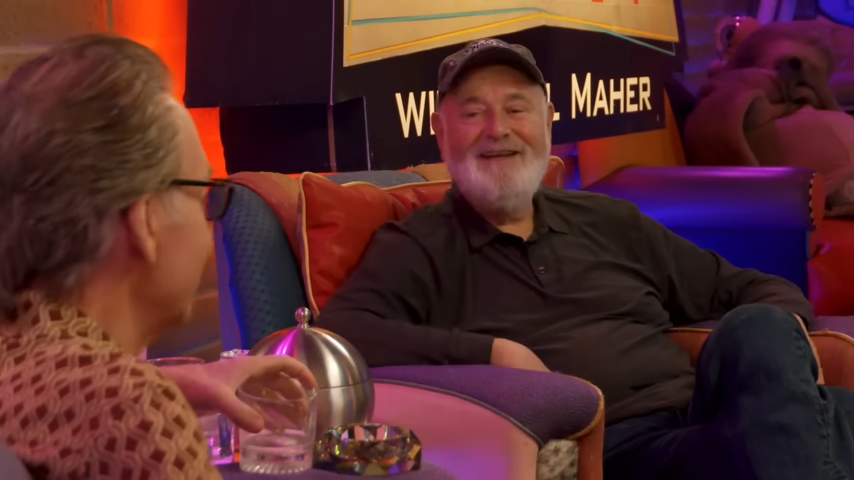
A brief interlude about Rob’s latest long-form interview. Just two months ago, he spent 90 minutes swapping ideas with Bill Maher on the latter’s Club Random podcast. They began with a friendly back-and-forth about the changes in the entertainment business over the last generation or two.
Then they turned to Trump. And Rob was off to the races. He wasn’t just hateful — he was disconnected from reality. The right, he maintained, has much more of a “grip … on the media” than the left. “We don’t have a media infrastructure the way the other side does,” he asserted. Maher’s reply: “Bullshit.” Rob pressed on: Yes, the left has CNN and MSNBC. But nobody watches them. The left has the New York Times. But nobody reads it. No, Americans listen to Fox News.
And for him, the point here was not that thoughtful American voters, by tuning in to Fox News, were paying attention to people who shared their views. No, for Rob, the point was that the left, which has billionaires like Soros behind it, needed even more truckloads of cash so that it could be more successful at manipulating the public. For Rob, in short, the whole business wasn’t about putting your views before the public and letting the public make an intelligent choice; it was about having the best propaganda machine.
One was reminded that Rob, who had been so ardent in his characterization of Trump as an enemy of the Constitution, had been intensely involved in a comprehensive effort by Beltway insiders to violate the Constitution and overthrow Trump. (Come to think of it, if the FBI had acted quickly during Trump’s second term to arrest and imprison the people who’d conspired against him, Rob might be alive today.)
Which brings us to a question: why was Rob Reiner so eager to help the Democrats take control of the government by any means necessary, constitutional or not? Was it because his own household was so terribly out of control, and he was desperate to feel that he wielded some degree of control over a far bigger entity?
Maher, of course, is still very much a leftist, even though he’s rebelled at some of the more far-out positions that have taken center stage on the left. It was fascinating to watch him raise these issues with Rob. For example, when Maher mentioned the left’s refusal to acknowledge the reality of biological sex, Rob was baffled. “What do you mean?” he asked. Maher replied that he was talking about subjecting children to “gender-affirming treatment.” Which is worse, Maher asked: a president who’s joked about grabbing “pussies” or a political party that supports the surgical removal of the healthy private parts of little girls? Rob simply couldn’t process Maher’s point. Maher pressed it: actually removing children’s vaginas, he contended, is worse — “crazier” — than joking about grabbing women’s vaginas, and it “affects people more.” To which Rob replied heatedly that the people performing such operations weren’t running for president. In other words, Trump’s silly joke with Billy Bush mattered more than any number of surgical procedures depriving boys and girls of their genitals.
Shortly thereafter, Rob served up the familiar leftist line that people on the right are racists. Maher countered that the left has its own problems with race. Again, Rob was confused: “Give me an example.” Maher began listing authors of Critical Race Theory texts: Robin DiAngelo, Ta-Nehisi Coates. That wasn’t good enough for Rob, who repeated: “Give me an example!” Maher cited the left-wing argument that “the only solution to past racism is future racism.” Rob, who seemed unaware that such ideas were at the heart of today’s Democratic Party, admitted that he wouldn’t agree with that view. But when Maher, noting that plenty of black women have complained on social media that they “just can’t deal with white people today,” commented that “you can’t imagine that in reverse,” Rob snapped back that you can fully understand why a black person would say that.
This was, clearly, a man who found it exceedingly difficult to explicitly question even the most extreme planks in his party’s platform. Why? Because, I would suggest, his loyalty to Democratic ideology was of a piece with his utterly mad hatred for Trump — which, I would further suggest, was the only thing that enabled him to deal with the daily dose of madness provided by Nick, and the only thing that enabled Rob to maintain the façade of sanity in his personal and professional life.
(By the way: in what ended up being a very creepy coincidence, the ad that Maher read before his interview with Rob was for a mental-health service called Rule: “Before you make the evening news, and not in a good way,” said Maher, turn to Rula, which makes “high-quality mental-health care easy and affordable.”)
I’ll close with Rob’s unprecedentedly bizarre reaction to Trump’s re-election last November. First, he posted a rant in which he accused “MAGA scum” of joining the Bluesky social-media platform and making it “vile, racist and evil.” The next day, following “much discussion and heated debate with family, friends and colleagues,” he announced that he was checking into a “facility” in order to find “peace and relaxation.”
Question: Was it really Trump’s re-election that did this to him? He claimed that he saw Trump as an existential threat, an apocalyptic figure, a demon. In fact the real demon, the real existential threat, the real apocalyptic figure, was living on Rob’s dime and sleeping in Rob’s own guest house. It had his DNA. He was feeding it every day and kissing it goodnight every night. At the time that he shared with the world his post-election rage about Trump, Rob’s own personal apocalypse was a bit over a year away, and, though he didn’t know it, he was bringing it closer and closer to him as he coddled, cosseted, and caressed the psychotropically altered monster whom he still thought of as his beloved son — even as he slapped and smacked and swatted, with ever-increasing hysteria, at what he considered to be the supremely menacing specter of Donald J. Trump.
READ MORE from Bruce Bawer:
Can Being Charlie Tell Us Anything About the Reiner Murders?



![Donald Trump Slams Chicago Leaders After Train Attack Leaves Woman Critically Burned [WATCH]](https://www.right2024.com/wp-content/uploads/2025/11/Trump-Torches-Powell-at-Investment-Forum-Presses-Scott-Bessent-to-350x250.jpg)
![James Carville Admits Democrats Had No Shutdown Endgame, Mishandled Strategy [WATCH]](https://www.right2024.com/wp-content/uploads/2025/11/1763070634_James-Carville-Admits-Democrats-Had-No-Shutdown-Endgame-Mishandled-Strategy-350x250.jpg)