A quiet revival in Christian belief among the young is said to have begun. How strong this revival will prove is impossible to say, for to predict the evolution of other people’s religious convictions is even more difficult than to give, without claiming either too much or too little, a true account of one’s own beliefs.
But there is certainly a more explicit recognition in the last year or two that we live in a nation created and pervaded by Christianity. See for example God Is An Englishman: Christianity and the Creation of England by Bijan Omrani, published in April this year to widespread acclaim.
And on visiting out of the way churches where one might expect to find evidence of terminal decline, quite often one is pleasantly surprised to detect signs of vitality, even of growth.
We have a national tendency to close our eyes to danger, and to put off the evil day when we admit that something must be done. The melancholy, long, withdrawing roar of Christianity, detected by Matthew Arnold in the mid-19th century, was generally regarded as something about which not much could be done.
We hoped, as usual, to muddle through. With any luck the benefits to our political culture obtained under Christianity would endure, even if Christianity itself faced extinction.
Those benefits included the gradual extension of the freedoms enjoyed by members of the Church of England to other denominations. Dissenters and Roman Catholics were at length allowed to become MPs and hold other public offices, and so were Jews.
The Monarch remained Head of the Church of England, but under his or her beneficent authority, one could believe anything, or indeed nothing.
The weakness of the Church of England for a long time proved favourable to liberty. This meant that other denominations, and in due course other religions, could not be denied equal rights.
It is today almost universally accepted that Muslims, Sikhs, Hindus, Buddhists, Zoroastrians, members of any religion under the sun who settle in this country can practice their faith, stand for Parliament, and if elected can rise to high office. We have just had, with very little fuss, our first Hindu Prime Minister.
Few of us expected this change to happen with such rapidity. It can be regarded as a testament to the adaptability of our institutions.
At the last general election, four Muslims proclaiming their fervent support for the Palestinian cause were elected as Independents, in seats which Labour would previously have won. Here was the Commons reflecting, as it is so good at doing, changes in British society.
Labour fears that at the next election, likely to be much tighter than the last one, it will lose more seats to Independents championing the Palestinian cause.
So Labour needs to treat with consideration the concerns of Muslim voters, which include complaints of Islamophobia, and deep anger at Israeli actions in Gaza.
But Labour has Christian roots. The party owes more to Methodism than it does to Marxism, let alone to Islam.
Most of Labour’s voters have Christian roots too. For them, special consideration shown to Muslim voters looks like a betrayal.
So this is tricky ground for the Labour Party. Populists naturally hope to stir up and profit from anti-Muslim feeling, by accusing Muslims of anti-semitism, and of support for terrorism.
In 2021 Ed Husain recounted, in Among the Mosques: A Journey Across Muslim Britain, reviewed here on ConHome, the words he used when invited to address 120 children in a Quran class at a mosque in Rochdale:
“never forget that you are children of this soil. You were born here and you belong here. Let nobody tell you otherwise. Muslims serve in Her Majesty’s Armed Forces and are present in every aspect of life here. Serve your country and your faith, and know that there is no contradiction between the two of them. Those who say we must choose between them, one or the other, are wrong. It’s like asking us to choose between our mum and our dad. Our religion tells us to serve our country, and our country gives us the freedom to be religious in a way that China or Russia does not.”
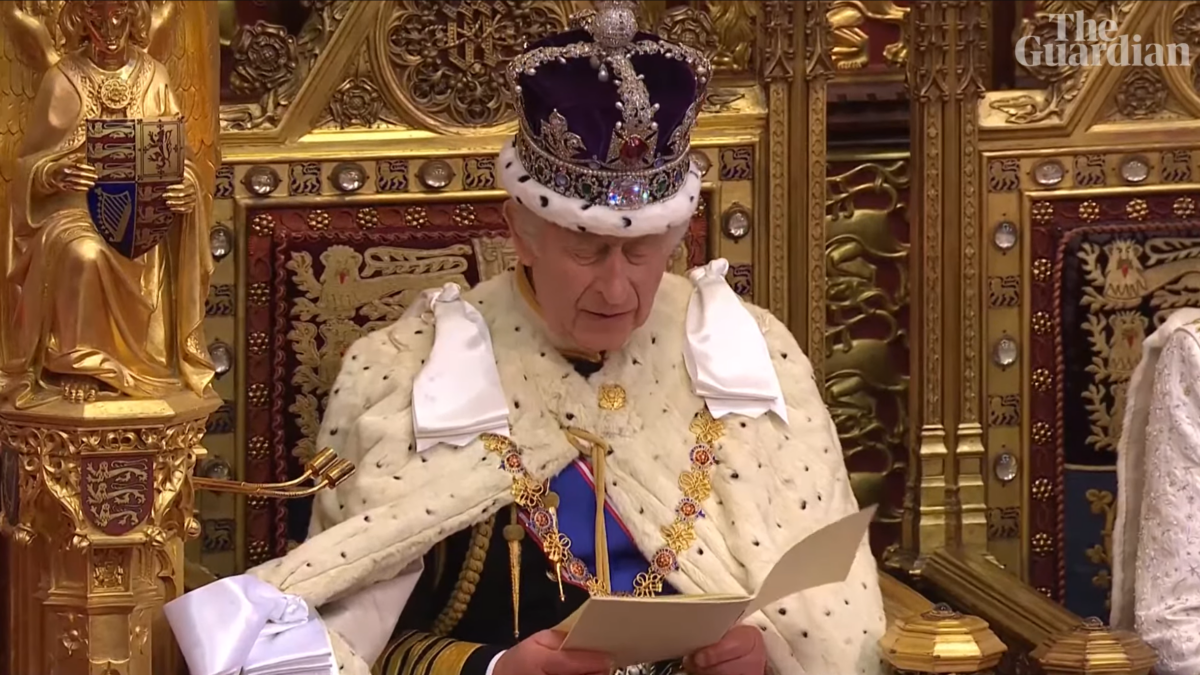
This is the key to the difficulty. Allegiance is what matters, and can be demonstrated by praying in church, synagogue or mosque for the good health of the King. He is not just a figurehead, but the guarantor of our constitution.
Because it is unthinkable to push the monarch aside – because in other words we are loyal to him – tyranny itself becomes unthinkable, for he occupies the space which a dictator would need to occupy. He takes great pains to enter into the lives of Christians, Jews and Muslims, and thereby to command their affection. In the person of the King the religious life of the nation is more integrated than it is anywhere else.
These are thoughts which small-c conservatives find easier to understand, and to articulate, than do rationalists who suppose that our liberties, far from being gained and defended in the course of a long and complicated history in a particular country, have nothing whatever to do with religion, or with the monarchy, and stem from perfect, immutable and universal human rights doctrines first formulated in the middle of the twentieth century.
“Like a man whose only language is Esperanto,” Michael Oakeshott remarks of the rationalist, “he has no means of knowing that the world did not begin in the twentieth century.”
Christians, fortunate inheritors of a tradition stretching back millennia, are more likely than the rationalist to understand the importance attached by Jews and Muslims to their traditions.
Husain found “a caliphist subculture” thriving in various northern towns, “a separate world from the rest of British society”. This dangerous situation has arisen at a time when the rest of British society has become increasingly secular, cut off from any idea of salvation beyond the purely material, shattered by the collapse of old industries, often too adrift to offer any chance of integration even if integration were desired.
So the revival of Christian belief in this country is devoutly to be wished. I write, incidentally, as an Anglican, and a devotee of The Book of Common Prayer. That volume may prompt mockery from those who have never used it, but appears to be encouraging the conversion of those who do.




![Donald Trump Slams Chicago Leaders After Train Attack Leaves Woman Critically Burned [WATCH]](https://www.right2024.com/wp-content/uploads/2025/11/Trump-Torches-Powell-at-Investment-Forum-Presses-Scott-Bessent-to-350x250.jpg)