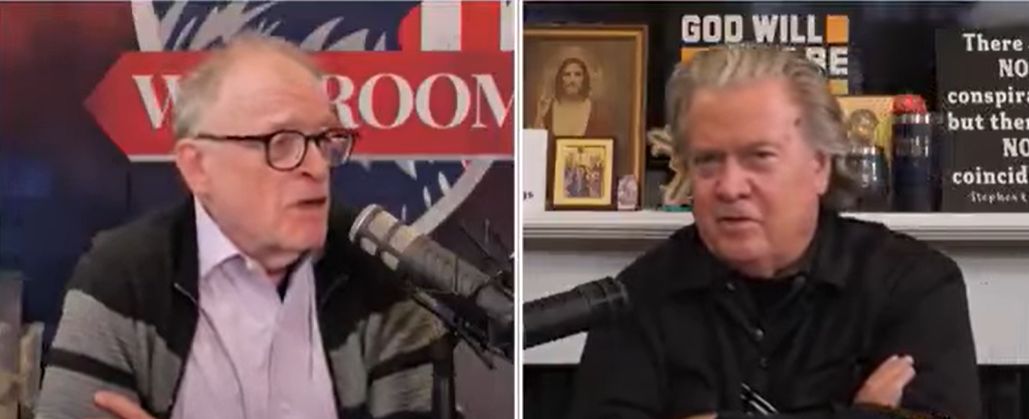
In a series of interviews on Steve Bannon’s War Room, liberal New York Times Book Review editor Sam Tanenhaus has discussed his new biography of conservative icon William F. Buckley, Jr. and the key events and personalities of the era when Buckley shaped the modern American conservative movement. The Bannon-Tanenhaus dialogue demonstrates how ideological differences can be overcome when philosophical partisans focus on facts and pay homage to the truth. Bannon and Tanenhaus are philosophical opposites but honest scholars and interpreters of historical events. In this respect, Tanenhaus puts most liberals to shame.
Buckley also had a populist streak that in some ways foreshadowed the political rise of Trump.
Tanenhaus established his reputation for good writing and fair treatment of conservatives with his magnificent biography of Whittaker Chambers, which appeared in 1997 to widespread acclaim. He has cemented that reputation with his recent biography of Buckley and his ongoing dialogue about the book and the era with Bannon on War Room. Tanenhaus not only shows admiration for Chambers, Buckley, and other conservative thinkers like James Burnham and Russell Kirk — all of whom were part of the National Review circle that Buckley recruited to combat the narrative promulgated by the dominant liberal media — but he also has some favorable things to say about Sen. Joe McCarthy and Richard Nixon, who were the liberal bogeymen of the conservative movement.
Tanenhaus, for example, praises Buckley for his defense of McCarthy in a book Buckley wrote with Brent Bozell titled McCarthy and His Enemies. Tanenhaus understands that McCarthy and Nixon were on to something very important when they warned about communist infiltration of our government. Liberals invented “McCarthyism” to discredit McCarthy’s efforts to reveal the enemy within, and they largely succeeded.
When the once-classified Venona papers were released in 1995 and 1996, McCarthy, Nixon, and other anti-communists were to some extent vindicated, causing the liberal commentator Nicholas von Hoffman to write that McCarthy was closer to the truth than the legions of his critics. That is a big thing for liberals to admit because it confirms what critics of Franklin Roosevelt and Harry Truman said at the time, namely that communists effectively infiltrated our government — including at the highest levels — on FDR’s and Truman’s watch.
During the Roosevelt administration, the number two man at Treasury (Harry Dexter White), a high-ranking State Department official (Alger Hiss), a White House staffer (Lauchlin Currie), and some participants in the Manhattan Project, among others, acted as agents of influence and/or spies for the communists. There is some evidence, though it remains the subject of debate among experts, that Harry Hopkins, FDR’s closest adviser, was a Soviet agent. And when Truman became president, he called the Hiss spy case a “red herring,” and his secretary of state said he wouldn’t turn his back on Hiss, while Democratic fixer Tommy Corcoran saw to it that the administration officials caught up in the notorious Amerasia spy case went unpunished.
And it wasn’t just Buckley and the National Review crowd that defended McCarthy. Tanenhaus notes that the entire Kennedy family was close to McCarthy. John F. Kennedy, Tanenhaus said, would leave the room when his Democratic allies and others criticized McCarthy, who was godfather to one of Bobby Kennedy’s children. When McCarthy died, Bobby quietly attended the funeral. The Kennedys, like Buckley, considered McCarthy a great patriot. McCarthy, like John Kennedy and like Nixon, served in the Pacific theater in World War II.
Tanenhaus, to his credit, doesn’t demonize McCarthy or his defenders. And that may be enough to excommunicate Tanenhaus from polite liberal society. One gets the sense listening to the Bannon-Tanenhaus dialogue that Tanenhaus doesn’t care because he values the truth instead of the conventional liberal narrative. Indeed, simply by appearing on Bannon’s War Room show, Tanenhaus risks ostracism by some of his fellow liberals for whom Bannon is the demonic Svengali behind Donald Trump.
Buckley also had a populist streak that in some ways foreshadowed the political rise of Trump. Buckley famously said that he would rather be governed by the first 2,000 names in the Boston phone book than by the combined faculties of Harvard University and M.I.T. And Buckley before many others on the Right turned against George W. Bush’s “endless wars” after the invasion of Iraq. Tanenhaus notes that a young William F. Buckley, Jr., at his father’s urging, joined the America First Committee in the lead-up to World War II.
The Bannon-Tanenhaus dialogue about Buckley and his era will continue. Do yourself a favor — watch/listen to the earlier interviews and tune in to the next one. It is a learning experience.
READ MORE from Francis P. Sempa:
Please Don’t Bring Back the Neocons
Finland’s Globalist President Lectures the United States About a New World Order
Hugh Sidey: The Last Honest Chronicler of the White House
![Donald Trump Slams Chicago Leaders After Train Attack Leaves Woman Critically Burned [WATCH]](https://www.right2024.com/wp-content/uploads/2025/11/Trump-Torches-Powell-at-Investment-Forum-Presses-Scott-Bessent-to-350x250.jpg)


![Kamala Comes Unglued, Makes Bogus Claim About Her Landslide Loss to Trump [WATCH]](https://www.right2024.com/wp-content/uploads/2025/10/Kamala-Comes-Unglued-Makes-Bogus-Claim-About-Her-Landslide-Loss-350x250.jpg)