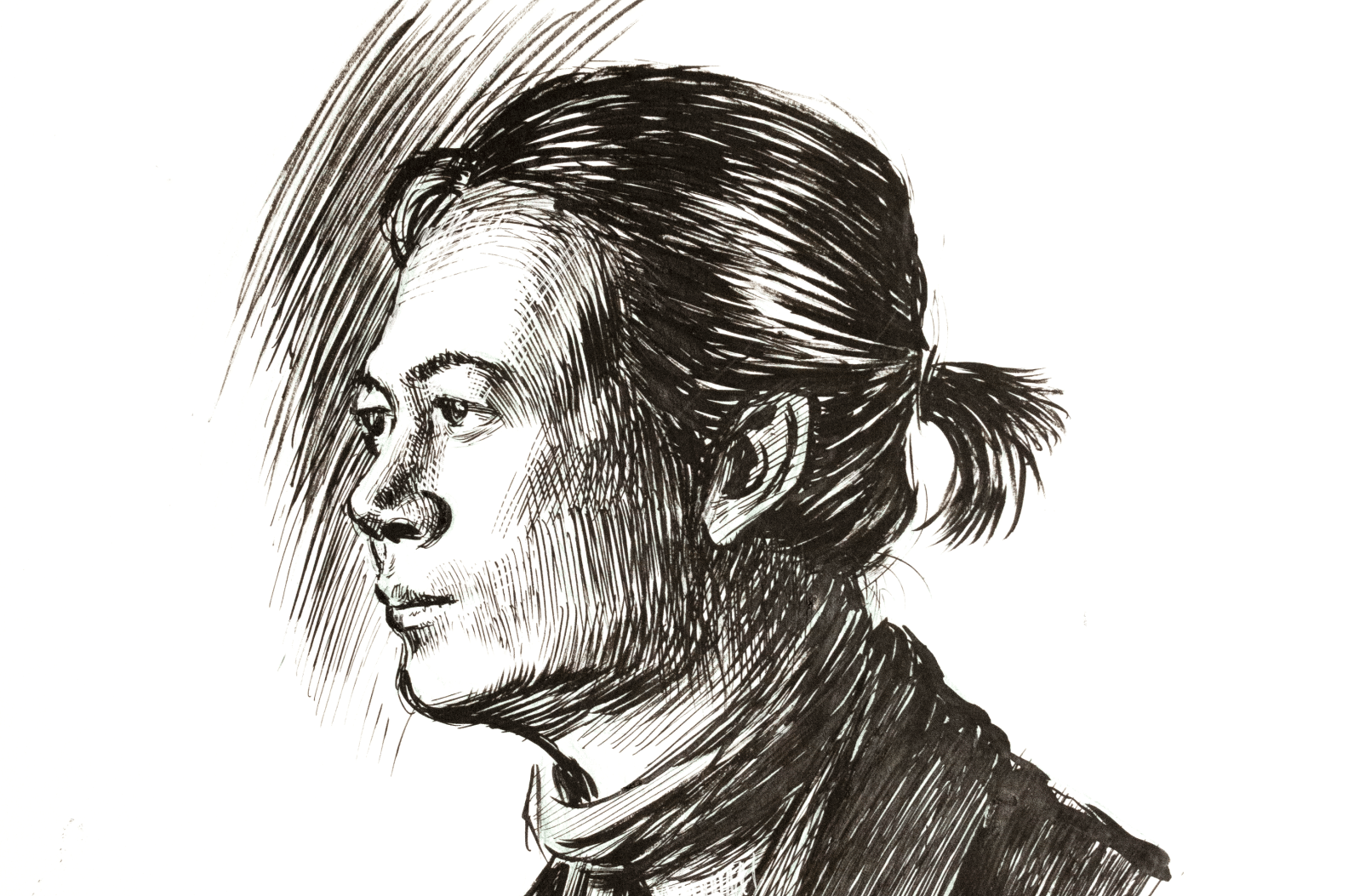
In Praise of the Earth: A Journey Into the Garden
Byung-Chul Han (tr. Daniel Steuer)
Polity Press, 160 pages, $19.95
I
Afar attah, v’el-afar tashuv.
Pulvis est et in pulverem reverteris.
Dust thou art, and into dust thou shalt return.
The language of Genesis 3:19 conjures up images of bodies lying a-mouldering in their graves, heaps of human ashes gathered into the urns of rest, or the residue of life being borne aloft by the winds of the world, away from the pyre, towards the vault of the sky. Yet the meaning of the Hebrew word עָפָר (afar) is not limited to dry dust or fine ash. It can mean powder, soil, earth, or ground, mould or marl, the fundamental material, the raw stuff of creation, and even detritus, rubbish, or rubble. As for the word human, it is traceable back to the Latin hūmānus, and back further still to its Proto-Indo-European root dhghem, is closely related to humus, the organic component of soil. Dust thou art, yes, but you are also humus, loam, sand, silt, clay, decomposed organic material, all the living and inanimate alluvial components of the primal soil. You are something formed, shaped, and molded, like pliable clay in the divine potter’s hands. You are what the Anglo-Saxons called an eorðling, an earth-ling, a privileged member of the eorðan-cynn, the earth-race.
With life becoming ever more digitized, urbanized, and deracinated, we have steadily lost touch with the soil, the source of our food, our energy, and our very selves. What is worse, we have declared war on the soil, treating it as an inert, utilitarian substrate, eroding it, drenching it in pesticides, herbicides, and synthetic fertilizers, crushing it with machinery, and devastating its once-teeming microscopic and macroscopic fauna. “Go touch grass,” we are so often told, but there is nothing more artificial than the curated, manicured, meagerly rooted, monocultural turf-grass planted in our yards and parks, which is usually slathered with potent lawn chemicals like glyphosate, chlorinated derivatives of o-Anisic acid, pyrethroids, neonicotinoids, and triazole fungicides.
What we really need to do is plunge our hands into the soil itself, familiarize ourselves with it, appreciate it, understand it, and then add to it, rather than subtract from it. Gardeners know this as well as anyone. In his marvelous The Gardener’s Year (1929), Karel Capek argued that a
real gardener is not a man who cultivates flowers; he is a man who cultivates the soil. He is a creature who digs himself into the earth and leaves the sight of what is on it to us gaping good-for-nothings. He lives buried in the ground. He builds his monument in a heap of compost. If he came into the Garden of Eden, he would sniff excitedly and say: “Good Lord, what humus!”
II
A time there was when I would have proclaimed The Gardener’s Year the finest book on the psychology and the spiritual component, if not necessarily the science, of gardening. Perhaps it still is, but there is now competition, in the form of the South Korean-born German philosopher Byung-Chul Han’s In Praise of the Earth: A Journey into the Garden, originally published in German under the title Lob der Erde. Eine Reise in den Garten back in 2018, and now translated into English by Daniel Steur, and accompanied by lovely, minimalist black-and-white botanical illustrations by the artist Isabella Gresser.
Around 10 years ago, Han experienced “a deep longing, even a pressing need to be close to the earth,” and resolved to spend time gardening each and every day. The more time he spent in his Bi-Won (Korean for “secret garden”), the more respect he gained for the glories of Creation. “I am now deeply convinced,” Han writes, “that the earth is a divine creation,” with everything in the garden revealing itself to be the result of “divine revolution,” not “biological evolution.” Biology, Han concludes, “is ultimately a theology, a teaching of God,” while the earth itself “is not a dead, lifeless, mute being but an eloquent living being, a living organism.” Han’s religion is syncretic — he is equally at home on the holy mountain of In-Wang-San, in central Seoul, sacrificing flowers to the Buddha, as he is chasing rude tourists out of the Monastero di Santa Chiara in Naples — and the breadth of his learning is unbounded, with everyone from Laozi and Bashō to Schiller and d’Annunzio appearing in his gardening essays, meditations, and diary entries. (His treatment of Gabriele d’Annunzio’s extraordinary poem La pioggia nel pineto, “The Rain in the Pine Forest,” is alone worth the price of admission.)
Han is particular in tune with the rhythm of the seasons, with some of his most haunting passages concerning the hibernal garden. In The Sorrows of Young Werther, Goethe describes a lunatic who, in the midst of winter, searches in vain for flowers to give to his inamorata. “You go forth with joy to gather flowers for your princess — in winter — and grieve when you can find none, and cannot understand why they do not grow.” Han completely rejects Goethe’s premise. “Numerous winter bloomers even blossom in snow,” something the philosopher finds “very comforting,” and so he describes how his secret garden became full of winter jasmine, winter cherry, winter aconites, winter heath, witch hazel, and snowdrops, with the result that “even during the deepest winter, my garden was in bloom.” It is comforting indeed to know that the “dead of winter” is only a mistaken impression. As the great Capek put it in The Gardener’s Year:
It is an optical illusion that trees and bushes are naked in autumn; they are, in fact, sprinkled over with everything that will unpack and unroll in the spring. It is only an optical illusion that my flowers die in the autumn; for in reality they are born. We say that Nature rests, yet she is working like mad. She has only shut up shop and pulled the shutters down; but behind them she is unpacking new goods, and the shelves are becoming so full that they bend under the load. This is the real spring; what is not done now will not be done in April. The future is not in front of us, for it is already here in the shape of a germ; already it is with us; and what is not with us will not be even in the future.
In winter, Nature can reculer pour mieux sauter — a lesson for us all in this the darkest season of the year.
At all times of year, the garden gives us hope. As Byung-Chul Han writes, “Hoping is the temporal mode of the gardener. Thus, my Praise of the Earth is directed at the coming earth.” There is, of course, the occasional tragedy, as when one of Han’s willows was given a fatal wound by a gnawing rodent, and he felt as if “my willow, my beloved, had bled to death,” a feeling any gardener knows all too well. A few months back, an adored weeping birch of ours succumbed to drought. It was one of the finest of our specimen plants, its drooping branches swaying elegantly in the lightest of breezes, and in wintertime it never failed to remind me of Sergei Yesenin’s poem “Beroza”:
Белая берёза
Под моим окном
Принакрылась снегом,
Точно серебром…Belaya beroza
Pod moim oknom
Prinakrylas’ snegom,
Tochno serebrom…A white birch
Beneath my window
Clad in snow
As if in silver…
Now we must wait to see if it revives itself in the spring, and what a loss it would be if it does not. And other horticultural tragedies followed, as when some species of vermin ravaged one of our troll ginkgos, the sight of which turned my stomach the morning the crime was discovered. The gardener’s intimate connection with the various eukaryotes comprising the kingdom Plantae is not to be underestimated.
Setbacks aside, the good invariably outweighs the bad within the confines of the garden. “Every day that I spend in my garden is a day of happiness,” Han enthuses at one point. “I often long for working in the garden. Previously I did not know this feeling of happiness. It is also something very physical. I had never been as physically active before. Never had I touched the earth so intensely. To me, the earth seems to be a source of happiness.” I am reminded of a passage in the Ukrainian writer Valerian Pidmohylny’s remarkable 1927 novel The City, in which the poet Vyhorskyi describes his summer plans to “wander on foot across Ukraine, like the famous Ukrainophile Skovoroda”:
I hate the city in the spring. Why? Because we have not quite escaped nature. When she awakens, she calls us like an abandoned mother. It’s a blessing to live beside her…The forests and the field. We have to remember them at least once a year. Life is a miserable thing, we are justified in our complaints about it, but, in choosing between life and death, there isn’t any choice. I raise a toast to Grandma Nature: although the present she gave us was meager, it was the only one at her disposal.
In the garden, we can reconnect with Grandma Nature, and be continually reminded what a blessing it is to live in her company, as we choose life over death, and commune with the genius loci, the numinous spirit of the place in which we live.
III
Han’s meditation on the value of the garden amidst the inhuman hellscape of digitized, slop-laden hyper-modernity is a timely one. One notes with interest the rather acrimonious debate that was recently touched off by an observation made by the blogger and Daily Wire contributor Matt Walsh, who complained on X that
It’s an empirical fact that basically everything in our day to day lives has gotten worse over the years. The quality of everything — food, clothing, entertainment, air travel, roads, traffic, infrastructure, housing, etc — has declined in observable ways. Even newer inventions — search engines, social media, smart phones — have gone down hill drastically. This isn’t just a random “old man yells at clouds” complaint. It’s true. It’s happening. The decline can be measured. Everyone sees it. Everyone feels it.
This blistering criticism of modern life prompted a response from techno-optimistic progressives and libertarians like Megan McCardle, who for her part countered that
Tomatoes, raspberries, automobiles, televisions, cancer drugs, women’s shoes, insulin monitoring, home security monitoring, clothing for tall women (which functionally didn’t exist until about 2008), telephone service (remember when you had to PAY EXTRA to call another area code?), travel (remember MAPS?), remote work, home video … sorry, ran out of characters before I ran out of hedonic improvements.
But what is the point of all these “hedonic improvements” if an unprecedented number of people are actually beset by anhedonia, and by acedia, asociality, and spiritual torpor, by a sense that life has no meaning or purpose (which something like three in five young adults report feeling). What a bizarre argument, when confronted with innumerable polls and anecdata demonstrating the moral, if not necessarily material, immiseration of modern life, to respond that gadgets really have come a long way. Either people are more miserable in spite of the gadgets, or because of the gadgets, but they are more miserable all the same. That deaths of despair more than doubled between 1999 and 2021 is not an endorsement of hyper-modern life.
There is an increasingly popular genre of Japanese fiction called “healing fiction” — iyashi-kei shōsetsu (癒し系小説), lit. “healing-style novels,” the likes of which you have likely run across at your local bookstore, works like The Miracles of the Namiya General Store, The Restaurant of Lost Recipes, and The Cat Who Saved Books, which typically provide therapeutic, relatively low-stakes storytelling and make sure to wrap things up with a welcome emotional catharsis. I have no personal familiarity with this genre, but I do know that one of the more popular iyashi-kei shōsetsu is Michiko Aoyama’s What You Are Looking For Is in the Library. And perhaps what people are looking for is in the library, or in a house of worship, or atop a mountain peak, a far more likely proposition than finding it in a social media feed, a sports gambling app, or a lukewarm meal delivered via Grubhub. But I am certain that what a great many people are looking for can be found in the soil and vegetation just outside their homes, as Byung-Chul Han discovered when he made his journey into the garden. May his miraculous new philosophical offering inspire more of our fellow modernity-plagued earth-lings to do the same.
READ MORE from Matthew Omolesky:
‘Claude Missed It’ — The Pitfalls of Artificial Intelligence
James Stevens Curl: A Champion for Beauty, Tradition, and Heritage in Architecture
![Scott Bessent Explains The Big Picture Everyone is Missing During the Shutdown [WATCH]](https://www.right2024.com/wp-content/uploads/2025/11/Scott-Bessent-Explains-The-Big-Picture-Everyone-is-Missing-During-350x250.jpg)