I
When the gloom of wintertide was deepest, when snow and ice fettered the earth, and a frost-wind came shoreward from the rime-cold sea, chewing through cloth and skin, even the hardiest Anglo-Saxon would confess to feeling wintercearig, winter-sorrowful, stricken by wintercealde wræce, the winter-cold misery of the hibernal season. We now refer to this phenomenon as “seasonal affective disorder,” “winter-pattern depression,” or “depressive disorder with seasonal pattern,” but the Anglo-Saxons were possessed of an extraordinary poetry we moderns have mislaid. It must have seemed to them, in bleak midwinter, as if the desolate world was dying in frozen silence. In the Old English poem The Wanderer, an unnamed speaker mourns elegiacally over the wintry ruins of the world to come:
Ongietan sceal gleaw hæle
hu gæstlic bið,
þonne ealre þisse worulde wela
weste stondeð,
swa nu missenlice
geond þisne middangeard
winde biwaune
weallas stondaþ,
hrime bihrorene,
hryðge þa ederas.A wise hero must know
How ghostly it will be
When all the wealth of the world
Lies in waste
As now in many places
Throughout this Middle-Earth
Walls stand
Wind-blown
Frost-bound
Halls in ruins
Yet hope remains, for as another Anglo-Saxon wisdom poem reminds us,
Winter sceal geweorpan, weder eft cuman,
Sumor swegle hat.Winter shall pass, fine weather comes again,
A summer hot in the heavens.
The haunting Lament of Deor puts it even more succinctly:
Þæs ofereode,
þisses swa mæg.That passed away,
So can this.
A comforting thought for those huddling by the hearth, with only wattle-and-daub walls separating them from the hare hildstapan, the “grey-frost warriors,” or “hoary battle-marchers” of ice and snow.
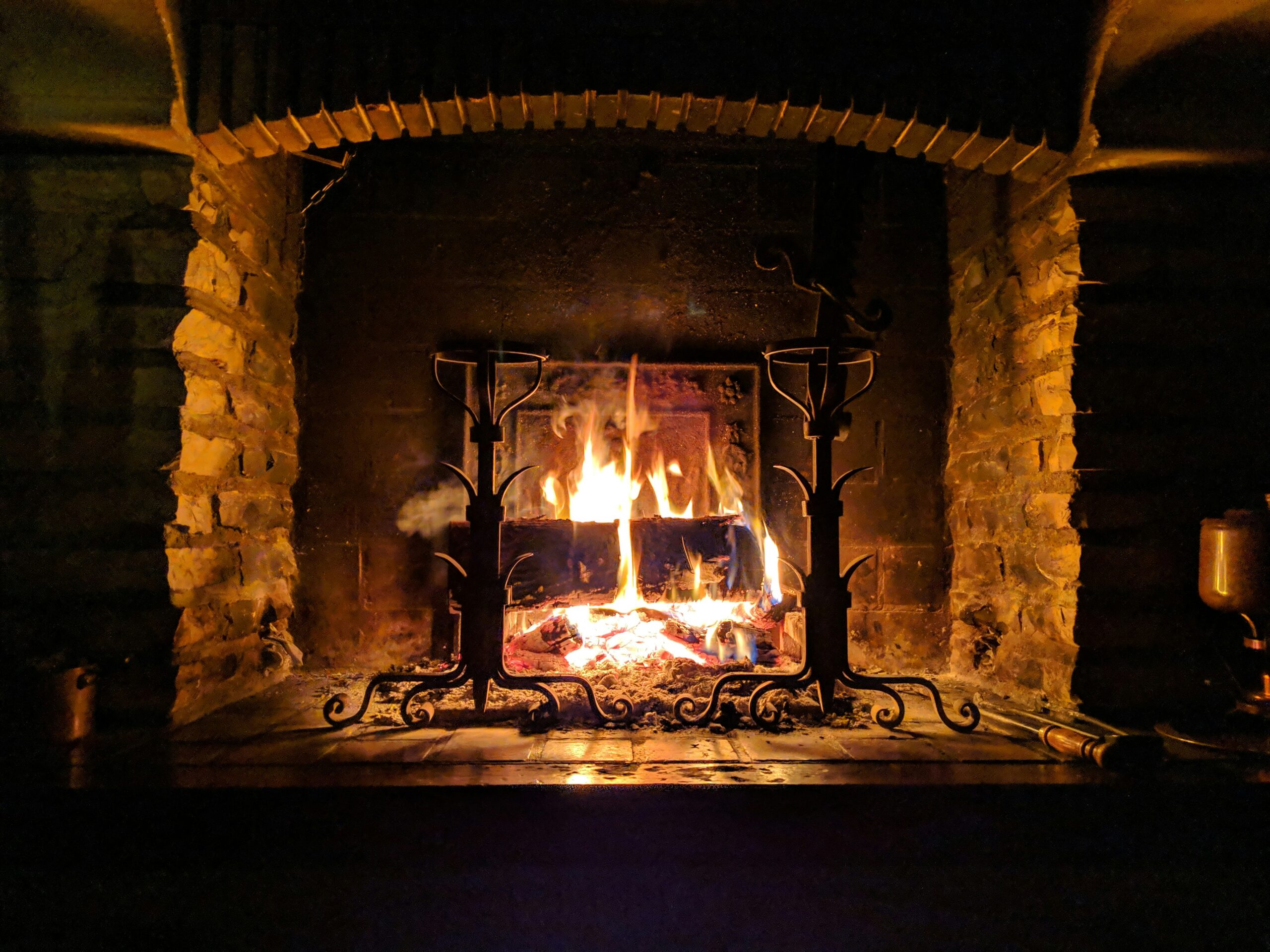
It is easy to forget, in an era of central heating, triple-pane windows, and loose-fill fiberglass insulation, just how brutal winters were for our ancestors. Peter Hitchens, in his 1999 jeremiad The Abolition of Britain, blamed the advent of central heating and double-glazing for the fragmentation of society, insofar as these technological developments have “allowed even close-knit families to avoid each other’s company in well-warmed houses, rather than huddling round a single hearth forced into unwanted companionship, and so compelled to adapt to each other’s foibles and become more social, less selfish beings.” Modern social disengagement has many root causes aside from forced air heating, but the decline of the hearth as the focal point of domestic life cannot be denied.
The hearth-fire was once sacred, held in the highest reverence. There was “clearly an ancient relation,” wrote the wonderfully-named French historian Numa Denis Fustel de Coulanges, “between the worship of the dead and the hearth-fire. We may suppose, therefore, that the domestic fire was in the beginning only the symbol of the worship of the dead; that under the stone of the hearth an ancestor reposed; that the fire was lighted there to honor him, and that this fire seemed to preserve life in him, or represented his soul as always vigilant.” In the ancient world, “hearth-fire demons, heroes, Lares, all were confounded,” and there “remained in the hearth-fire whatever of divine was most accessible to man.” These days, a domestic fireplace is usually surmounted by a flat-panel television, a device that once forced families into a sort of passive companionship, at least until the appearance of laptops, smartphones, and tablets further fragmented our social relations. The decline of the hearth is the decline of song, of memory, of culture, of the gentle art of belonging.
The origins of storytelling around the fire are prehistoric in nature, and it has even been hypothesized that the extended hours of firelight, and the complex social interactions made possible by these evening gatherings, fostered cognitive development in our species. In midwinter, when the day submits so readily to night’s cold embrace, the need for hearthside tales was all the greater, but what sorts of stories should they be? In the second act of Shakespeare’s The Winter’s Tale, the precocious, ill-fated young prince of Sicily, Mamillius, gives us an answer:
HERMIONE
What wisdom stirs amongst you?—Come, sir, now
I am for you again. Pray you sit by us,
And tell ’s a tale.MAMILLIUS
Merry or sad shall ’t be?
HERMIONE
As merry as you will.
MAMILLIUS
A sad tale’s best for winter. I have one
Of sprites and goblins.HERMIONE
Let’s have that, good sir.
Come on, sit down. Come on, and do your best
To fright me with your sprites. You’re powerful at it.MAMILLIUS
There was a man—
HERMIONE
Nay, come sit down, then on.
MAMILLIUS
Dwelt by a churchyard. I will tell it softly,
Yond crickets shall not hear it.
My brother-writer Shakespeare has not always been known for his economy with words, but here we have perhaps the finest ghost story ever written, in just eight words. There was a man dwelt by a churchyard.
II
A sad tale’s best for winter. A ghost story is even better. Wintertide, and Christmastide in particular, has an eerie quality to it. It is a liminal period in the year, a ritual pause in time, when an interval of enforced inactivity is relieved by some of the holiest days of the calendar. On the longest night of the year, the hibernal solstice, according to the Venerable Bede, the pagan Anglo-Saxons would celebrate Mōdraniht, Mother’s Night, presumably in honor of the sacred female dead. With the coming of Christianity came the period of Advent fasting, the celebration of Middewinter (the word Cristesmaesse does not appear until around the year 1000), and the communal, festival Twelve Days of Christmas leading up to the Epiphany.
In his 1729 almanac, James Franklin, the older brother of Benjamin, posited that the blessed month of December was “a great Enemy to evil Spirits, and a great Dissolver of Witchcraft, without the help of Pimpernal, or Quicksilver and Yellow Wax…Some Astrologers indeed confine this Power over evil Spirits to Christmas Eve only; but I know the whole Month has as much Power as any Eve in it: Not but that there may be some wandering Spirits here and there, but I am certain they can do no Mis-chief, nor can they be seen without a Telescope.” And in Hamlet, the Danish officer Marcellus similarly observes that
Some say that ever ‘gainst that season comes
Wherein our Saviour’s birth is celebrated,
The bird of dawning singeth all night long:
And then, they say, no spirit dares stir abroad;
The nights are wholesome; then no planets strike,
No fairy takes, nor witch hath power to charm,
So hallow’d and so gracious is the time.
It is a postulation rather undercut by the appearance of the late King Hamlet, clad in “complete steel,” wandering around in the moonlight, “making night hideous.”
In any event, the eery stillness of pre-modern Middewinter certainly lent itself to thoughts of the supernatural, and perhaps the numinous power of the season gave people the confidence to confront the sprites, goblins, ghosts, and other fiends lurking beyond the ramparts of civilization, for this is the moment when the days at last begin to lengthen, and “the light shineth in darkness, and the darkness did not comprehend it” (John 1:5). And surely a certain frisson accompanied thoughts of dangerous spirits in the middle of all the merrymaking. The late fourteenth-century chivalric romance Sir Gawain and the Green Knight famously takes place at Christmastide, when King Arthur’s court is enjoying its holiday revels and frolics, only to be interrupted by the arrival of the otherworldly Green Knight, a fae lord bearing an axe in one hand and a holly bough in the other, and daring the assembled knights to deliver a blow that will be returned a year hence. I would, without hesitation, select this alliterative poem, with its wonderful rhyming bobs and wheels, as my favorite work of verse in any language, from any period, and part of what makes it so special is its uncanny atmosphere, and its curious mingling of Christian and pagan themes, which also give the Christmas season its distinctive ambience.
Sir Gawain and the Green Knight was perhaps the first great Christmas ghost story. Many more would follow. Charles Dickens’ 1843 novella A Christmas Carol is by far the most celebrated, of course, though Henry James’ 1898 gothic horror novella The Turn of the Screw, nearly as well-known, is also framed as a ghost story for Christmas. It was Montague Rhodes James, provost of King’s College, Cambridge, and later Eton College, who perfected the art form, though I am also partial to the ghost stories of the Canadian novelist and professor Robertson Davies, who as Master of the University of Toronto’s Massey College imitated James by telling tales of the beyond at annual Christmas celebrations and Gaudy Nights. Davies, in his essay “How the High Spirits Came About,” observed (in a passage that might have been written just for me) that “Massey College is a building of great architectural beauty, and few things become architecture so well as a whiff of the past, and a hint of the uncanny. Canada needs ghosts, as a dietary supplement, a vitamin taken to stave off that most dreadful of modern ailments, the Rational Rickets.” At a time when our collective imagination has been weakened and softened by the Rational Rickets, it is clear that we need a whiff of the past, and a hint of the uncanny, more than ever.
The ghosts of Robertson Davies’ devising were “party-ghosts, emanating from high spirits,” and seldom as macabre or frightening as those of some of his illustrious Victorian and Edwardian predecessors. Those high spirits are also evident in a marvelous print produced by the artist John Massey Wright in 1814, entitled The ghost — a Christmas frolic — le revenant, in which a mischievous child frightens the guests at an intimate Christmas gathering, with the aid of a ghoulish home-made mannequin-ghost robed in white and holding a candle aloft, its hideous visage constructed out of what looks like a face-cone for hair-powdering. Distinctly Hogarthian in tone, the print gently satirizes the age-old connection between Christmas and ghostly apparitions, but when we recall that winter in the year 1814 was brutally cold — the Thames was frozen enough to hold the Great Frost Fair of 1814, the last of its kind — Wright’s composition can be seen in a different light, as an appeal for merriment and lightheartedness in the midst of privation and austerity.
III
When we return home from midnight mass, early of a Christmas morning, I am invariably struck by the all-encompassing silence, the hush that fills every part of the world, an effect wonderfully enhanced by a fall of snow (which unfortunately will not be the case this Christmas, with a brief, poorly-timed warm spell in the offing). There is something otherworldly, something numinous about this quietude. But we do not always respond well to silence. Robertson Davies writes of how “there is a quality of deep silence which I know to be the accompaniment of evil.” Virgil evoked this feeling in the Aeneid:
Horror ubique animos,
simul ipsa silentia terrent.Horror is everywhere in our minds,
Even the very silence terrifies.
It is the silence of winter, and the associated desolation of nature, that gave rise to the sad and spooky tales of sprites and goblins, revenants and Green Knights, that we have come to know and love so well.
The tradition does live on in the popular consciousness, though in an attenuated fashion, in the form of the BBC’s A Ghost Story for Christmas anthology series. Between 1971 and 1978, the BBC regularly broadcast adaptations of ghost stories by M.R. James and Charles Dickens on Christmas Eve — The Stalls of Barchester, The Treasure of Abbot Thomas, and The Signalman were stand-outs among these, though others may have their own preferences — and the tradition has been revived in recent years. This Christmas, the adaptation will be that of E.F. Benson’s first-rate 1912 story “The Room in the Tower,” with the setting apparently changed by the writer Mark Gattis, for some unknown reason, to a 1944 air-raid shelter. These television adaptations have predictably become less faithful over time, and are, at any rate, it hardly needs to be stated, no substitute for the real thing.
Contemporary society, with its Rational Rickets, relative absence of atmosphere, and, yes, central heating, has become largely allergic to the spirit that once made midwinter a time of mystery, wonder, and terror. Most people, I am sure, would not trade their material comforts for a heightened sense of spiritual awareness, but something profoundly important was lost when we abandoned the cherished custom of telling ghost stories by the fireside, so as to pass the winter-time, and banish feelings of wintercealde wræce, of winter-cold misery. Fortunately, it does not cost much to acquire a copy of A Christmas Carol, Ghost Stories of an Antiquary, or High Spirits, and read them to yourself or others while huddled by fire of the hallowed hearth, while in the company of ancestral spirits, Lares, and ghosts, safe for the moment from the hoary battle-marchers of ice and snow, and the hollow specters of modern life.
READ MORE from Matthew Omolesky:
Genius Loci: Byung-Chul Han’s In Praise of the Earth
‘Claude Missed It’ — The Pitfalls of Artificial Intelligence
![Scott Bessent Explains The Big Picture Everyone is Missing During the Shutdown [WATCH]](https://www.right2024.com/wp-content/uploads/2025/11/Scott-Bessent-Explains-The-Big-Picture-Everyone-is-Missing-During-350x250.jpg)