“When should the Tories announce that they’re going to abandon the Pension Triple Lock?” This question I posed to an astute and experienced Conservative on happening to bump into him at Westminster just before the Christmas recess.
“Not before the next election,” he instantaneously replied.
It would indeed be ludicrous for the party to fight the next election on a promise to cut the incomes of the people most likely to vote Conservative.
But his reply made me wonder how one can prepare the nation for the long overdue reform of taxes and benefits, without driving voters into the arms of other parties.
It would be hopeless simply to declare that one intends to balance the books by making spending cuts, even if, strictly speaking, one only proposes to cut the rate at which spending is going up.
In his Notebooks, Geoffrey Madan (1895-1947) records the retort of a Hyde Park orator to an interrupter: “When I hear a man talk of Sound Finance, I know him for an enemy of the people.”
Essential though it is to put the public finances on a sound footing, one will find oneself dismissed as an enemy of the people if one makes honest money the over-riding purpose of one’s measures.
One will be convicted of balancing the books on the backs of the poor, or pensioners, or whoever else gains from existing spending.
This was what happened to the Labour Government a few months ago, when it tried to restrain the rise in disability benefits by getting the Universal Credit and Personal Independence Payment Bill through the Commons.
Shrieks of alarm went up from Labour backbenchers who said they had not come into politics to pass such a heartless measure, hard cases were publicised of disabled people who faced serious losses, and the Bill was only passed after ministers eviscerated it by making sweeping concessions.
Labour backbenchers have been carefully selected for their moderation and docility, but nothing, unfortunately, was done to prepare them for the discovery that to govern is to choose, and the choices generally prove hard.
Sir Keir Starmer and his colleagues had instead assured everyone, including themselves, that growth would obviate the need for hard choices.
They boxed themselves in by promising, in the 2024 manifesto, that “Labour will not increase taxes on working people, which is why we will not increase National Insurance, the basic, higher, or additional rates of Income Tax, or VAT.”
The only way to keep these promises was to get a grip on spending, and at first it seemed possible that a plan to do so existed.
The cut in the Winter Fuel Allowance, announced on 29th July 2024, made sense as the first instalment of a much wider programme of retrenchment.
While checking the details of this allowance, I was reminded that it was introduced by Gordon Brown in 1997, soon after he became Chancellor of the Exchequer, at first as a universal benefit of £20 each winter for everyone from the age of 60, though within three years he increased the amount to £200.
There is clearly a strong case for scrapping the allowance, but the Government never made that strong case. It was instead dismayed to find that the cut, about which nothing had been said during the general election only a few weeks earlier, was extremely unpopular.
On 1st May 2025 the Government lost the Runcorn and Helsby by-election by six votes to Reform, who overturned a Labour majority at the general election of 14,696.
But for the scrapping of the Winter Fuel Allowance, Runcorn and Helsby would today be in Labour hands. The allowance was soon afterwards restored, but will be reclaimed by HMRC from any pensioner with an income above £35,000.
It is clear from this history that piecemeal stabs at benefit reform, conducted without a plan and without the preparation of public and parliamentary opinion, are almost certain to lead within weeks or months to that most debilitating manoeuvre, the U-turn, the Chancellor and Prime Minister being blown to and fro by events, groping in vain for a story which might explain their bizarre manoeuvres.
Conservatives are rightly suspicious of grand designs, realise the necessity of making adjustments to any plan according to circumstances, and do not wish to engage in the folly and dishonesty of promising heaven upon earth.
But reform of our over-complicated tax system, and over-extended welfare state, cannot be left to a process of trial and error if and when one gets into power, for by that stage one has no time to think.
There has to be a plan, a story, a manifesto.
In her conference speech, the best she has delivered as leader, Kemi Badenoch promised to abolish one conspicuously counter-productive tax, stamp duty on property transactions, and declared: “We are fighting for people who work hard and do the right thing…take risks and get things done.”
That is the starting point for the Conservative story. People who work hard, do the right thing, take risks and get things done find themselves paying heavy taxes to support a state which provides second-rate services, crowds out private and charitable provision, and raises the pay of public-sector staff without requiring them to become more productive.
The tax system contains various cliff edges over which it can seem, even to energetic and capable people, more trouble than it is worth to go. Why work harder if by doing so one will enter a higher tax bracket? Why not settle for a moderately comfortable life at a lower level?
Why, if one runs a small business, risk exceeding the turnover level at which one has to start paying VAT? And why bother to hire and train new staff who will greatly increase one’s costs?
This is not just an argument about economics, but about fairness, freedom and moral assumptions. Individuals, businesses and charities are almost always better at discovering what they need, and learning from their mistakes, than the state is.
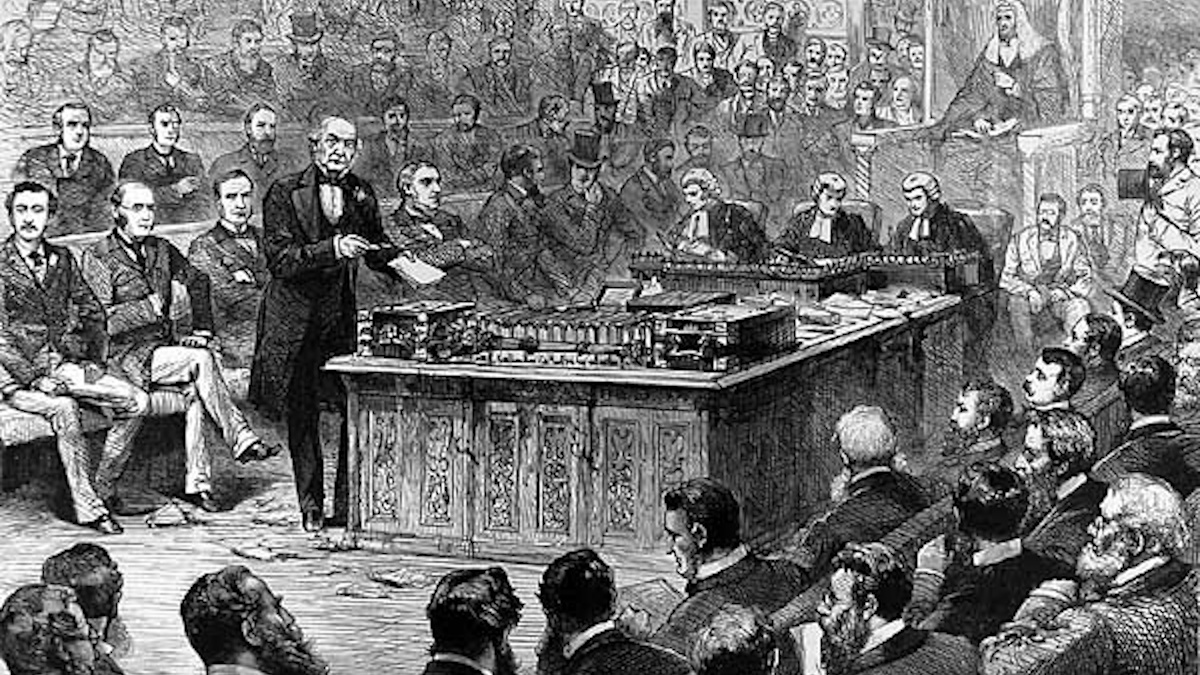
Money should fructify in the pockets of the people. That song was once sung with high moral purpose by Gladstone, and the Conservatives should sing it again now.
![Scott Bessent Explains The Big Picture Everyone is Missing During the Shutdown [WATCH]](https://www.right2024.com/wp-content/uploads/2025/11/Scott-Bessent-Explains-The-Big-Picture-Everyone-is-Missing-During-350x250.jpg)