This content was produced via a partnership with KCPAC. The views and opinions expressed in this commentary are those of the authors and do not reflect the official position of the Daily Caller.
A President Against Religion
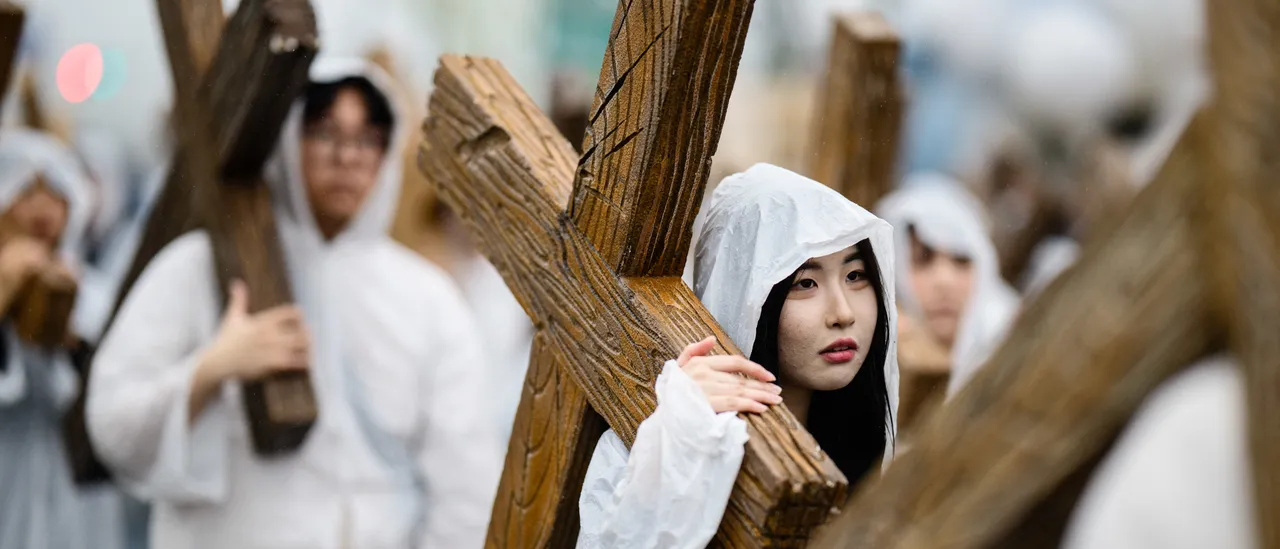
The most essential defense of any free society is the sanctity of conscience. For Americans, this truth is codified in the First Amendment. Yet, in South Korea Article 20 of the Constitution, which guarantees religious liberty, is facing an unprecedented assault from the South Korean president himself.
Last month, President Lee Jae-myung ordered his cabinet to review institutional measures that would allow the government to dissolve religious foundations, citing organizational political intervention. The unpopular cult Unification Church appeared to be the public pretext. But do not be fooled as this is not about rooting out cults. It is about rooting out political opposition with an opening salvo in a war against the country’s conservative Christian community. (RELATED: The Hypocrisy Of Hate)
Twisting the Constitution
To understand the gravity of Lee’s order, we must refer to the history of tyranny. The principle of Separation of Church and State was established to shield the Church from the encroachment of the State. It was not to silence believers from airing their views in the public square.
Lee Jae-myung is twisting this shield provided by law into a sword. By effectively claiming that organized political expression by religious groups is “unconstitutional,” he is reversing the very purpose of religious freedom. He is attempting to forge a legal weapon that would allow the state to brand any church criticizing the regime’s policies as a “political criminal organization” subject to immediate dissolution. These are legitimate criticisms, everything from economic populism to submission to North Korea.
This is a classic authoritarian tactic. Start with a marginal target to manufacture consent and then expand the purge. We have seen this before. The Nazis targeted minority sects before moving against the Confessing Church. The Chinese Communist Party (CCP) uses “sinicization” (Chinese influence) to crush any faith that places God above the Party. We believe that Lee is following these authoritarian scripts.
Purging the Faithful
The ultimate targets are the conservative, pro-alliance Protestant churches that have vehemently opposed the impeachment of former President Yoon Suk-yeol. While Lee seeks new legislation, his prosecutors are already carrying out what is called “lawfare.” This word describes the use of the law to inflict damage akin to warfare itself. (RELATED: The Chinese Trap Sprung On America In South Korea)
We are witnessing a campaign of intimidation against religious leaders that is unprecedented in South Korean history. The persecution began with the arrest of Pastor Son Hyun-bo of Busan Segyeoro Church, who was imprisoned for leading the “Save Korea” movement against the government’s totalitarian drift. Emboldened by this illegitimate move, the prosecutors then escalated their offensive by launching aggressive raids on Yoido Full Gospel Church. This target was chosen with strategic malice, as it is the world’s largest Pentecostal congregation and a site visited by Donald Trump Jr.
The crackdown did not stop there. Authorities raided the headquarters of the Far East Broadcasting Company (FEBC), led by the venerable Pastor Billy Kim.
Former U.S. House Speaker Newt Gingrich correctly identified this trend. He compared the regime’s “all-out assault” on political and religious opponents to the FBI’s raid on Mar-a-Lago on Aug. 8 2022. He also addressed a South Korean operation on a joint U.S.-South Korean base, warning that this “arrogance” threatens the future of the U.S.-South Korea Alliance.
A Call to Action
Why should Washington care about a local church law in Seoul? It is because this fight for religious liberty in South Korea is inseparable from other strategic battles being waged in the Indo-Pacific region. We have recently published several articles about the war in this region in this column.
The persecution currently unfolding in Seoul disturbingly aligns with the CCP’s model of ideological control. If the Lee administration establishes a legal precedent for the state-sponsored dissolution of churches, it will mark the end of liberal democracy in South Korea. A nation where the state dictates what a pastor can preach is no longer a free nation, as the suppression of religious expression is a direct assault on fundamental human rights.
The United States should send an unequivocal signal to the Lee administration that nations that decide to subject their citizens to such repression must face consequences. (RELATED: Money, Politics And The Wealth Of Nations)
First, we would like the U.S. State Department and the Ambassador-at-Large for International Religious Freedom to publicly condemn any attempt to dissolve religious bodies based on their political speech.
Second, Congress should direct the Administration to review South Korean officials involved in any such political persecution under the Global Magnitsky Act. This 2016 Act is a U.S. law enabling sanctions such as asset freezes and visa bans to be put in place. It punishes individuals worldwide who are involved in serious human rights abuses or significant corruption. Those who abuse the law to imprison pastors and raid churches should be sanctioned.
There can be no compromise on liberty. Lee Jae-myung’s maneuver is a bid to silence the moral voice of the nation. We must ensure that South Korea does not trade the legacy of its Christian foundation for such a playbook.
KWON KYUNG-HEE is the Publisher and Representative Reporter for Mega Focus, a conservative media outlet in South Korea. She advocates for core conservative and Judeo-Christian values in public life and is a prominent voice on the mismanagement of the current Korean economic policy.
![Donald Trump Slams Chicago Leaders After Train Attack Leaves Woman Critically Burned [WATCH]](https://www.right2024.com/wp-content/uploads/2025/11/Trump-Torches-Powell-at-Investment-Forum-Presses-Scott-Bessent-to-350x250.jpg)
![Two Dead, 14 Injured After Gunfire Erupts Following College Football Game in Alabama [WATCH]](https://www.right2024.com/wp-content/uploads/2025/10/Two-Dead-14-Injured-After-Gunfire-Erupts-Following-College-Football-350x250.jpg)