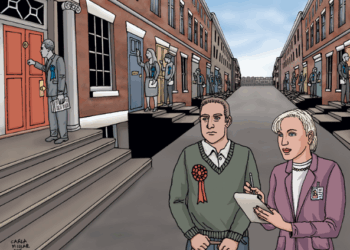
“Honestly Giles, I don’t care. I’ve never even heard of the bloke”
This comment, made to me about a back bench MP in 2011, by a Special Adviser to the Tory wing of the Coalition, was an early indicator problems to come.
This was eleven years before I became a Special Adviser, or Tory member, and back when as a BBC reporter I was determinedly neutral.
To me ignoring backbench concerns seemed reckless arrogance. In 2010, I was – as many were with us in 2024 – glad that after 13 years, and having run out of money and steam, Labour were out. However the Coalition didn’t get much honeymoon and Government is damn hard – a fact too often forgotten by those aspiring to it. It’s all trade-offs, least worst options, and endless complex stubborn problems that are not fixed simply or quickly, whoever is in charge. ‘Executive orders’ won’t fix it, and anyone thinking they will are in for a shock.
Anyway, the ‘bloke’ in question was an experienced Tory back bencher, who I suggested was ‘not going to like’ (that’s the polite version) a new policy the adviser’s boss was having to roll out. It might have been the casual arrogance of a SpAd – they’re not the most loved species – but more, I realised this person genuinely didn’t care they hadn’t heard of this MP or their objections.
That struck me as a weakness.
True, getting to grips with the hard reality of trying to pull the levers of power can try the patience of any thrust into office, especially if it’s their first time and they see their passion for change thwarted by frustrating reality. They’ll rail against officials, No 10, other advisors, and quangos, and ‘the blob ‘making life difficult’. But to then add a layer of not being aware of, the feelings and views of their own – arguably a Whip’s job – just seemed self-defeating. Not reading then riding the ebbs and flows of mood in the parliamentary party was a flaw for the last Conservative government’s string of Prime Ministers, and was a drag anchor on government business.
In opposition, Tories mustn’t forget their Government experiences, good and bad. If the state needs rewiring (it does) and just barking orders at civil servants won’t unblock things (it won’t) the Conservatives must remember exactly what it is they want to fix, and not slip into the cosy bath of easy solutions and promises.
Labour have inadvertently taught everyone some lessons:
- Going into an election with no plan beyond winning, is a recipe for disaster.
- Don’t promise what you know already you can’t deliver.
- Imagining that just by being members of a particular party you’re inherently more sensible, ‘grown up’, efficient and moral is another gigantic trap.
- Simple, quick solutions when actually attempted are rarely simple or quick and if they are, they’re not really a solution.
- Not understanding the government landscape, how the system works – and doesn’t – is negligent and foolish.
Dominic Cummings has assessed the system and been saying it’s broken long before he became a Prime Ministerial chief of staff – and louder since he fell out with that Prime Minister, that PM’s wife and, frankly now, the Conservative Party.
If ‘Dom’ analyses and diagnoses a problem within the system it’s unwise to dismiss it. I suspect the Labour advisor who early on admitted “Cummings was right” was none other than former Labour Number 10 man, Paul Ovenden who, in a recent article suggested why Labour has struggled to get important things done by obsessing about fringe issues.
Our Columnist David Willetts, a politician and a former civil servant had useful insights into both what Cummings has said – a high priest of the ‘demolish-it-all-and-start-again’ school, but valid – and Mr Ovenden’s offering about the ‘stakeholder state’.
My own experience was that it takes serious focus to assess if obstacles to delivery are deliberate, systemic, or brewed within the quangocracy. But it can also come from the party, No 10, or your political opponents. It changes depending on topic.
One rule for the future should be no executive power without accountability. Arm’s-length bodies execute the former with little of the latter. The Blairite tendency of outsourcing power has become a hindrance.
Whilst politicians blame Whitehall and Whitehall blames ‘inadequate’ politicians, to varying degrees, the truth is, it’s a bit of both.
My beef was that a rigid adherence to one way of doing things rather than outright Sir Humphrey-esque skull-duggery is how the system manages rather than enacts political direction. It can see ‘process’ as ‘delivery’, marks its own work and continually swaps measured cautious advice, with paralysing risk aversion.
Starmer clearly hadn’t clocked this, convinced that ‘Tory is the problem, Labour the solution’. Besides he outsourced solving it with Sue Gray, who in the end, briefly, ossified the political by trying to make it more civil service!
Farage, for all his strengths and poll lead is still ‘headline-only’ about how he’d resolve a broken state – one that he and Reform have never worked with – beyond ‘sack them and get in true believers’. Conservatives want to reduce headcount, it’s the last bit that’s less clear.
It’s a popular slogan. But that’s pretty much all it is.
Rewiring the state is a dull, details heavy, time consuming project with few votes in it.
It’s done more effectively if you already have blueprints, and know what needs to be fixed, where. However it is a valid question: why, if ‘you had fourteen years’ did you not get on with it?
Truth is this largely unseen work is too often kicked into the long grass by governments pressured to tackle more immediate spotlit issues. That mistake has consequences.
Too often we’d be told our directives were busily being worked on but aside from the nuts and bolts there were “tricky legal aspects” at which point a government lawyer would feel duty-bound to warn we were ‘highly likely to be challenged in court’ with ‘a 70 per cent chance of losing’. It was always 70 percent; not quite open opposition but just enough risk to imply ‘pause or change tack’. Some Secretaries of State would respond with ‘let them take us to court!’ But the legal ‘advice’ often stalled or delayed progress.
However to return to those backbenchers, some fault lies with them. And here’s where I differ slightly from David Willetts.
Government is like balancing an equation, and a party’s unity of purpose is an invaluable ingredient – it’s why politicians bang on about it so much. But building it involves listening, and persuasion.
The Conservative party in 14 years did not have complete political control either as part of a Coalition, or because of a negligible majority. Frustratingly post 2019 bad habits had become norms. The broad church stretched towards collapse as its components vied to get the whip hand over the executive, usually because they felt ignored by it.
You can’t make the system deliver if you can’t get your party behind you. Civil servants can sniff out if Governments are weak – or might lose – and recalibrate their efforts. Back benchers can collectively hobble their own government as much as the system.
Look at Labour.
The welfare reform rebellion was a defining moment. Starmer cannot bounce his party into doing certain things because they won’t let him. Worse I suspect he’s not that keen to ‘do the necessary’, as he personally doesn’t like it.
It’s the old ‘I didn’t come into politics to….(add hated policy here)’ to avoid ‘tough decisions’
If, and it’s still a big ‘if’ (‘impossible’ if you believe Cummings’ last podcast analysis) the Conservatives look like forming a government, or being in one, any plan to rewire the state as Kemi Badenoch has suggested to do ‘less but brilliantly’ needs a parliamentary party fully on board with what that’ll take. It will be a mammoth task.
That’s members and volunteers too. We are a site for members as much as MPs. They mustn’t be told ‘this is the way, now follow’ – but persuaded and enthused about making government work better. The Chairman’s New Year call to action will fall flat unless the wider party voluntarily ‘buys in’.
The leader has had a bounce, the party less of one, but we are still 4-5 points off the polling we had when we lost. If Conservatives are serious about fighting oblivion predictions, we need to accept and embrace what it will take to change them.
The golden trio is: a clear credible and detailed plan, lessons properly learned and shown to be learned (and plenty of members voice scepticism that that’s happened) and a whole party machine enthused and positive about what it is selling.
Reform will happily tell you it’s too late. It’s up to you to prove them wrong.
Then, and only then, will Conservatives even get a shot at fixing the Cummings-Ovenden rewiring conundrum.
Then the hard work really starts.



![Donald Trump Slams Chicago Leaders After Train Attack Leaves Woman Critically Burned [WATCH]](https://www.right2024.com/wp-content/uploads/2025/11/Trump-Torches-Powell-at-Investment-Forum-Presses-Scott-Bessent-to-350x250.jpg)