Riccardo Cantadori is an Italian writer and a recent graduate, focusing on economics, finance, and international relations. He believes in individual liberty and personal responsibility.
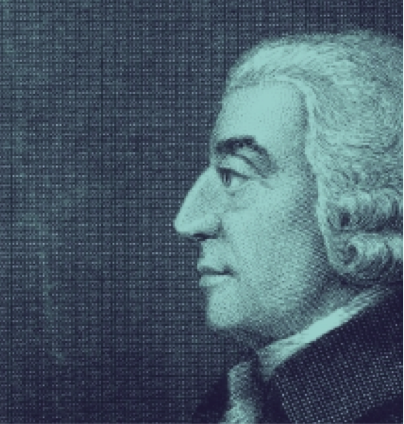
We are nearing the 250th anniversary of the publication of The Wealth of Nations, the work that in 1776 Adam Smith handed to William Strahan, an erudite publisher and politician, but also a far-sighted businessman. We do not know what Strahan thought when he first held Smith’s manuscript, but he chose to publish it and, 250 years on, we can say he made the right call.
The Wealth of Nations indeed remains a milestone in economic thought to this day. Praised by some as “the bible of capitalism,” it is criticised by others for the very same reason. Yet both camps – supporters and opponents of the free market – agree on one point: Smith’s legacy is among the most influential of the past few centuries. That alone would be enough to recommend leafing through The Wealth of Nations, especially in times of heightened economic and social uncertainty.
As the free market loses its appeal for many, old questions are back in fashion: Is capitalism failing? Should we seek alternative ways of living? Can the logic of profit justify all the injustices we see in the world? While these questions are simple, the answers are complex.
Still, it is possible to notice that they rest on a very common misunderstanding: that capitalism is the market’s dominion over human beings. This false belief may stem from Smith’s famous explanation of why exchanges arise. “It is not from the benevolence of the butcher, the brewer, or the baker,” he wrote in The Wealth of Nations, “that we expect our dinner, but from their regard to their own self-interest”. The pursuit of profit, then, is for Smith the material reason that makes the market exist.
But the Scottish philosopher was well aware that personal ambition ultimately rests on broader values and commitments, such as mutual trust and confidence. For example, Smith argued:
“When the people of any particular country has such confidence in the fortune, probity, and prudence of a particular banker, as to believe he is always ready to pay upon demand such of his promissory notes as are likely to be at any time presented to him; those notes come to have the same currency as gold and silver money, from the confidence that such money can at any time be had for them.”
Trust, therefore, is an indispensable condition for the efficient functioning of the economy. And it is not always a given.
For many years now, growing distrust in the economy and in politics has been a phenomenon that shows no sign of stopping, at least where people are free to express dissent. And in any case, mistrust often appears more realistic than optimism.
State (or supranational) interventions have often gone beyond the bounds of economic freedom, masking ideological battles as urgent social or environmental duties. In the best cases, public interventionism has achieved nothing. In the worst cases, it has curbed the manufacturing competitiveness of Western countries, weakened the middle class, and fuelled widespread disillusionment.
The champions of the butcher-brewer-baker reading of Smith risk overlooking a broader analysis of relations among individuals. Years before The Wealth of Nations, Smith wrote The Theory of Moral Sentiments (1759), in which he extensively investigated the power of non-profit values, an inquiry he partly carried over into the work whose 250th anniversary falls in 2026.
The Wealth of Nations is also the book that gave modern economics its most enduring account of specialisation: productivity rises when tasks and knowledge are efficiently divided. That logic still underpins our economies, but in a changed world. Today’s specialisation is embedded in global supply chains, and those chains are being continually redrawn as the perceived risks of interdependence — from shocks to sanctions — become harder to ignore.
Moreover, by making knowledge easier to copy, translate and distribute, generative models are beginning to put usable know-how in almost any domain within reach of anyone who wants it, at a modest marginal cost.
The consequences could be far-reaching. When expertise becomes less scarce, its economic value falls. In this context, many analysts suggest knowledge and skills that remain difficult to transfer (say, because they cannot easily be described or documented) will increase in value. In other words, a sizeable share of human capital that has been rewarded for two and a half centuries could be devalued, while another share becomes more valuable than ever. A question that must now be investigated is how large each of these shares will be.
The questions of our time do not call for a form of “new capitalism” (a label often used for the oldest statism). They do call instead for an open-minded reading of classics that still have much to tell us.
We do not know what William Strahan felt when he first read Smith’s manuscript in 1776, but we can experience an astonishment perhaps even greater in realising how contemporary The Wealth of Nations remains after two and a half centuries. That is what makes Adam Smith one of the great figures of our history.





![Donald Trump Slams Chicago Leaders After Train Attack Leaves Woman Critically Burned [WATCH]](https://www.right2024.com/wp-content/uploads/2025/11/Trump-Torches-Powell-at-Investment-Forum-Presses-Scott-Bessent-to-350x250.jpg)

![Kamala Comes Unglued, Makes Bogus Claim About Her Landslide Loss to Trump [WATCH]](https://www.right2024.com/wp-content/uploads/2025/10/Kamala-Comes-Unglued-Makes-Bogus-Claim-About-Her-Landslide-Loss-350x250.jpg)