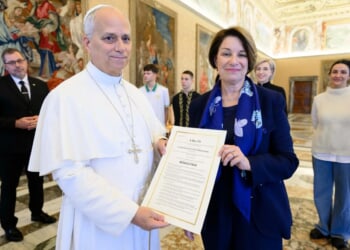
Mel Stride has become the first Tory to stress test the party’s new strategy for attacking Reform: take aim at Nigel Farage’s relationship with the White House. Speaking at the Transatlantic Trade and Investment Policy Conference in London, Stride accused Trump of “not playing by the rules”, warned that protectionism is the “tool of populists”, and claimed Reform is “acting as apologists for the US administration”:
“Tariffs are not the answer to our economic troubles. Increasing trade barriers is unquestionably a step backwards and will leave everyone worse off, so the approach of the current US administration is concerning. Being close partners, we have a duty to be honest when we see our friends making a mistake. As with any community, whether of people or of nations, the whole system can be strained if just one member chooses not to play by the rules. It is disappointing that some politicians in our own country – in the Reform Party, for example – want to be seen as the champions of the White House in the UK, rather than being unequivocal in their stance on free and fair trade.”
Reform is pushing back:
“Nigel Farage has been explicitly clear that he opposes Trump’s tariff regime. Once again the Tories have to resort to dishonesty because no one listening to them. Minor party Mel should be making a speech apologising for ballooning welfare budget he allowed to happen under his watch as a Minister.”
Punchy…
Read his speech in full below:
It’s a pleasure to be here and thank you to British American Business for inviting me
today.
The ties between the UK and US are deep and longstanding.
Our two countries have stronger bonds than perhaps almost any other two nations in
the world – culturally, diplomatically, and of course, economically.
And Britain for centuries has thrived as an open, free-trading nation.
It is how a small set of islands off the north coast of Europe became the world’s first
industrialised economy.
And trade has always been and continues to be the lifeblood of our prosperity.
And despite the changing world we live in – the rise of other developing economies
across the world – the US remains our biggest single country trade partner.
£60 billion of goods exported every year – roughly one sixth of all of our goods exports,
and twice as much as our next largest market, Germany.
And of course even more vital for us here in the UK is our trade in services – with more
than £130 billion of services exports to the US every year. Similar flows come back the
other way in US exports, of course. And our industries collaborate closely in many areas
– such as in the defence sector. To give just one example, the F-35 fighter jet contains
British ejector seats.’ That exchange between our economies creates jobs for our
citizens, markets and investment opportunities for our businesses, and tax revenue for
our public services.
The more we can foster and strengthen those economic bonds, the better.
And that relationship is not just about selling our wares.
Closer ties also mean ideas and technologies are shared and dispersed.
I visited the West Coast last year and went to see firms which are right at the cutting
edge of innovation.
Driverless cars, robotics, artificial intelligence.
It felt like one could almost reach out and touch the future.
The dynamism of some parts of the American economy is outstanding – and I want as
much of that dynamism as possible to diffuse across my own country.
And as a result of that dynamism by some measures the US is around 40% richer per
capita than the UK.
And US firms and investors enjoy deep pools of capital which they invest not just in
America but all over the world – including in the UK.
An enterprise economy, where innovation and entrepreneurship are cherished and
rewarded, where taxes are kept relatively low, where regulation is not overbearing,
where it is instinctively understood that wealth creation is a good thing.
I am not saying that the US economy is perfect – you will all, I am sure, have your
frustrations.
But there is much to be admired, and much we can learn.
In the modern world it is perhaps more important than ever that this model of
competitive innovation, free markets and private investor led capitalism is embraced
and defended. Not least in the face of an increasingly assertive China.
Now the rise of Chinese economy is in many ways something to be welcomed.
Around three quarters of all the reduction in world poverty that has happened since
1980 has happened in China.
But it also comes with its critical challenges, and questions.
Of course some of that is a moral question.
How should we approach our trading relationship with a country which is
unapologetically undemocratic, and with a concerning record on human rights?
We saw that debate played out last week with the Prime Minister’s decision to fly to
Beijing.
But China’s rise also raises issues about how our economies work and the future of
capitalism.
The Chinese model is one of strong state control, subsidies, protection from foreign
competition through non-tariff barriers, and currency manipulation.
What is often referred to as ‘capitalism with Chinese characteristics’
.
And beyond China’s borders, we see the Chinese state taking an aggressive approach to
investment and economic leverage, including over key natural resources in parts of
Africa, for example.
The Belt and Road Initiative has become the classic case of using economic power not
just for the mutual benefits of investment and trade, but for the strategic goals of the
state.
With all of this comes disruption.
And as with any community, whether of people or of nations, the whole system can be
strained if just one member chooses not to play by the rules.
We in the Conservative Party see open competition and free trade not just as the fairest
way to do business, but as the best way to drive productivity and efficiency.
And despite the challenges we face, I have the firm belief that free trade remains the
right approach for our own economy.
“A belief that we must avoid responding to our challenges by turning towards
protectionism – albeit that we must also be unflinching in protecting our markets in the
face of unfair trading practices.
In those circumstances, we of course have recourse to perfectly legitimate counter
measures under WTO rules.”
The right approach is to defend free trade and free markets, not to give up on them.
And in the face of China this is surely a time when nations like Britain and America need
to stick together, to unite in our commitment to freedom and free markets.
And being close partners, we have a duty to be honest when we see our friends making
a mistake.
Tariffs are not the answer to our economic troubles.
Trade is about mutual benefit. It is not a zero-sum game.
It was British economists like David Ricardo who established long ago that free trade
between nations leaves both sides better off – even if one nation was dominant in every
single sector, every commodity, every product, it would still make sense for it to trade
and seize the benefits of ‘comparative advantage’ .
Increasing trade barriers is unquestionably a step backwards and will leave everyone
worse off.
So the approach of the current US administration is concerning.
We are here today to celebrate the economic ties between the UK and the US, and to
discuss how they can be strengthened. And yet those ties have been strained by recent
US policy and, in the round, to no obvious benefit to either the US or to other countries.
Countries upon which tariffs have been threatened or applied not just as part of a
negotiation aimed at driving towards freer markets in the longer term but as a means of
attempted coercion for a range of political aims including the acquisition of the
sovereign territory of US allies including members of NATO.
The rhetoric of protectionism may be instinctively popular and domestically it may in
some quarters play well indeed –it has often been the tool of populists.
But the costs are ultimately borne not just by foreign corporations, but by your own
citizens.
And I think we have to be honest and upfront about that.
And it is disappointing that some politicians in our own country – in the Reform Party, for
example – want to be seen as the champions of the White House in the UK, rather than
being unequivocal in their stance on free and fair trade.
I want to see an end not just to tariffs but to non-tariff barriers as well.
I want to see trade and investment flowing across the Atlantic like never before, creating
jobs and wealth.
I want us to respond to the economic challenges we face in the modern world by
recommitting to the power of free markets and free trade – not by rejecting them.
I want us to see free trade as a bulwark against the rising global challenges to the
freedoms which our two great countries embody and cherish. As an enduring anchor in
the shifting sands of global power.
Together our countries have been bastions of economic progress. We have stood
together in so many ways – when the world needed us – needed the best of the US and
the best of the UK.
Free trade has been central to all of that. It brings jobs and investment, it creates
wealth, it lifts people out of poverty.
It means we can make things, build things, invent things which on our own we might
never achieve.
It binds us together. It makes us stronger. It is worth defending.





![Florida Officer Shot Twice in the Face During Service Call; Suspect Killed [WATCH]](https://www.right2024.com/wp-content/uploads/2025/12/Inmate-Escapes-Atlanta-Hospital-After-Suicide-Attempt-Steals-SUV-Handgun-350x250.jpg)