Since it is appearing more and more likely that the Iranian mullahs will fall, unexpected and dramatic realignments have been occurring in the Middle East. On December 30, 2025, in Yemen, where Saudi Arabia and the United Arab Emirates had hitherto been allied against the Houthis, the former unexpectedly turned against and attacked the latter’s assets in the southern port city of Mukalia, thus giving courage to the Iranian proxy. And now, as a joint American-Israeli strike in support of the Iranian protestors seems imminent — for Israel, this would also be a pre-emptive strike against an attack by Iran — both Saudi Arabia and Qatar have lobbied against it.
As far as the Saudis are concerned, they have most likely had a change of heart now that they are no longer threatened by Iran acquiring nuclear capabilities. But underneath their actions is a greater ideological imperative. Though in the past, Saudi Arabia has felt threatened by Qatar because of its support of the Muslim Brotherhood and other more radical Islamic movements, at the end of the day, they are both Sunni Muslim states, whereas Iran is Shia. Welcome to the great Muslim Sunni-Shia divide.
Commentators in both Washington and Israel have taken notice.
On Jan. 23, 2026, Hussain Abdul-Hussain of the Foundation for the Defense of Democracies wrote,
Saudi Arabia is undergoing a major regional realignment, abandoning the pursuit of an integrated Middle East with a thriving knowledge economy and dusting off the kingdom’s old rhetoric against Zionism and in favor of the Muslim Brotherhood. Last week, Saudi Arabia went as far as lobbying President Donald Trump to spare the Iranian regime, Riyadh’s archrival since 1979 … This followed Saudi Arabia’s parting ways with the United Arab Emirates over Yemen. The Saudi air force struck Emirati assets and paved the way for its Yemeni allies — mainly the Muslim Brotherhood’s Al-Islah — to expand southward toward Aden.
And on Jan. 28, 2026, Edy Cohen, a research fellow at the Israel Center for Grand Strategy, wrote, “When [the Saudi and Qatari leadership] heard [exiled Iranian Crown Prince Reza Pahlavi] say the new Iran will normalize relations with Israel … this drove [them] crazy. Imagine Iran and Israel together … the Shi’a and the Jews together; it’s their biggest nightmare.”
Writing on X (formerly Twitter) well-known Israeli journalist Amit Segal,
The strategic decision to pursue reconciliation with Israel has been replaced by a wild incitement campaign, whose depth and damage are questionable in terms of awareness. When Qatar’s “plastic empire” attacks Israel via Al Jazeera, it is very harmful — but when the preacher in Mecca poisons the entire Sunni world against Israelis, that is something else entirely.
Over the past month, [Saudi-owned] Al Arabiya has been worse than Al Jazeera in the texts broadcast against any normalization with Israel. Saudi podcasters who specialize in luxury cars or sports are suddenly cursing Zionism and the Abraham Accords.” When concern over Iran reached its peak and interest in the Palestinian issue reached a low point, the de facto ruler, Mohammed bin Salman, embarked on a campaign to prepare hearts for peace with Israel. The date was late September 2023.
[The Hamas-led] October 7 [invasion of Israel] changed everything: it both reignited Arab interest in the Palestinian issue and led to an Israel–Iran war on seven fronts. Saudi Arabia received, for free, the goods it wanted in Tehran, and the price it demanded on the Palestinian issue rose sharply.
Though these developments have been dramatic, none of them should be surprising. It must be remembered that Saudi Arabia is the leader of the Sunni sect, which comprises 85-90 percent of adherents to Islam. There is no question that the Shia sect is a significant minority, but with Iran, its most prominent country, now on the verge of collapsing and perhaps aligning with Israel, the entire configuration on the Middle East chessboard has taken on a radically different color.
Islam began in Saudi Arabia, and to this day Mecca remains its religious capital. It looks like Saudi Arabia is merely reverting to form. It is now quite obvious that in the past, when this major Gulf state flirted with the idea of joining the Abraham Accords, it was only hedging its bets. Its reforms, such as allowing women to drive and stopping the religious police from hassling them, were real enough but not fundamental. It always kept the Palestinian issue in its back pocket as an escape valve, and therefore, all of its peace proposals have highlighted it. And now the mask has finally slipped off. Saudi Arabia is not a friend of Israel, America, or the West but rather a so-called “frenemy.”
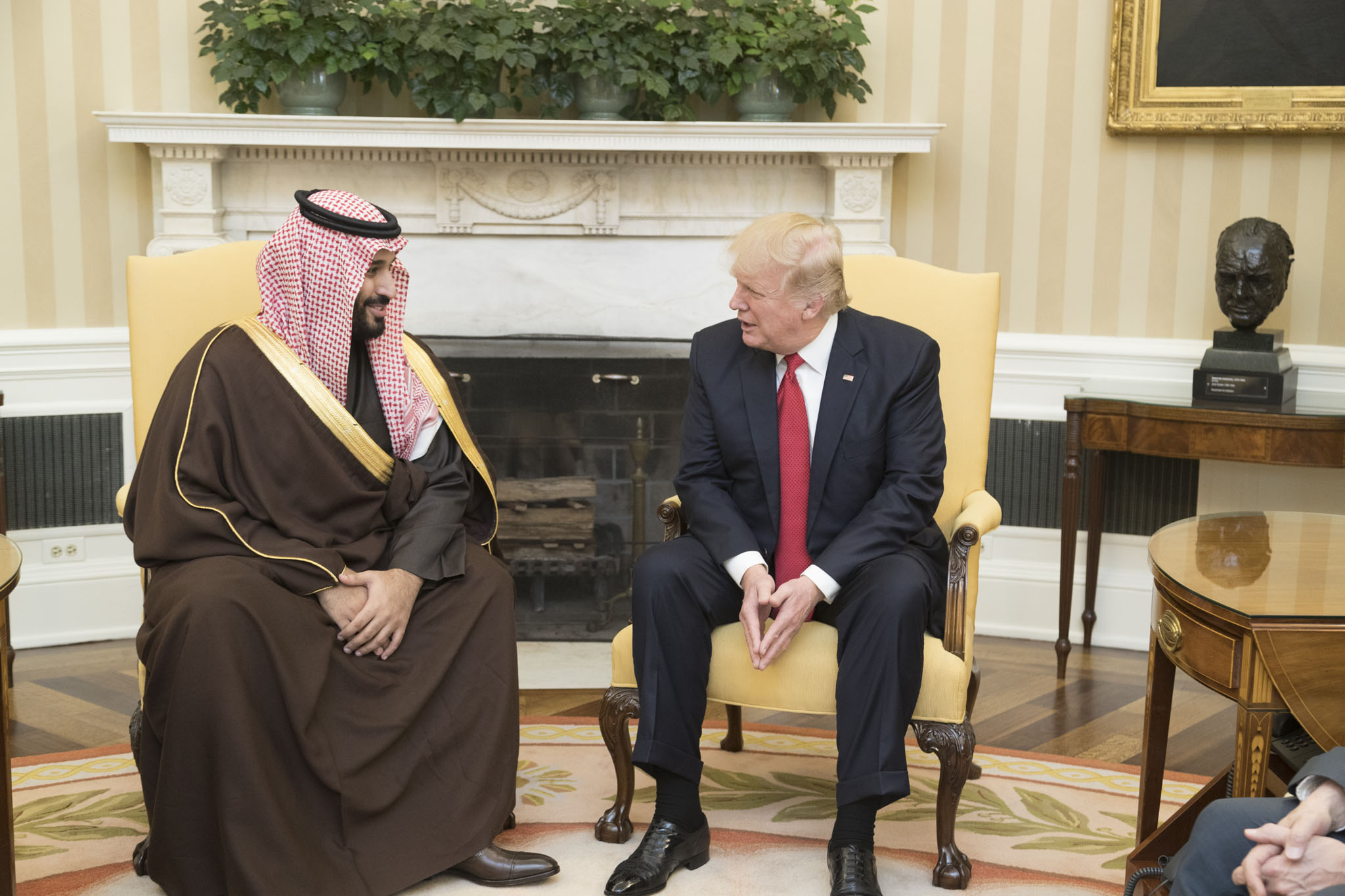
One has to wonder what Trump is thinking as he pals around with America’s frenemies. And in that context, one cannot help thinking that it is very unfortunate that the president relies on advice from the likes of Steve Witkoff, Jared Kushner, and Tom Barrack, all of whom have blatant conflicts of interest because of their business dealings with Qatar. Are there no folks in all of America who are savvy and not conflicted who could do their jobs? Has Trump himself been blinded by the business deals, mainly in the form of arms sales, that will create jobs in America?
One often hears that diplomacy is complicated, that things are not always what they appear to be, that the moves one is seeing are part of 3D chess that only the players themselves understand. But perhaps it’s not that complicated after all, and the only reason that it appears to be is because of a lack of clarity of vision, muddied by competing and conflicted players.
It is understandable that President Trump wants to add more signatories to the Abraham Accords…. But America, too, should be able to wait.
What is clear is that Saudi Arabia has now dropped its mask. America may be surprised by what is underneath, but Israel will not be. Whenever Israel has made overtures of normalization with Saudi Arabia, unlike the present signatories of the Abraham Accords, the kingdom has consistently raised the establishment of a Palestinian state as a precursor. For Israel, especially now after the Oct. 7 terrorist invasion from Gaza, the idea of a Palestinian terror state right next to its major population centers is a non-starter. And that is why Netanyahu’s response to that precondition has consistently been, no hurry, that’s too much of a price to pay, we can wait.
It is understandable that President Trump wants to add more signatories to the Abraham Accords, the most significant foreign affairs accomplishment of his first term. But America, too, should be able to wait. And if America and Israel can help the protestors bring down the mullahs in Iran, and if Reza Pahlavi becomes the new Iranian leader and normalizes relationships with Israel — and ostensibly also with America — that would be a much bigger feather in the president’s cap, and would lead to much greater regional stabilization.
Now that Saudi Arabia has unmasked itself, America would do well to do a little unmasking of her own and clear the air of some of the strategic ambiguity that has so often worked against her. At the end of the day, all of America’s so-called allies in the Middle East need it more than it needs them. America could do some testing of its frenemies’ friendship by asking for the extradition of the terrorists who have murdered Americans that Qatar and Turkey are openly harboring. As leverage, the U.S. could threaten to cancel arms sales to these nations as well as to Saudi Arabia, and also threaten to move America’s major military bases out of Qatar and Turkey.
America’s weakness diplomatically has always been too much carrot and not enough stick. Saudi Arabia’s unmasking herself offers an excellent opportunity to balance that equation.
READ MORE from Max Dublin:

![Donald Trump Slams Chicago Leaders After Train Attack Leaves Woman Critically Burned [WATCH]](https://www.right2024.com/wp-content/uploads/2025/11/Trump-Torches-Powell-at-Investment-Forum-Presses-Scott-Bessent-to-350x250.jpg)


![Two Dead, 14 Injured After Gunfire Erupts Following College Football Game in Alabama [WATCH]](https://www.right2024.com/wp-content/uploads/2025/10/Two-Dead-14-Injured-After-Gunfire-Erupts-Following-College-Football-350x250.jpg)