SACRAMENTO, Calif. — There’s nothing intrinsically wrong — and a lot that’s right — about building a high-speed rail system that speedily transports people across vast tracts of land. Some family members recently returned from a trip to Japan, where they traveled the country on the Shinkansen network of bullet trains. Begun in 1964, the system is widely admired for its efficiency, safety, and speed. One can travel the 313 miles between Tokyo and Osaka in two hours and 22 minutes — slower than an airplane, but it’s quicker when one considers all the time wasted at airports.
Every transportation system has its pros and cons and its costs and benefits. Taxpayers funded the development of the Japanese network, but the high-speed trains run without direct taxpayer subsidies. Some transportation experts critique the bullet train concept and financials, arguing that airplane travel is the superior technology. As California struggles to build its own high-speed rail system, I’ve often argued that the state already has a similar system, known as Southwest Airlines. It inexpensively connects Sacramento to Los Angeles in about one hour and 30 minutes.
Nevertheless, I can’t blame California officials for embracing the concept given the size of the state, the huge population in our metro areas, and the vast, empty spaces between them. But — and it’s a big caveat — there never was any reason to believe that California could expeditiously and cost-effectively build high-speed rail whatever ones views of the bullet train’s merits. Between our overlapping and litigation-inducing environmental rules, bureaucratic and profligate state government, and union-controlled contracting procedures, we really just can’t build anything efficiently.
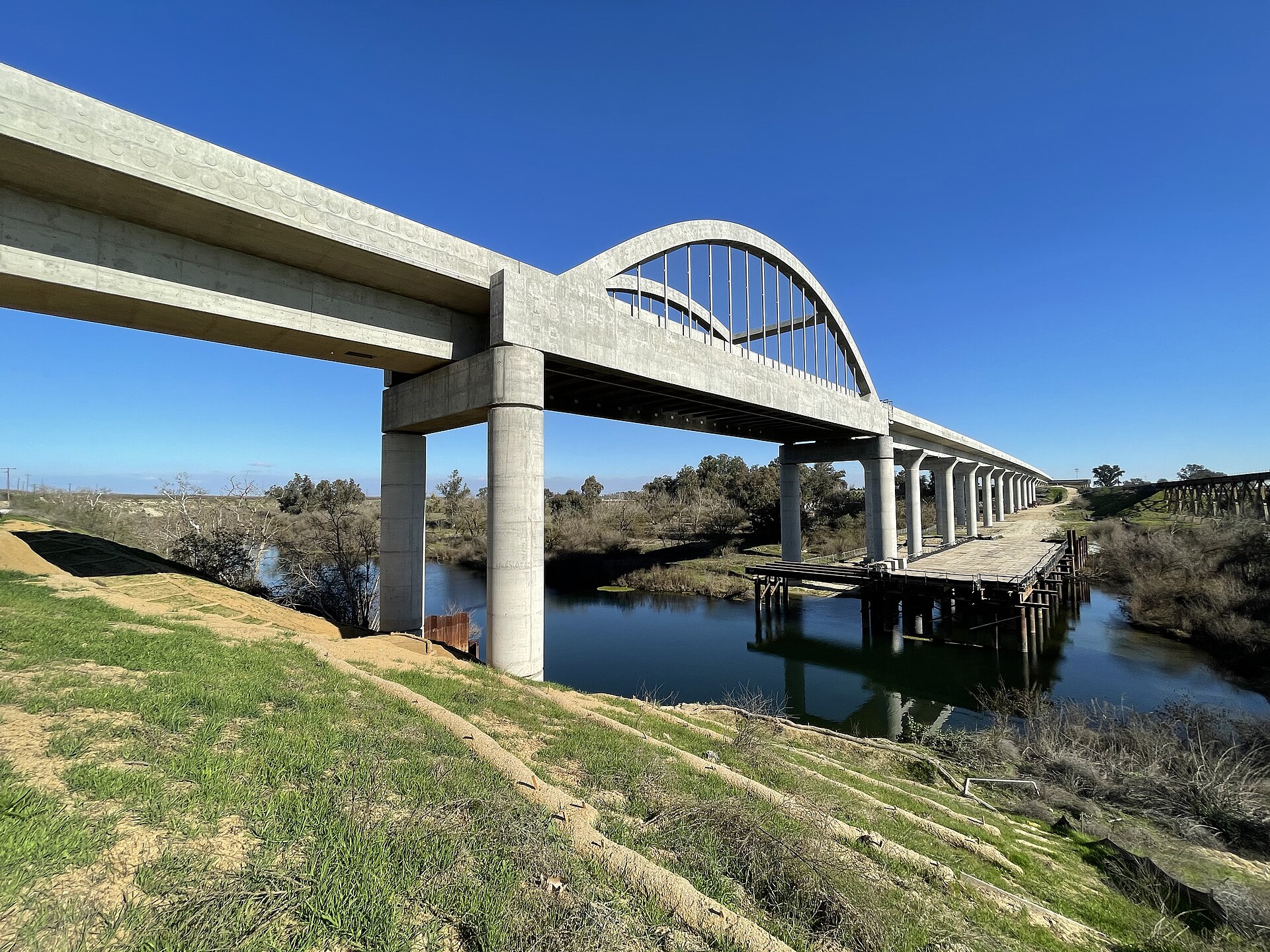
Now fast forward to this week, when Gov. Gavin Newsom touted California’s high-speed rail system during a trip to the Central Valley. His appearance in Bakersfield and the economic-development points he emphasized say a lot about the fundamental problems with the project. “This is about reimagining the future of this region, one of the fastest and most dynamic regions, fastest growing in the state of California. These are real jobs with family-sustaining wages,” he said.
The entire premise of the rail line was to quickly connect the Bay Area to Southern California. Yet thanks to politics and cost factors, the alignment started instead in the inland agricultural region, with the current plan to connect the small cities of Merced and Bakersfield. That conforms to former San Francisco Mayor Willie Brown’s cynical explanation of how to get a massive infrastructure project going (“Start digging a hole and make it so big, there’s no alternative to coming up with the money to fill it in.”) But it’s not the ideal place to lay track if you’re trying to connect San Francisco with Los Angeles.
Furthermore, the goal of this project has never been primarily about economic development. The funding — originally estimated at $33 billion and now around $130 billion — comes from taxpayers. Sure, if you dump public dollars into a giant infrastructure project, you’ll get some jobs, but it’s not creating wealth so much as spending it. The rail authority has touted all sorts of new plans, including a new promise to lure private investors and talk about shifting the northern alignment closer to the coast. But excuse my lack of confidence that these new promises will pan out any better than the last round of them. The feds wisely pulled funding, but the state doubled down and agreed to pay $20 billion more over 20 years. We’ll just keep filling in that hole.
In 2008, California voters approved $9.95 billion in initial funding for the rail system with Proposition 1A. The initiative contained a variety of promises: no operating subsidies, two-hour-and-30-minute travel times from the Bay to LA, private investment, specific deadlines, and so forth. The ongoing plan repeatedly strayed from those promises, but the courts let it move forward anyway. The governor touted the completion of rail preparation on the starter segment, so that will just encourage the state to stay the course.
To save money, the rail authority in 2014 adopted a blended route that required the system to ultimately share tracks with commuter trains in metro areas. That prompted Sen. Quentin Kopp, a strong initial backer of the project, to say: “I want to kill this iteration of it because it betrays the representations to the voters in November 2008.” The blended routes undermined the promised travel times because the trains would have to move slowly along commuter tracks. It’s been one disappointment after another, all followed up with new, empty promises by the HSR bitter-enders.
Fundamentally, the problem is it’s a project designed by government planners rather than the private sector. The largely privately funded Brightline West bullet train that will connect the LA area with Las Vegas in around two hours has had its own shares of delays and cost overruns — but it at least provides a service that many people want. Taking a party train from Rancho Cucamonga to the Strip in half the time of a grueling drive through the desert is far more appealing than parking in Merced, then hopping on a train to a parking lot in Bakersfield.
So again, there’s nothing necessarily wrong with the technology itself. But there is a lot wrong with the California state government. Until we fix the latter, don’t expect much progress on the former.
Steven Greenhut is Western region director for the R Street Institute. Write to him at [email protected].
READ MORE:
Overdose Drops: More Policy and Less Politics






![Donald Trump Slams Chicago Leaders After Train Attack Leaves Woman Critically Burned [WATCH]](https://www.right2024.com/wp-content/uploads/2025/11/Trump-Torches-Powell-at-Investment-Forum-Presses-Scott-Bessent-to-350x250.jpg)

![Two Dead, 14 Injured After Gunfire Erupts Following College Football Game in Alabama [WATCH]](https://www.right2024.com/wp-content/uploads/2025/10/Two-Dead-14-Injured-After-Gunfire-Erupts-Following-College-Football-350x250.jpg)