President Trump campaigned on an “America First” foreign policy, vowing that the U.S. would no longer serve as the world’s policeman, entangled in unaffordable forever wars.
Yet he has unleashed America’s military might time and again.
Since the year began, Mr. Trump dispatched U.S. forces to Venezuela to capture the country’s leader, carried out a military operation in Ecuador to combat narco terrorists, and in the most expansive use of the military of his presidency, launched a joint attack with Israel on Iran to destroy its missile capabilities and leadership.
Those moves taken over the past two months follow Mr. Trump’s heavy use of the military last year, ordering strikes in eight separate nations, including Somalia, Yemen, Syria and Iran.
He also has had the military carry out nearly four dozen strikes on boats allegedly smuggling illicit drugs into the U.S.
In each of these operations, Mr. Trump offered two distinct rationales: a moral responsibility to uphold freedom and democracy around the world, or locking up bad guys such as Venezuela’s former president Nicolas Maduro, who is now awaiting drug trafficking charges in New York City.
SEE ALSO: Trump says there will be no deal with Iran except ‘unconditional surrender’
Foreign policy analysts say those explanations underscore that the U.S. is now the world’s policeman, something Mr. Trump has insisted should not be the nation’s role.
“Under Trump, the U.S. has become a more robust world policeman, not less of one,” said Brandan P. Buck, a research fellow in foreign policy at the Cato Institute. “Trump has expanded military capacity in Latin America, an extended air campaign in Iran and remilitarized the war on drugs in a way that is more vigorous than his predecessors.”
Others dispute that Mr. Trump’s overarching goal is to make bad actors around the globe follow the law. They say each military action is aimed at protecting the nation from a specific threat.
For example, Mr. Maduro was accused of trafficking drugs into the U.S., while Iran was engaged in its decades-long pattern of threatening Israel and America’s interests in the Middle East.
“If you look at all of the steps that have been taken, they’re tied to hard U.S. interests, not just the nice idea of stopping bad stuff,” said Steven Bucci, a visiting fellow who studies military special operations at the Heritage Foundation. “The president has identified specific threats to the U.S. and [is] removing them.”
The flurry of actions have made Mr. Trump’s MAGA base uneasy. Some of his most loyal media backers have been critical of the move, saying the president betrayed his promise to keep the U.S. out of foreign entanglements.
Among his fiercest loyalists-turned-critics are media personalities Tucker Carlson, Megyn Kelly and Matt Walsh, as well as former GOP Rep. Majorie Taylor Greene of Georgia.
Ms. Greene, on Friday, publicly supported Mr. Carlson after the president blasted the conservative commentator over his criticism of the Iran war. She said Mr. Carlson would beat Mr. Trump if they squared off in a presidential race.
“Trump doesn’t even know what MAGA is anymore and turned it into MIGA [Make Iran Great Again],” she wrote on X. “Trump is not America First, he’s donor first.”
Mr. Carlson called the war “absolutely disgusting and evil,” while Ms. Kelly said she needs to be convinced the war is “worth the sacrifice of American blood treasure.”
The president said last week that he doesn’t believe the views of Mr. Carlson and Ms. Kelly are shared by his base.
“I think MAGA is Trump,” he said. “MAGA is not the other two.”
Many of those supporters were already frustrated with Mr. Trump’s Venezuela operation, but became more critical after the Iran attacks and the president’s acknowledgement that the Middle East conflict could last longer than he had bargained for.
“I think the America First movement, as encapsulated by the president, died on [Feb. 28],” Mr. Buck said, noting the first wave of attacks on Iran. “It was on life support for a while but when the stated reason by Secretary of State [Marco] Rubio was acting for the benefit of Israel, it’s pretty hard to [unring] that bell.”
The White House has offered varying explanations for the attack on Iran and what the U.S. ultimately hopes to achieve with its mission.
After the first wave of strikes, Mr. Trump said there was an “imminent threat” to the U.S. and the operation was necessary to disrupt a preemptive attack by Iran on U.S. forces in the region.
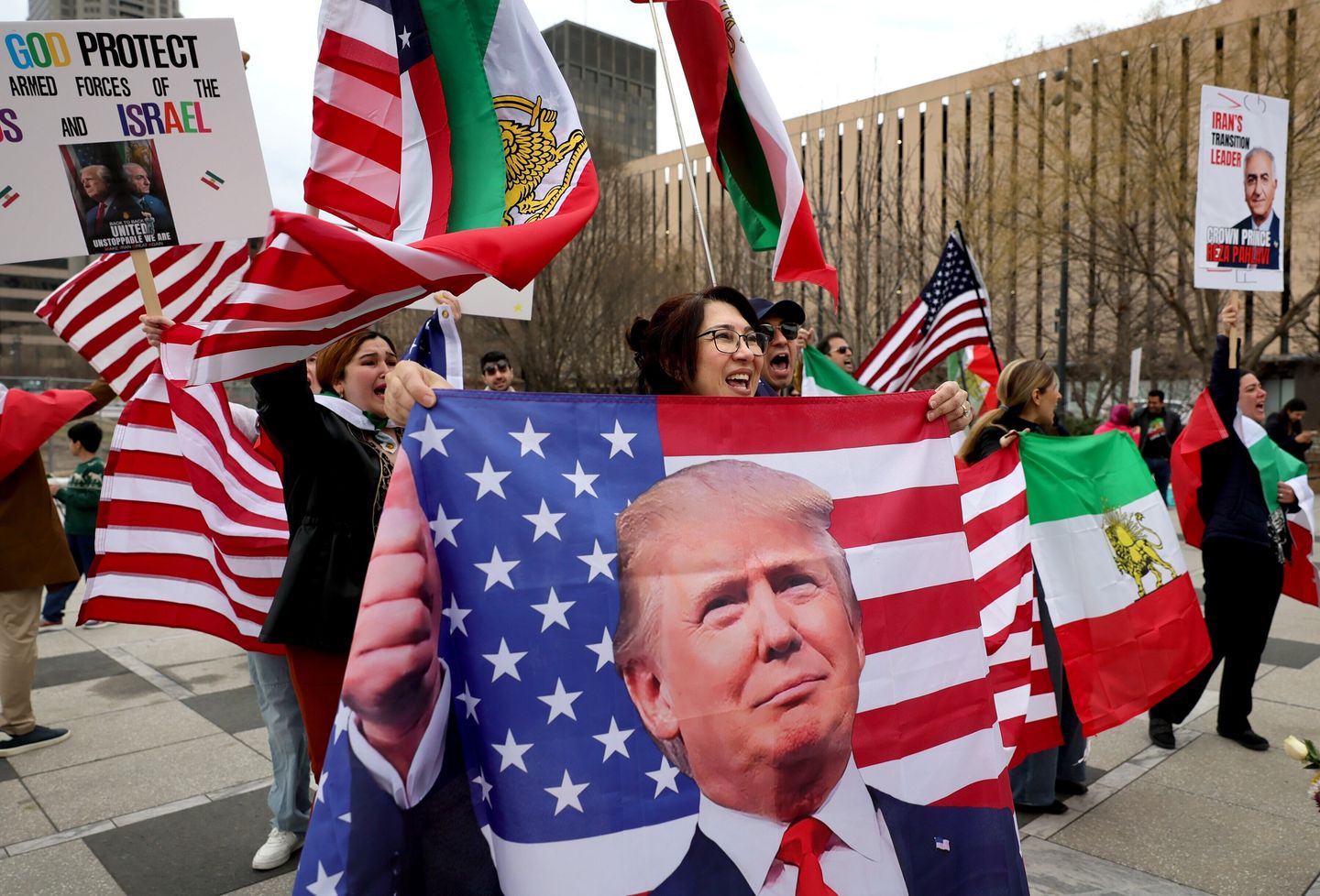
But the rationale shifted to preventing Iran from reviving its nuclear program, to demolishing a regime that’s backed terrorists killing Americans for decades. Mr. Trump even cited protecting the Iranian demonstrators who protested against the regime in January.
“Everyone feels we really had no choice. They were going to hit us before we hit them,” Mr. Trump said at the White House on Thursday. “In the long term, the actions we are taking will dramatically increase the stability of the region, oil prices, stock markets and everything else.”
Peter Doran, an adjunct researcher with the Foundation for Defense of Democracies, said that regardless of the reasoning, the mission is clearly in line with protecting American interests rather than acting as the world’s policeman.
“I don’t see this as the U.S. acting as the world’s policeman. If anything, President Trump is staying true to his initial statement at the inauguration, ’The Golden Age of America will be judged not only by the wars we win, but the wars we stop.’ And he’s very clearly aiming to end the clerical regime in Iran’s 47-year war against America.”
Mr. Buck sees it differently, describing taking preemptive action in Iran as the police “arresting someone before a crime has been committed.”
In Venezuela and Ecuador, however, the mission is more clearly defined: the elimination of drug cartels and curbing the number of illicit substances coming into the U.S. Although American troops didn’t directly participate in the raids, they advised and supported Ecuadorian troops against the drug cartel.
Since early September, the U.S. has killed at least 150 people in 44 known strikes against boats in the Caribbean and Eastern Pacific. The Trump administration has said those boats were carrying drugs to U.S. shores, though it has provided little evidence of that.
All the moves in Latin America blur the lines between a military action and a law enforcement one. The U.S. has a legitimate interest in preventing drug trafficking into borders, but Mr. Trump is using the military to carry out what has traditionally been a law enforcement matter.
Under international human rights standards established by the United Nations, only law enforcement officials can deliberately use lethal force when unavoidable to protect lives.
“On the drug war alone, the U.S. had long used military power, but that had always been in a support role for our law enforcement officials,” Mr. Buck said.
But Mr. Bucci says the actions against the cartels fall squarely into the category of protecting the U.S. from international threats. He noted that both Israel and Russia have economic and military ties with Venezuela that pose a threat to Americans.
“Russia, Hezbollah, all these folks were using Venezuela in ways that are a direct threat to the United States. You don’t use the police to address a national threat like that, you address it with the military,” he said.
Mr. Trump isn’t the first U.S president to caution against America serving as a global police officer, only to turn around and deploy the military as a necessary move to stop bad guys. President Obama ordered military strikes in Libya as a “humanitarian intervention,” saying he hoped to prevent Libyan dictator Muammar Qaddafi from massacring his own people.
The 2011 mission faced similar criticism to Mr. Trump’s attack on Iran, with opposing lawmakers saying the mission lacked a clear objective or exit strategy. The stated goal of preventing human rights violations would be impossible to quantify.
But Mr. Doran cautions that with Mr. Obama, the moves were more one-off military interventions, whereas Mr. Trump’s actions point to an overarching strategy that will cause U.S. adversaries to fall like dominoes.
Mr. Trump has already suggested that Cuba is next in his crosshairs, describing the regime as ready to fall, but noting that it could be a “friendly takeover.”
“By denying the Cuban regime oil from Venezuela, we have the opportunity, similar to Iran, to allow the Cuban people the time and space to throw off the brutal shackles they’ve lived under for decades,” Mr. Doran said.
• Mallory Wilson contributed to this story.






![Donald Trump Slams Chicago Leaders After Train Attack Leaves Woman Critically Burned [WATCH]](https://www.right2024.com/wp-content/uploads/2025/11/Trump-Torches-Powell-at-Investment-Forum-Presses-Scott-Bessent-to-350x250.jpg)
![James Carville Admits Democrats Had No Shutdown Endgame, Mishandled Strategy [WATCH]](https://www.right2024.com/wp-content/uploads/2025/11/1763070634_James-Carville-Admits-Democrats-Had-No-Shutdown-Endgame-Mishandled-Strategy-350x250.jpg)