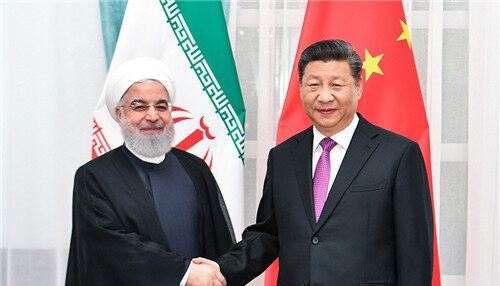
In an interview with The Free Press, Israeli analyst Haviv Rettig Gur argues that the U.S.–Iran war should not be understood primarily as a conflict driven by Israeli interests. Instead, he frames it as a geopolitical confrontation rooted in the growing strategic alliance between Iran and China.
Gur’s central claim is that Iran has increasingly positioned itself as a critical Chinese partner in the Middle East, giving Beijing leverage over global energy markets and American military power. Over the past several years, he explains, Iran has become “probably the most important Chinese ally in the Middle East,” serving as both an energy supplier and a potential military asset for China in the event of a larger conflict with the United States.
Iran’s geographic position makes this partnership particularly dangerous from Washington’s perspective. Located near the Strait of Hormuz — one of the most important energy chokepoints in the world — Iran could disrupt global oil flows in a crisis. As Gur puts it, Tehran now represents a Chinese-backed capability to “cut off … 25 percent of the world’s oil supply at will.” In addition, Chinese missile technology has strengthened Iran’s ability to threaten U.S. naval forces operating in the Persian Gulf.
Whether the United States admits it openly or not, the war with Iran is ultimately driven by American national security concerns.
Energy is another key pillar of the relationship. Gur notes that roughly 90 percent of Iranian oil exports now go to China, allowing Beijing to build a massive strategic reserve designed to protect its economy during wartime. China has used this cheap oil to accumulate a “1.2 billion barrel strategic oil reserve … enough to hold China afloat … for almost 100 days” if the United States attempted to block its supply routes.
For American strategists concerned about China’s long-term ambitions, this arrangement presents a major vulnerability. Gur argues that Iran effectively functions as a second front in a potential U.S.–China conflict. Just as Hezbollah serves as Iran’s proxy threat against Israel, Iran itself could serve as China’s proxy threat against the United States. In his words, “If America has a war in the South China Sea, Iran will open up a front in the Indian Ocean.”
From that perspective, neutralizing Iran becomes a prerequisite for confronting China. “You cannot be ready in the South China Sea … if you don’t have Iran neutralized as a threat to the American supply lines,” Gur says.
The interview also addresses the claim — popular on social media — that Israel manipulated the United States into fighting its war. Gur strongly rejects that narrative. Instead, he argues that Israel functions as a valuable regional partner that lowers the cost and risk of military action. Israel provides intelligence, absorbs retaliation, and conducts operations that allow Washington to maintain some distance from the conflict.
“Israel is doing something very different from dragging America to war,” he explains. Rather, it acts as a “cost-lowering local ally that makes a war like this a lot easier … a lot less costly and … more effective.”
Still, Gur cautions that American and Israeli interests will not always perfectly align. Washington’s ultimate goal may simply be to weaken Iran’s strategic alliance with China, while Israel may seek a more decisive defeat of the regime itself. But for now, the two countries share overlapping interests.
As Gur concludes, those who claim Israel “wagged the dog” misunderstand both American strategy and global geopolitics. The conflict with Iran, he argues, reflects a much larger contest between the United States and China over the future balance of power in the international system.
Gur says that the Trump administration is unlikely to openly say the war with Iran is partly about China because doing so would be strategically reckless. Publicly framing the conflict as part of a broader confrontation with Beijing would risk provoking a direct Chinese response and escalating tensions between the world’s two superpowers. As Gur explains, it would be “incredibly foolish to tell a superpower adversary, this is part of my war against you,” since successful strategy often requires giving opponents room to step back rather than forcing them to retaliate.
In other words, openly declaring the China dimension would remove that diplomatic escape hatch. Instead, the administration emphasizes more immediate justifications — such as Iran’s threats to U.S. forces and regional stability — while the deeper geopolitical logic remains largely unstated.
Whether the United States admits it openly or not, the war with Iran is ultimately driven by American national security concerns — especially its strategic competition with the world’s second-most powerful nation, China.
READ MORE from Tyler Rowley:
Michael Knowles: Coalitions Over Policy
How Thomas Sowell Changed Coleman Hughes’s Mind About Human Nature
The Right’s Nick Fuentes Problem — and Tucker Carlson’s Role in Mainstreaming It





![Donald Trump Slams Chicago Leaders After Train Attack Leaves Woman Critically Burned [WATCH]](https://www.right2024.com/wp-content/uploads/2025/11/Trump-Torches-Powell-at-Investment-Forum-Presses-Scott-Bessent-to-350x250.jpg)



![Kamala Comes Unglued, Makes Bogus Claim About Her Landslide Loss to Trump [WATCH]](https://www.right2024.com/wp-content/uploads/2025/10/Kamala-Comes-Unglued-Makes-Bogus-Claim-About-Her-Landslide-Loss-350x250.jpg)