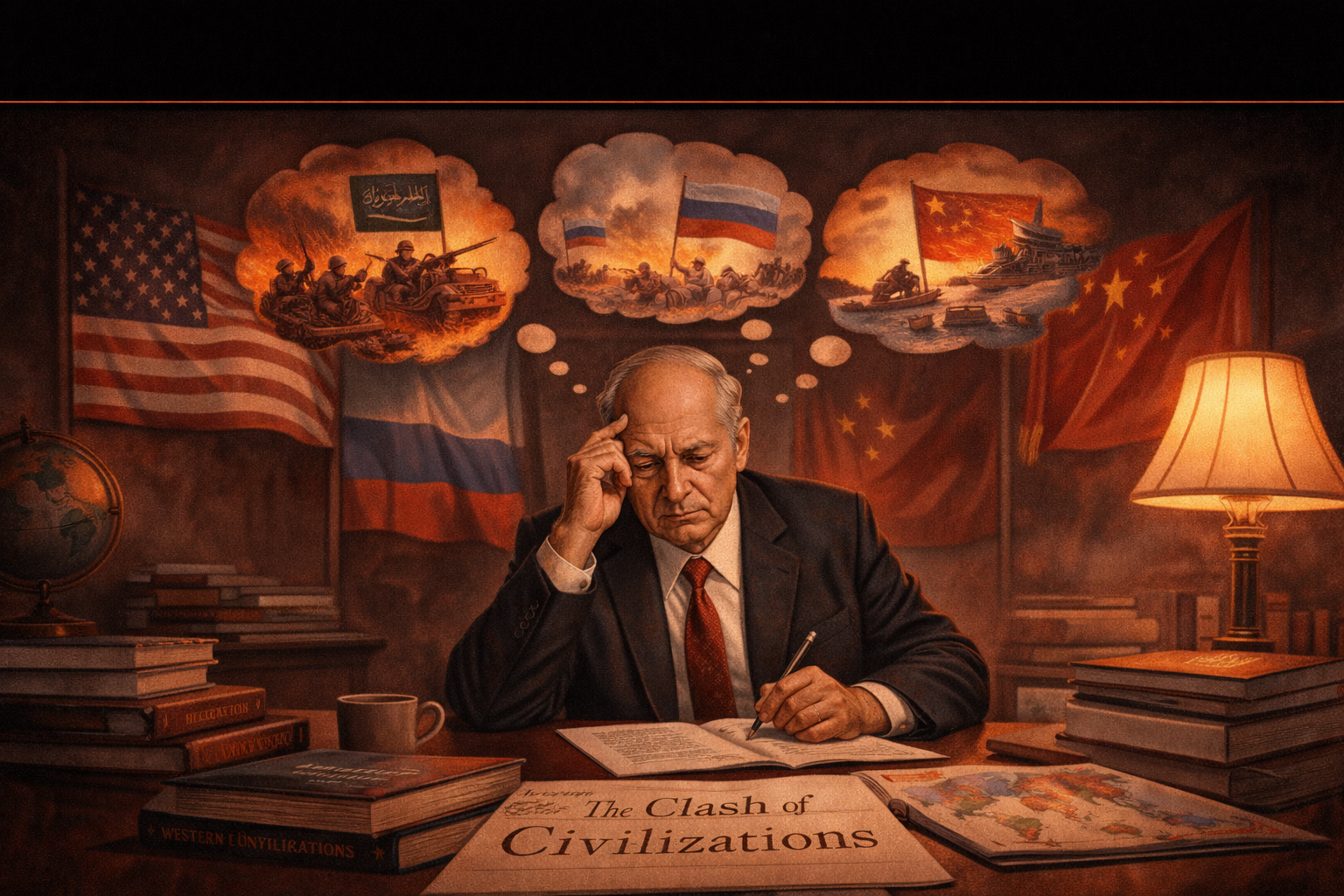
Thirty years ago, Harvard Professor Samuel Huntington (who died in 2008) wrote The Clash of Civilizations and the Remaking of World Order, which accurately predicted the trajectory of the post-Cold War world order. It would be dominated, he wrote, by a clash of civilizations, a clash of cultures. Huntington’s book echoed Arnold Toynbee’s A Study of History and James Burnham’s Suicide of the West. Huntington foresaw an Islamic resurgence, the rise of China, and the relative decline of the West. He even envisioned trouble between Russia and Ukraine.
Huntington’s book was a welcome rejoinder to Francis Fukuyama’s influential 1992 book The End of History and the Last Man. Fukuyama wrote that the end of the Cold War was ushering in the world-wide triumph of Western-style liberal democracy. Western leaders and observers, especially in the United States, spoke of a “peace dividend,” a “new world order,” and America’s “unipolar moment.” Our victory in the Cold War resulted for some in the U.S. and the West an unbounded hubris, which led, as it usually does, to nemesis. We expanded NATO right up to the borders of Russia. We treated Communist China as a member in good standing of the “rules-based international order.” And we met the challenge of the Islamic resurgence that Huntington predicted with a Wilsonian program to transform Islamic regimes into democracies.
Had more of our leaders read Huntington, we might have prudently limited NATO expansion, cast a more wary eye on a rising China, avoided the “endless wars” in Iraq and Afghanistan, and established better relations with post-Cold War Russia. He foresaw the trouble Muslim migration would cause Europe and predicted that immigration would become a major political issue in the United States, especially at our southern border with Mexico. He noted that the Islamic resurgence was moving in an “anti-Western direction.” He wrote that what he called “Greater China” was a “rapidly growing cultural and economic reality” that would likely become a political reality, too. He explained that Russia would never accept a Ukraine tied to the West and even suggested that Ukraine might be split with Crimea and a portion of eastern Ukraine gravitating toward Russia while western Ukraine increased its ties to western and central Europe.
The challenges of Islam, China, and … Russia, Huntington wrote, might emerge at a time when “multiculturalists” … were undermining the very concept of Western civilization.
For Huntington, the U.S.-China rivalry was more cultural, more civilizational than ideological. “China’s history, culture, traditions, size, economic dynamism, and self-image,” he wrote, “all impel it to assume a hegemonic position in East Asia.” Its leadership, he continued, was converting economic growth into “military power and political influence.”
Huntington worried about the potential for a “Confucian-Islamic” alliance against the United States and other Western powers, suggesting the possibility of a “Tehran-Islamabad-Beijing axis.” He hoped that the United States would play the “Russia card” against China, just as it had played the “China card” against the Soviet Union during the last two decades of the Cold War. A key ingredient in establishing good relations with Russia to counter China, he wrote, would be a commitment by the U.S. and the West to limit NATO expansion to only the “Western Christian states of Central and Eastern Europe,” but no further.
The challenges of Islam, China, and a potentially hostile Russia, Huntington wrote, might emerge at a time when “multiculturalists” in the United States and the West were undermining the very concept of Western civilization. Within the U.S. and nations of Western Europe, he explained, there is an ongoing cultural clash between multiculturalists and the defenders of Western civilization. “The futures of the United States and of the West,” he wrote, “depend upon Americans reaffirming their commitment to Western civilization.”
Huntington wrote all of this in 1996. Thirty years later, the United States is waging war against the Islamic regime in Iran. We are helping Ukraine fight against Russia. And we are in the midst of a cold war with China. The “clash of civilizations” is here.
READ MORE from Francis P. Sempa:
Violence in Mexico: When Cartels and Terrorists Converge
Lepanto’s Legacy: The Fight for Western Survival
American Lives: Frozen Moments, Lasting Sorrow






![Donald Trump Slams Chicago Leaders After Train Attack Leaves Woman Critically Burned [WATCH]](https://www.right2024.com/wp-content/uploads/2025/11/Trump-Torches-Powell-at-Investment-Forum-Presses-Scott-Bessent-to-350x250.jpg)