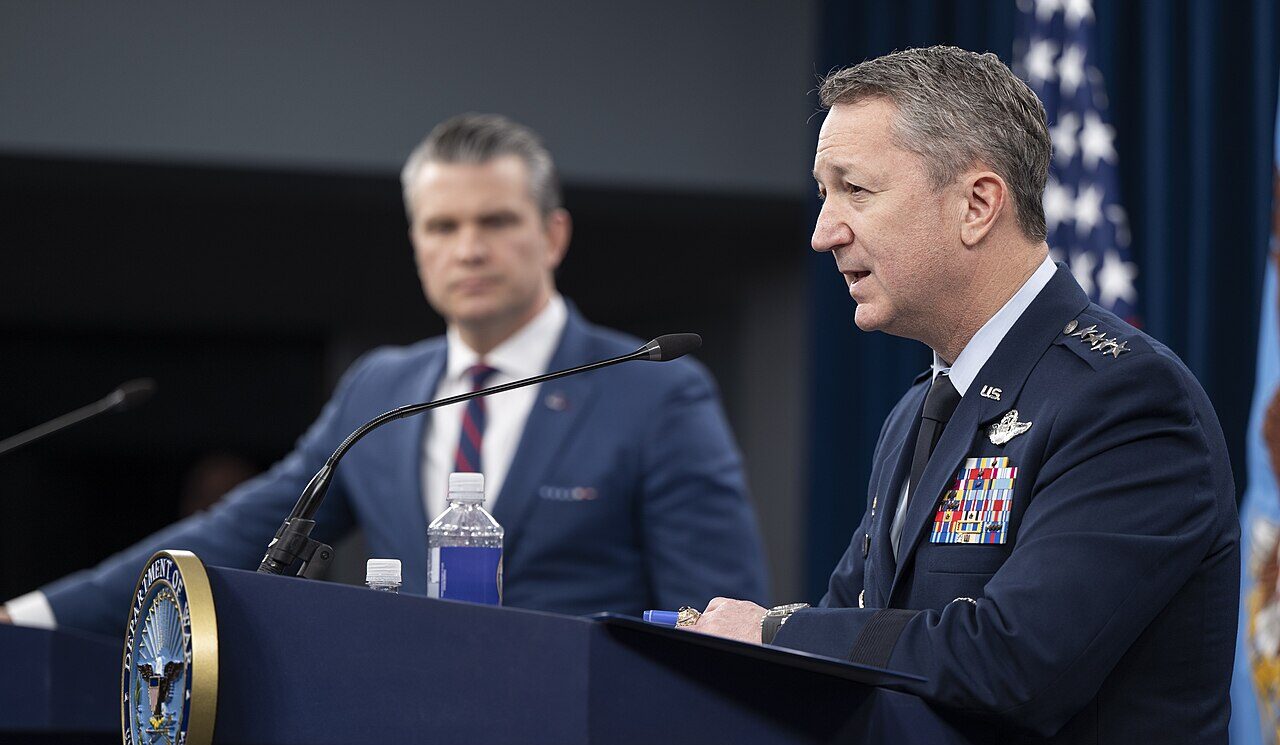
On Monday, President Trump stated that the war with Iran was “very complete, pretty much.” However, since then, the Iranians have shown no desire to negotiate an end to the conflict, have deployed naval mines in the Strait of Hormuz, where 20 percent of the world’s oil passes daily, and have also attacked oil tankers with drones and missiles.
Iran’s navy and air force have been devastated, missile and drone sites and manufacturing assets have been destroyed, and command centers of the Islamic Revolutionary Guard (IRGC), and nuclear and telecommunications infrastructure have been annihilated. Iran’s supreme leader, Ayatollah Ali Khamenei, was killed along with dozens of other senior officials in a decapitation strike by Israel.
While devastated, Iran has absorbed the kinetic fury of the combined militaries of America and Israel, without a willingness to capitulate, making regime change impossible now. The naming of Khamenei’s son, Mojtaba, a hardliner with a rapport with the IRGC, means that the Iranian military and government are committed to resisting. The strategy of the regime appears to be to cause economic pandemonium in world markets and, through retaliatory strikes on numerous Gulf and other Middle East countries, pressure the United States and Israel to desist.
A protracted conflict has unintended consequences: the specter of immediate inflation, volatility of oil and equity prices, upward pressure on the 10-year treasury, chaos in shipping and insurance markets, longer term risk of recession due to business uncertainty, and damage to numerous Gulf and other Middle East states that Iran attacked, which could potentially turn on the U.S. and Israel out of anger.
Preparing the nation for a long conflict that he did not want, Trump should explain that a war with Iran was inevitable, and better now with Operation Epic Fury than later against an even stronger adversary in the future. The president should also identify the objective of paramount importance — destroying Iran’s nuclear assets and conventional military capability to eliminate a threat to the United States, Israel, moderate Arab countries, and Europe.
While the war has been prosecuted with spectacular success by the U.S. and Israeli armed forces, the rationale for it was never clearly communicated.
While the war has been prosecuted with spectacular success by the U.S. and Israeli armed forces, the rationale for it was never clearly communicated. Confusion has prevailed, and the president should seize the opportunity to set the record straight. The initial justification was to destroy nuclear infrastructure; however, last June, Trump emphatically described the result of the joint U.S.-Israeli strikes at Natanz, Fordow, and Isfahan as “obliteration.”
Other objectives were then said to be the destruction of missile and drone inventory, their manufacturing sites, and the Iranian navy, and the decapitation of the leadership of the Islamic Republic to facilitate regime change. Not only that, the White House advised that the president had a “feeling” that an attack by Iran was imminent, necessitating a first strike. Secretary of State Rubio further indicated that Israel had called our hand, leading to speculation that Israel was calling the shots, while President Trump later said that he might have called Israel’s hand. Moreover, Secretary Hegseth said that regime change was not an objective, while the president stated that he wanted to participate in the selection of Ayatollah Ali Khamenei’s successor, while demanding “unconditional surrender.”
Trump should explain to the nation and the world why Iran had it coming. Over the years, three U.S. presidents, European nations, and the International Atomic Energy Agency of Vienna were unable to achieve a diplomatic solution to end Iran’s enrichment of uranium, whose ultimate goal was a nuclear weapon. Through negotiations, Iran bought time to install thousands of centrifuges to achieve near weapons-grade uranium. Contemporaneously, Iran manufactured tens of thousands of cheap drones, as well as roughly 3,000 short and medium-range ballistic missiles, before the Israeli and U.S. strikes of last June. According to an Israeli estimate, 8,000 of these missiles would have been operational by 2027, in addition to numerous land-attack and anti-ship cruise missiles. Iran’s conventional forces and Islamic Revolutionary Guard Corps (IRGC) are massive, with an estimated army of 350,00 and an IRGC force of 150,000. Iran’s objective has been to raise the cost of aggression to act as a deterrent, allowing it to commit nuclear blackmail, similar to Russia in the Ukraine War.
Much has already been written and said about Iran as a belligerent — taking Americans hostage in 1979, blowing up the barracks of the Marines and our embassy in Beirut in 1983, supporting Hamas, Hezbollah, the Houthis, and militias in Iraq and Syria as proxies, planning assassination of American leaders including President Trump, killing and maiming American soldiers, and other provocations against the U.S., Israel and Europe.
Consideration is reportedly being given to engage the Iranian and Iraqi Kurds and Balochis to conduct a ground war against the regime. This would take time to mobilize effectively and pose a serious challenge to the Iranian military, but it could also cause a lengthy civil war driven by ethnic antagonism. The Economist currently estimates an armed force of Iraqi Kurds known as Peshmerga at 200,000 plus several thousand Iranian Kurds. Not only that, for their support and bloodshed, the Kurds and Balochi would demand something in return — more autonomy and recognition. As principally tribal populations, they lack political standing and integration into the mainstream of Iran. The result could be the disintegration of Iran, which also has various Turkic minorities (Azerbaijani, Turkmen, and Qashqai). A largely ungoverned space nearly four times the size of California, descending into tribal conflict is a possibility.
Even with an end to this war, the U.S. and Israel will be involved with Iran indefinitely in some capacity. Overhead platforms will meticulously monitor activity at suspected uranium enrichment sites, and Israel will use its covert means to determine Iranian intent. The U.S. will still need to assure secure passage of the world’s oil in the Gulf. Both countries will maintain their option to strike again. Unless Iran stops fighting and ends other provocations in the region, there will be a quagmire indeed.
READ MORE from Frank Schell:
The Objective Should Be a Secular and Moderate Iran
America’s Robust National Security Strategy
A 50-Year Mortgage Is a Financial Narcotic
Frank Schell is a business strategy consultant and former senior vice president of the First National Bank of Chicago. He was a Lecturer at the Harris School of Public Policy, University of Chicago and is a contributor of opinion pieces to various journals.





![Donald Trump Slams Chicago Leaders After Train Attack Leaves Woman Critically Burned [WATCH]](https://www.right2024.com/wp-content/uploads/2025/11/Trump-Torches-Powell-at-Investment-Forum-Presses-Scott-Bessent-to-350x250.jpg)

![Two Dead, 14 Injured After Gunfire Erupts Following College Football Game in Alabama [WATCH]](https://www.right2024.com/wp-content/uploads/2025/10/Two-Dead-14-Injured-After-Gunfire-Erupts-Following-College-Football-350x250.jpg)