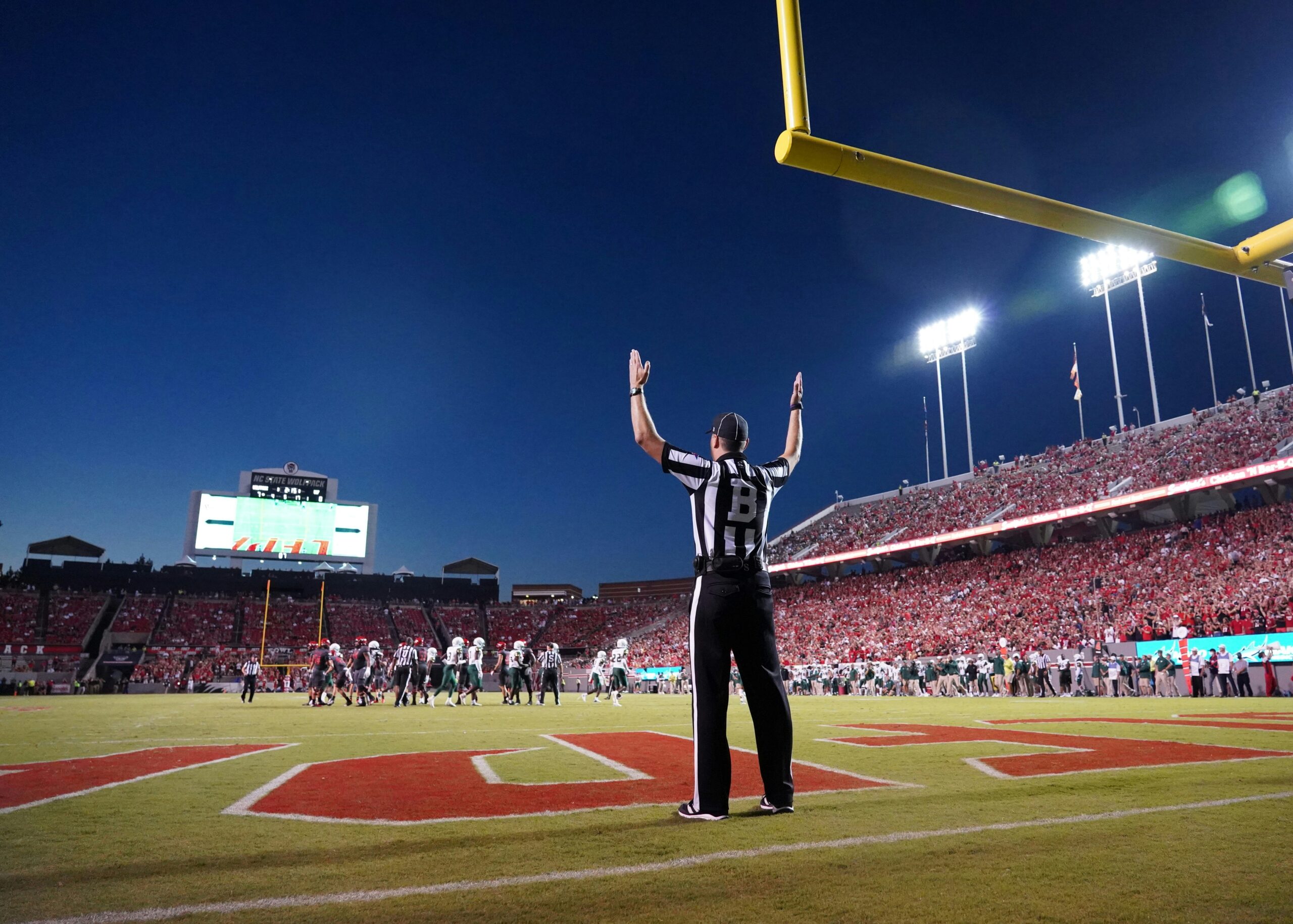
The United States is unique in having universities make the sponsoring of ball throwing and kicking contests a significant part of the campus mission. Now, college intercollegiate athletics programs are facing a financial crisis despite record spectator interest and robust revenues. Even in the best of times, only a handful of big-time university programs operate at a profit, and using honest accounting techniques (for example, providing for the depreciation of facilities like stadiums and gymnasiums), intercollegiate sports at even those schools are probably at least financially moderately burdensome.
At schools with big athletic aspirations but not one of the 67 institutions located in the four power conferences (Southeastern Conference, Big Ten, Atlantic Coast Conference, and the Big 12), intercollegiate sports can be at least a $20 million annual burden on budgets, perhaps $1,000 for every student attending the schools. Yet the universities themselves are facing increasing financial pressures: reduced or stagnant federal funding, more discounting of tuition fees to entice students to enroll, and routine but substantial cost pressures from inflation (like individuals, they have to buy gasoline and electricity). Both Moody’s and Standard and Poor’s issued negative assessments of university finances recently. Moreover, the pool of potential freshmen is starting to fall next fall because of plummeting 21st century fertility rates, foreign student enrollments are down, and even more U.S. students are traveling overseas for their education. There are even some early indications that AI and other innovations may be weakening job prospects for college graduates.
It gets worse. Until a few years ago, the athletic directors and coaches at big-time college programs were financially a bit like the overseers of southern plantations before the Civil War. Like the earlier slaveowners, they paid their workers (players) a small fraction of what they would have received in competitive labor markets. A star quarterback or basketball forward might add $3 million annually to school revenues from the victories he helped achieve, but receive maybe $60,000 in benefits from free tuition, room, and board (I once called it “academic financial child molestation”). The huge income the universities gained from this ultra-cheap labor allowed high pay for coaches. In his last season as a coach, Alabama’s coach Nick Saban made a reported $11.41 million — he made more in a month than the university president (or, for that matter, the U.S. president) did in a year. When Texas A&M wanted to fire football coach Jimbo Fisher, it apparently forked out more than $75 million due under his labor contract.
The revolution in player compensation began this decade with name, image, and likeness (NIL) payments and has recently evolved to include direct cash payments to players costing major colleges $20 million or so annually. Yet, coaches’ pay for the top teams still is in the millions annually, even for offensive and defensive coordinators as well as the head coach. (RELATED: Figures Flip the Field)
The top athletic conferences have expanded geographically — the Big Ten, for example, has schools within a few miles of both the Atlantic and Pacific Oceans, along with many schools in its original Midwestern base. But that raises travel costs dramatically. If the UCLA wrestling team needs to play the University of Maryland in College Park, how much does it cost for two transcontinental airplane trips for each player and coach?
When players bounce on an annual basis from team to team and have ever smaller resemblances to students, what does that do for spectator and media interest?
I probably have understated the potential future cost explosion facing college sports. What if uber-woke judges decree that women athletes are underpaid relative to their male counterparts? What if lawsuits start mounting from middle-aged athletes now suffering debilitating injuries associated with earlier football team play? What if the federal government outlaws tax deductions for luxury stadium boxes? And the general college financial woes are accelerating: stagnant enrollments and falling public support might lead to reduced financial assistance from the state and the federal governments. Will schools have to decide whether to buy books for the library or uniforms for the football team?
Moreover, the radical changes in the way major college sports are conducted are becoming disconcerting to many fans and may eventually lead to reduced enthusiasm. When players bounce on an annual basis from team to team (“transfer portal”) and have ever smaller resemblances to students, what does that do for spectator and media interest? Are we going to soon face a financially endangered university selling its name, image, and likeness regarding college football to a private group, along with its stadium, basketball arena, and parking? If billion-dollar payoffs are involved, the prospects of it happening are not at all far-fetched. Some universities may feel they are primarily in the business of creating and disseminating knowledge, and strengthening that main function may be more important than placating some gung-ho alums and politicians craving season tickets.
There are other issues. The NCAA has operated as a form of athletic cartel, and the erosion of that function on antitrust grounds by the courts has unleashed most modern changes. Last week, President Trump gathered a variety of people to discuss the dysfunctionality in college sports and declared he was going to issue a fatwa (or the Trumpian equivalent executive order) that would revolutionize college sports, admitting, however, that it would no doubt face court challenges. The revolution in college sports is probably roughly at halftime. Stay tuned for the second half, as the ultimate outcome is still in doubt. In the meantime, enjoy March Madness, which helps fund much of the collegiate mayhem that the NCAA has helped create.
READ MORE from Richard K. Vedder:
Administering Colleges: 1960s and Today
A Neglected Colonial Era Polymath, Manasseh Cutler
Richard Vedder is Distinguished Professor Emeritus of Economics at Ohio University and Senior Fellow at both Unleash Prosperity and the Independent Institute.






![Donald Trump Slams Chicago Leaders After Train Attack Leaves Woman Critically Burned [WATCH]](https://www.right2024.com/wp-content/uploads/2025/11/Trump-Torches-Powell-at-Investment-Forum-Presses-Scott-Bessent-to-350x250.jpg)

![Kamala Comes Unglued, Makes Bogus Claim About Her Landslide Loss to Trump [WATCH]](https://www.right2024.com/wp-content/uploads/2025/10/Kamala-Comes-Unglued-Makes-Bogus-Claim-About-Her-Landslide-Loss-350x250.jpg)