Sally-Ann Hart is the former MP for Hastings and Rye and a former Rother district councillor.
As a practising Roman Catholic and a Conservative, I am often asked how faith should sit alongside politics. How can someone be both Catholic and Conservative? Is this even a reasonable question? It is certainly one that deserves a serious answer, particularly at a time when religion is increasingly drawn into political conflict, both abroad and at home.
Across the world we can see the consequences of religion being politicised. In Iran, an extreme Islamist theocracy fuses religious authority with state power, suppressing dissent, restricting women’s freedoms and undermining democracy. In Russia, Vladimir Putin has repeatedly invoked the Russian Orthodox Church to lend spiritual legitimacy to his aggression and nationalism. In Afghanistan, the Taliban have used religion to coerce, control and instil fear. None of these examples shine a good light on religion. Instead, they demonstrate what happens when faith is used for extreme political ends, rather than shaping conscience. Faith should not become dogma or used as a political weapon but inform how we exercise power and not be used to legitimise power itself.
Britain’s tradition has been different. Whilst our institutions are not governed by scripture, centuries of Christian thought have profoundly shaped our laws, traditions and social norms. Ideas such as the dignity of the individual, the importance of family life, care for the vulnerable and the moral limits of power all have deep roots in Christian teaching. These are not imposed religious doctrines but principles that have informed our understanding of justice, responsibility and the public interest.
At a time of rapid social change and increasing political division, it is worth remembering why these values remain relevant, especially within Conservative politics.
Throughout my own public life as a solicitor, magistrate, school governor, councillor and Member of Parliament, my faith has never been a party badge or a political slogan. It has been something quieter but more important – a moral compass, my driving force.
Catholicism does not offer a political manifesto. It does not instruct believers how to vote. What it offers instead is a framework for thinking about human fallibility, human dignity, responsibility, and restraint. In that sense it sits naturally alongside the best traditions of British Conservatism. Both recognise that human beings do not flourish in chaos but within an ordered moral framework. Both understand that institutions, though imperfect, carry accumulated wisdom and provide stability across generations. Both recognise that compassion cannot endure without order and that rights must be balanced by responsibilities.
Modern politics often presents a false choice between rules and compassion, as though law and kindness were somehow incompatible. Catholic teaching rejects that. Rules are not the enemy of compassion but the recognition of human fallibility. Without law the weak suffer first. Without boundaries, power accrues to the loudest, the strongest or the most ruthless.
This balance is particularly visible in debates around immigration. Catholic teaching emphasises the dignity of every human person, including those fleeing poverty, persecution or conflict. But it also recognises the legitimacy of borders, the rule of law and the need for democratic consent. A system without rules is not compassionate. It is dysfunctional, and dysfunction harms the most vulnerable first, migrants and host communities alike. Catholics are used to holding these truths together. Conservatism, at its best, seeks to do the same.
Another similarity lies in our understanding of institutions. Catholicism is deeply institutional, believing in tradition, continuity and authority passed down through generations. This makes Catholics nervous about anything that might corrupt institutions from the inside or cause the whole system to collapse. Current populist politics attacks institutions as inherently corrupt or illegitimate. Theocratic politics, by contrast, seeks to capture them in the name of divine authority. Both paths are dangerous. Conservatives choose a different path, of reform rather than destruction, stewardship rather than domination, and authority exercised as service rather than theatrics.
Anger and hatred have sadly become a powerful force in modern politics. Reform UK and the Green Party thrive on grievance and division, drawing sharp distinctions between “the people” and “the system”, or between insiders and outsiders. Catholic moral teaching approaches such politics with caution. Whilst hatred can never be justified, anger can sometimes be – but it must be disciplined by reason, caution and responsibility. Politics driven primarily by grievance rarely produces stable outcomes.
Catholicism is conservative in the truest sense of the word. It seeks to preserve moral boundaries, the wisdom of tradition, and the understanding that not everything we can do is something we should do. Catholicism does not seek to impose belief by force or collapse the distinction between Church and state. Christianity is a moral tradition rooted in humility, responsibility and service, not politics. Faith loses its integrity when it becomes an instrument of the state, and politics loses legitimacy when it claims divine sanction. Faith in public life should elevate political debate rather than inflame it. It should encourage leaders to exercise power with conscience and restraint and remind us that politics exists to serve the public.
Catholic social teaching speaks to many current challenges. Its emphasis on subsidiarity – the principle that decisions should be taken as close as possible to those affected – reinforces the importance of local communities and civil society. Its understanding of stewardship is in line with the Conservative instinct to care for the environment and the resources we pass on to future generations. Its recognition of human dignity underpins the belief that every individual deserves opportunity, respect and protection under the law. These principles help guide political judgment rather than dictate policy.
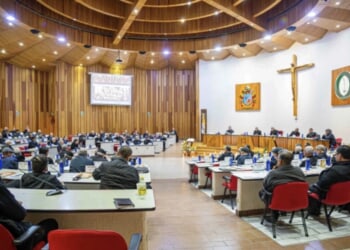
I was recently elected President of Catholics in the Conservative Party, a group that encourages Catholics to engage thoughtfully in political life and public policy. Its purpose is not to campaign for specific outcomes, but to reflect on how Catholic social teaching – human dignity, subsidiarity, solidarity and the importance of family and community – can inform Conservative thinking. It also provides a space to consider public service as a vocation rooted in responsibility and charity, not power, and to consider the moral foundations of politics in today’s increasingly divisive culture.
Part of that task is rebuilding confidence among Catholic Conservatives that their faith-informed perspective has a legitimate place in political discussion. It also means reaffirming principles that lie at the heart of both Catholic social teaching and the best traditions of Conservatism – the inherent dignity of every person, the importance of family life, and the understanding that strong communities depend not only on government but on the institutions, relationships and responsibilities that exist between individuals and the state. Encouraging the next generation of Catholics to consider public service, whether in politics or the voluntary sector, will be equally important if these values are to continue shaping the character of our national life.
The balance between faith and politics is worth preserving. Voters need to understand not only what political parties propose to do, but why. Policies will evolve in response to changing circumstances, values should not.
At a time of growing division in politics, Catholicism offers a steady focus on responsibility, freedom and the common good. If these values continue to shape public life, our politics will be stronger for it.


![Donald Trump Slams Chicago Leaders After Train Attack Leaves Woman Critically Burned [WATCH]](https://www.right2024.com/wp-content/uploads/2025/11/Trump-Torches-Powell-at-Investment-Forum-Presses-Scott-Bessent-to-350x250.jpg)



![Two Dead, 14 Injured After Gunfire Erupts Following College Football Game in Alabama [WATCH]](https://www.right2024.com/wp-content/uploads/2025/10/Two-Dead-14-Injured-After-Gunfire-Erupts-Following-College-Football-350x250.jpg)