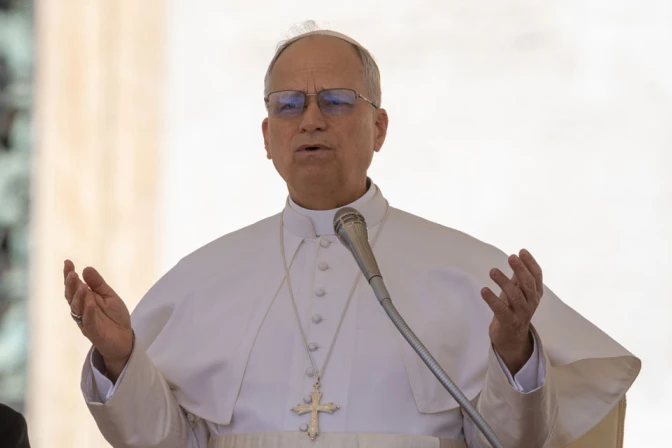
Questions about whether Pope Leo XIV must vote in Peru or pay taxes in the United States remain unresolved, with one canon law expert arguing that the pope’s unique status as a sovereign head of state likely exempts him in practice — even if the legal picture is not entirely settled.
The debate has gained attention following Leo XIV’s election, given that he holds both U.S. and Peruvian citizenship. In Peru, voting is mandatory, with elections scheduled for April 13. In the United States, citizens — including those living abroad — are generally required to file tax returns, including disclosures of foreign income.
The Holy See Press Office did not immediately respond to questions about whether the pope will vote in Peru or in the United States or file U.S. income tax returns.
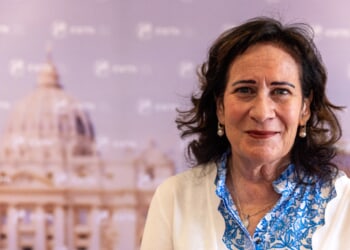
According to Professor Antonio G. Chizzoniti, a canon law scholar at the Catholic University of the Sacred Heart, these questions arise from treating the pope as an ordinary dual citizen — an assumption he argues is incomplete.
“The issue of the pope’s citizenship lies at the intersection of distinct legal systems,” Chizzoniti told ACI Stampa, the Italian-language sister service of EWTN News, referring to canon law, Vatican law, and the laws of the countries from which popes originate. “None of these systems establishes uniform rules,” he said, noting that the pope’s legal status is the result of a “complex layering of norms” that has led to different outcomes in modern history.
Chizzoniti emphasized that canon law does not require a pope to renounce prior citizenship, nor does it forbid retaining it. He described this as an intentional gap, reflecting the Church’s focus on the pope’s spiritual and ecclesial role rather than his civil status.
At the same time, Vatican law grants the pope citizenship of Vatican City automatically upon his election. This “functional citizenship,” tied to office rather than birth or descent, exists alongside any prior nationality, which may still be retained depending on the laws of the country of origin.
As a result, modern popes have typically held multiple citizenships. Historical examples include St. John Paul II retaining Polish citizenship and Pope Francis maintaining Argentine nationality.
In principle, Chizzoniti said, obligations tied to original citizenship — such as taxes or voting — could still apply. However, he argued that the pope’s status as a foreign head of state introduces a decisive complication.
“It will be necessary to verify the applicability of such obligations to a foreign head of state,” he said, pointing to the well-established principle in international law that grants heads of state immunity from the jurisdiction of other countries.
This immunity, he explained, generally covers both official and private acts and prevents enforcement of civil or administrative obligations by foreign states.
For that reason, while the pope’s dual citizenship is not merely theoretical, “there are multiple reasons to consider these obligations not applicable or no longer enforceable” in his case, Chizzoniti said.
Still, his analysis reflects a legal interpretation rather than a definitive resolution. The interaction between citizenship obligations and head-of-state immunity — especially in cases as unique as the papacy — remains a matter of ongoing discussion rather than settled law.
Leo XIV’s situation is particularly notable because he holds three citizenships: U.S. citizenship by birth, Peruvian citizenship acquired in 2015 when he became bishop of Chiclayo, and Vatican citizenship by virtue of his election as pope.
Ultimately, Chizzoniti argues that the pope’s identity as both the Holy See and the sovereign of Vatican City distinguishes him fundamentally from ordinary citizens — even those with dual nationality.
But the broader questions — whether and how civil obligations tied to citizenship apply to a reigning pope — remain open, highlighting the unusual intersection of international law, state sovereignty, and the unique nature of the papal office.
A version of this story was first published by ACI Stampa, the Italian-language sister service of EWTN News. It has been translated and adapted by EWTN News English.