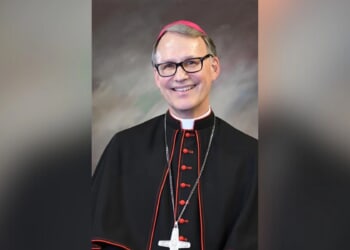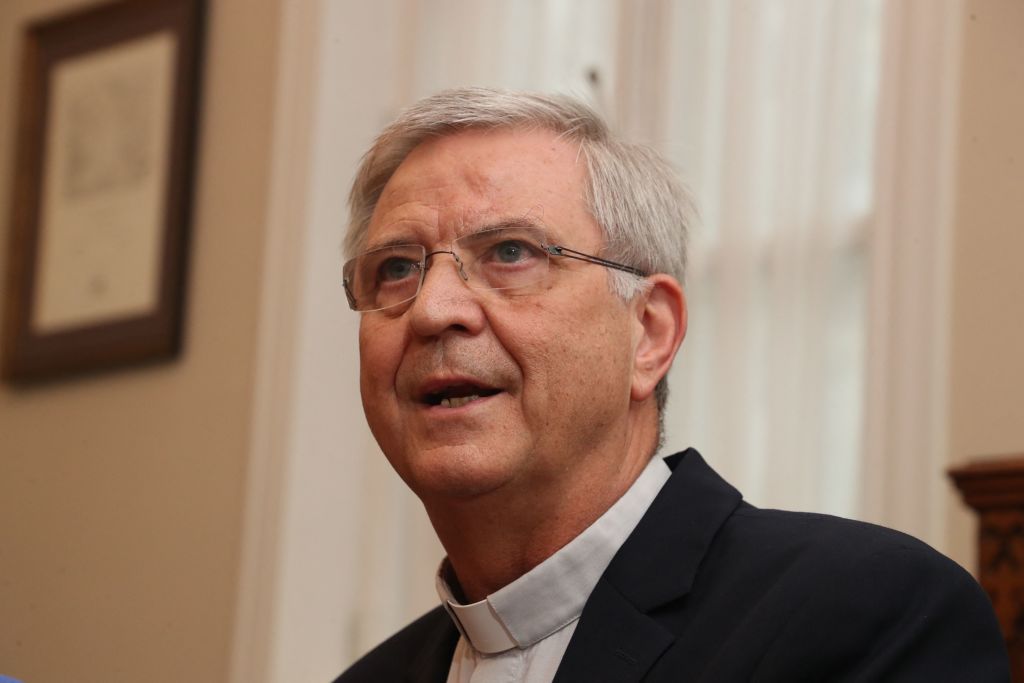
A Catholic bishop in Belgium wrote an 11-page pastoral letter that included a plan to ordain married men into the priesthood by 2028, even though such actions would violate the Code of Canon Law.
Bishop Johan Bonny, head of the Diocese of Antwerp since 2009, noted that the topic of ordaining married men was discussed in the Vatican’s Synod on Synodality (2023-2024). Although the topic was openly discussed, neither the late Pope Francis nor the authors of the final document authorized the ordination of married men or recommended any future changes to canon law to authorize it.
Despite this, Bonny wrote in the pastoral letter that in every synodal discussion “the question arises of ordaining married men … for the priesthood.” He claimed “the consensus on this question is almost total … especially among the most faithful and devout” and “has existed for many years.”
“The question is no longer whether the Church can ordain married men as priests but when it will do so, and who will do it,” the bishop said. “Any delay comes across as an excuse.”
Contrary to the asserted consensus, Canon 1042 prohibits the ordination of married men in the Latin rite under most normal circumstances. It states clearly that the only holy orders “a man who has a wife” is eligible for is the permanent diaconate — not the priesthood. A married man can enter the permanent diaconate with the consent of his wife if he is at least 35 years old, but a permanent deacon who is a widower cannot remarry.
The rule is not completely universal in the Catholic Church. The Code of Canons of the Eastern Churches permits the ordination of married men in Eastern-rite Catholic Churches, which have long practiced it.
There are also limited exceptions in the Latin rite. A married Anglican priest who converts to Catholicism is allowed to be ordained as a Catholic priest and remain married. The Church makes some limited exceptions for other Protestant ministers who are married and also wish to convert to Catholicism and be ordained into the priesthood.
However, apart from rare exceptions, married men are not permitted to be ordained into the priesthood in the Latin rite.
Bonny does not address the relevant canons in his letter. He also did not cite any approval from the Vatican or reveal any insight about a potential change in canon law.
The bishop did not state that he will first seek approval before the ordinations, but he did say he would ensure “the necessary communication and arrangements” with the Vatican and Belgian Bishops’ Conference, “as we can learn from each other’s experiences and insights.”
“I will make every effort to ordain married men as priests for our diocese by 2028,” he said. “I will approach them personally and ensure that by then they have the necessary theological training and pastoral experience, comparable to that of other priest candidates. This preparation will be transparent but discreet, away from the media spotlight.”
“For many a bishop, the ordination of married men has become a matter of conscience,” he wrote. “At that level, too, transparency, accountability, and evaluation are important for the credibility of the Church.”
Bonny makes several cases for why he intends to ordain married men, such as the “historical shortage of local priests in many dioceses.” He said many foreign-born priests fill the gap now, but “it would not be fair to place the burden of our shortages on their shoulders.”
He noted that the Church in Belgium already works “with a number of married Catholic priests,” citing the Eastern-rite Catholic priests and converts who fell under the limited exceptions.
Bonny also said “there is a cluster of experiences related to the psychosocial health of priests and the transparency of their lifestyle.” He said “the issue of sexual abuse continues to weigh heavily” and “clerical subcultures and lifestyles have had their day.”
“The fact that almost no domestic candidates are coming forward for ordination seems to me undoubtedly related to the absence of synodal discernment in classical vocation ministry,” the bishop continued. “When I visit parishes or pastoral unities, I regularly meet people whom the community would consider to be a good priest. Just as I myself know several co-workers who would be well suited as candidates for ordination.”
Tom Nash, a staff apologist for Catholic Answers, told EWTN News that he hopes Bonny “is docile to the Holy Father, Pope Leo XIV.”
“It is the pope alone, the successor of St. Peter, who has God-given primacy in definitively teaching on faith and morals, and also the divinely given primacy of authority in binding and loosing on matters of discipline, and thus one must be very wary of going forward in a manner that would gravely violate that divinely ordained papal primacy of governance,” he said.
Nash explained that married men can be validly ordained to the priesthood, as one can see in the Eastern rite and the rare exceptions in the Latin rite. However, without approval from the pope and a change to canon law, such ordinations would be “illicit” under the circumstances discussed by the bishop in the pastoral letter.
If Bonny ordained married men to the priesthood, Nash said the situation would be similar to the Society of St. Pius X, which illicitly consecrated bishops in 1988 and are threatening to do so again. Such consecrations, he explained, were “valid but illicit.”
A priest who is ordained validly but illicitly would be a real priest and could validly celebrate Mass, according to Nash. However, such celebrations would be illicit, and in defiance of the Holy See, and sinful, he said. Other priestly faculties, however, may not be valid, he said.
“Just because such ordained priests could validly but illicitly celebrate Mass, they would need delegated priestly faculties from the pope to validly absolve sins in the confessional and also to receive the consent of the parties during the Church’s marriage rite, lest they marry each other invalidly,” Nash said.
“It’ll be interesting to see how this matter develops in the coming two years, and I pray that Bishop Bonny is docile to the Holy Father,” he added.
David Long, director of the Institute for Policy Research and Catholic Studies at The Catholic University of America and a canonist, told EWTN News that the question of ordaining married men “does not lie within the authority of a diocesan bishop acting on his own.”
“Any current change in practice in a Latin diocese would require action by the Holy See and could not be accomplished by a unilateral decision by a diocesan bishop, no matter how pastorally urgent the circumstances may be,” he said.