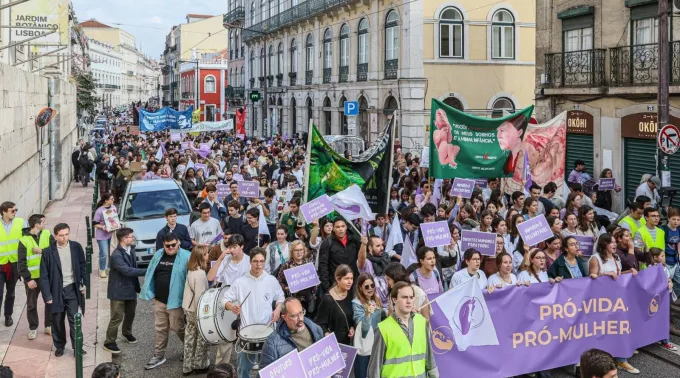
A 39-year-old man was arrested on Saturday, March 21, for throwing an incendiary device at participants at the March for Life in front of the country’s Parliament building in Lisbon, Portugal.
According to the police, at the time of the attack “the demonstration comprised approximately 500 participants,” including families with young children and babies. The man approached the scene and “hurled an improvised incendiary device — a ‘Molotov cocktail’ containing gasoline — in the direction of the people present; the device struck the ground but failed to ignite, thereby averting potentially more serious consequences.”
The suspect was apprehended and arrested at the scene. The police stated that other “individuals who were allegedly part of a group with anarchist leanings” fled, but three members were subsequently identified.
The authorities also seized the device, “consisting of a glass bottle containing flammable liquid and textile material — as well as other items of evidentiary value.”
Commenting on the case, Portugal’s minister of internal administration, Luís Neves, said on social media: “We do not tolerate any form of violent extremism, and we will continue to act firmly to prevent and combat it, safeguarding democratic values.”
Act of terrorism
The Portuguese Federation for Life, which organized the March for Life, issued a statement on March 23 classifying Saturday’s incident as a “terrorist attack.”
In recounting the event, the federation emphasized that while the incendiary device did not ignite, “the fuel used in the device” splashed on “several people, including two babies.”
“Had the ignition not failed, we would be talking today about the deaths of children and infants,” the federation stated. However, the group emphasized that “the failure of the attack cannot obscure the fact that a political organization planned and sought to carry out an attack using an incendiary device against a public event packed with families, youths, and children.”
The Portuguese Federation for Life urged “that this attack be treated by the authorities as the act of terrorism that it is.” The group also requested that if any link between the attackers and a political organization is established, that organization should “be declared a terrorist organization, as provided for in the counterterrorism law.”
Furthermore, the federation called upon “all those who, especially in the exercise of public office, have in recent years employed a tone of hatred against the pro-life movement, accusing us of countless evils, to search their consciences and understand the consequences of their rhetoric.”
The federation announced that it will request a meeting with the minister of internal administration and the prosecutor general of the republic to address the incident and that, “at the appropriate moment,” it will “join as an amicus curiae [friend of the court] in the ensuing judicial proceedings.”
Gravely unacceptable incident
The patriarch of Lisbon, Rui Manuel Sousa Valério, condemned the attack against the March for Life.
“Such events are gravely unacceptable,” Sousa Valério said. He emphasized that “violence is never the way,” that it “harms human dignity and does not serve the truth.”
“And it becomes even more painful when it threatens the most vulnerable, especially children, who should always be a sign of hope and never exposed to fear,” he pointed out.
The patriarch expressed “his closeness to all those who participated in this initiative and, in particular, to the families and children who may have felt fear and insecurity.”
“The Church is close to everyone; it accompanies and prays for each person. No incidence of violence can erase the good accomplished, the witness given, and the hope sown,” he said.
The March for Life
The March for Life took place in 12 Portuguese cities on Saturday. In addition to Lisbon, demonstrators took to the streets to take a stand against abortion and euthanasia in Aveiro, Beja, Braga, Bragança, Coimbra, Faro, Guarda, Lamego, Porto, Setúbal, and Viseu.
This year, the March for Life adopted the theme “The Pro-Life People Take to the Streets” and aimed to be a march “for the dignity of all human beings, for life from the moment of conception until natural death, and for families.”
Abortion was legalized in Portugal in 2007 after a national referendum.
Pope Leo XIV sent a message to the participants of the March for Life, stating that “the family is, by divine design, the natural guardian of life” and therefore, it is necessary “to ensure that it does not lack the conditions required to welcome nascent life and to care, with renewed commitment, for that which is in decline (ailing or elderly persons).”
“May public resources sustain Portuguese families, specifically supporting women who are about to become mothers and fostering the implementation of authentic policies of solidarity that draw citizens closer to the most needy, the marginalized, the lonely, and migrants in whom the face of Christ shines,” the pope said.
Of the culture of death, Leo said that “mere declarations of good intentions, and least of all, illusory forms of compassion such as euthanasia and, ultimately, abortion, do not serve the development of our societies.”
In his view, “ideas and words that inspire actions and gestures that raise up human dignity are indispensable, a goal to which friendship with Christ, fostered through the prayerful reading of the Gospel within the family, contributes immensely.”
The pope also encouraged newlyweds to “welcome God’s love and allow it to bear fruit, thereby mirroring the joy of marriage and parenthood.”
This story was first published by ACI Digital, the Portuguese-language sister service of EWTN News. It has been translated and adapted by EWTN News English.