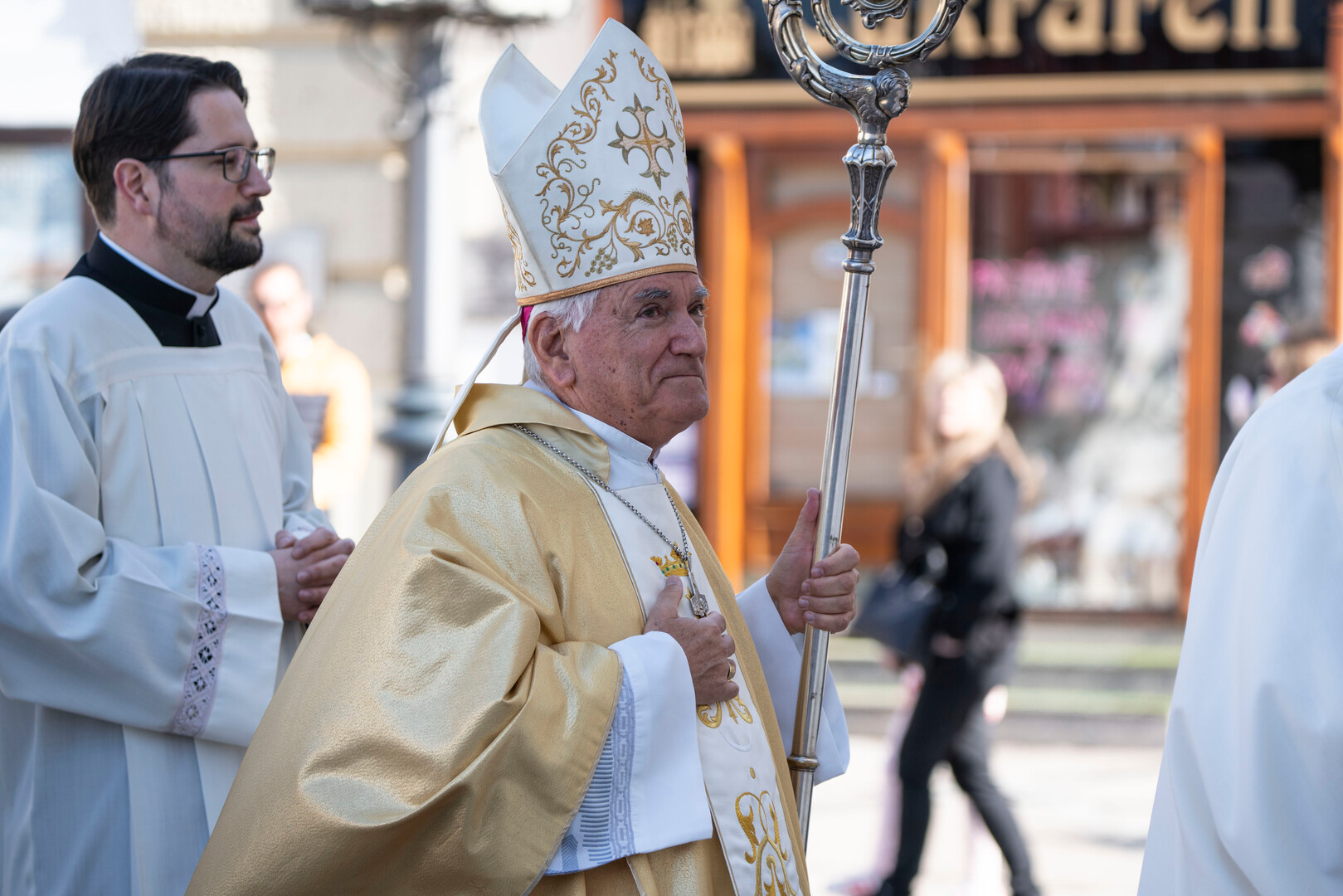
ROME — This year marks the 250th anniversary of three dioceses in Slovakia, then part of the Hungarian monarchy: Banská Bystrica, Rožňava, and Spiš.
On the occasion, Pope Leo XIV wrote a letter to the Diocese of Banská Bystrica, saying: “The diocesan community has remained faithful also in a time of trial, protected the Gospel, and passed it on from generation to generation.” The pope expressed hope the diocese will grow as a community and in mission “to witness Christ, serve the weakest, and pass on the joy of the Gospel.”
The letter was presented on March 14 as Archbishop Nicola Girasoli, apostolic nuncio to Slovakia, celebrated a Mass in Banská Bystrica.
The three dioceses were officially established on March 13, 1776, carved out of the vast territory of the Archdiocese of Esztergom.
“It was not just an administrative decision but a pastoral response” to be “closer to people, to their daily lives,” and “to preach the Gospel more effectively and with greater proximity,” the current bishop of Spiš, František Trstenský, wrote in a pastoral letter. On March 13, he inaugurated a special diocesan jubilee.
He hopes for his parishes to become “places of closeness” and “united community.”
“Let us not be afraid to talk about faith and the Gospel in public life,” as it is not a private matter, he said. Faith “manifests concretely in forgiveness, honesty, service, and peace in the midst of turmoil,” the bishop underscored.
Events are also planned in the other two dioceses, including historical conferences, special Masses, pilgrimages, and an exposition of a replica of the Shroud of Turin.
The empress, the archdiocese, and a dubious document
Back in the 18th century, “The Esztergom Archdiocese did not want to separate,” Cardinal Jozef Tomko (1924–2022), former prefect of the Congregation for the Evangelization of Peoples, noted in his book “Na životných cestách” (“On Life’s Roads”).
The reorganization was the initiative of Habsburg sovereign Maria Theresa, archduchess of Austria and queen of Hungary. She was a devout Catholic who “had information from good priests that it was absolutely necessary for effective pastoral work of those territories,” wrote Tomko, who as a priest completed doctoral research on the question.
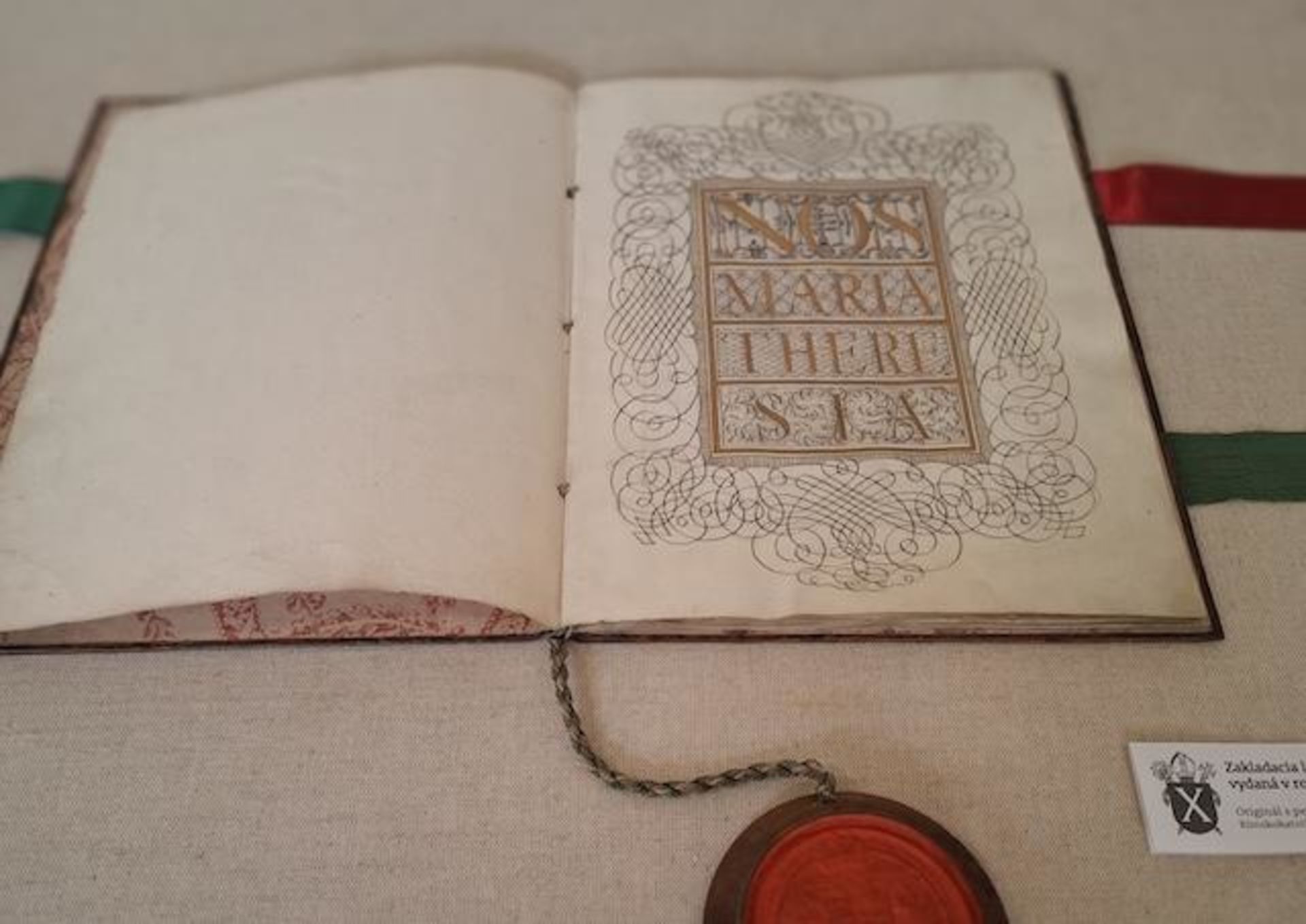
The original document by Empress Maria Theresa relating to the establishment of the Diocese of Banská Bystrica in Slovakia is displayed at the diocesan archive. | Credit: Archive of the Diocese of Banská Bystrica
At the time, some invoked a dubious claim regarding the “right” of the Hungarian sovereigns: that Pope Sylvester II had allegedly granted in a bull the right to the first king of Hungary, St. Stephen, and to his successors, to found dioceses and nominate bishops. The document is now generally considered a forgery.
Yet, “it credibly imitated the style of the Roman Curia, which could have easily misled people,” Tomko wrote.
“A custom had existed since the Middle Ages, respected by the Apostolic See, that a Hungarian king appointed bishops who were subsequently confirmed by the Apostolic See,” Dominican Father Viliam Štefan Dóci, president of the Historical Institute of the Order of Preachers in Rome, told EWTN News.
Over time, “the kings increasingly claimed not only the right to appoint Church dignitaries but also to regulate Church affairs in other ways,” Dóci continued.
Although the title “apostolic king” for King Stephen “does not correspond to historical reality, the fact is that Pope Clement XIII granted this title” to Maria Theresa and “to her successors in 1758,” the Dominican priest explained.
Maria Theresa was thus “encouraged” to pursue the reform of the Church’s organization in the Central European monarchy, where she also founded other dioceses, Dóci said.
The whole matter “was complicated from a Church and legal viewpoint,” since the monarchs asked the popes “for the confirmation of their acts.” At the same time, “the founding documents, issued by the Apostolic See, were formulated” in a way that made it appear “as if it was the pope who came up with the initiative,” stressed Dóci, who teaches at the Pontifical University of St. Thomas Aquinas in Rome.
Both the historian and Tomko agree it was primarily Maria Theresa who drove the creation of the three dioceses — and that formal approval from Rome followed.
Similar patterns existed in other monarchies, where sovereigns at times intervened “even more radically” in Church affairs “out of the conviction that it was part of their royal authority — and that it also belonged to their duties — to take care of the functioning of the Church on their lands,” Dóci concluded.
8 centuries of faith
Slovakia has another ancient Church province worth noting: the Diocese of Nitra, founded — according to historians — in A.D. 880 as the oldest Slavic diocese and later renewed as a suffragan of the Archdiocese of Esztergom.
Today, there are eight Roman Catholic dioceses and three Greek Catholic church provinces in Slovakia.
During the communist regime in Hungary in the 20th century, certain historians took an interest in the question of the Hungarian royal “right,” Tomko recalled. They attempted, he said, to “prove” that the dubious privilege of the kings had passed, after the end of the monarchy in 1918, to the leaders of a totalitarian regime in Hungary — which “would be a strong argument for communists,” Tomko said, implying they could have used it to legitimize state control of the Church.