Georgia L Gilholy is a journalist.
Generally speaking, you will be hard pressed to find something that myself and Ed Davey agree on. But this week, the jolly but rather juvenile Liberal Democrat leader, told MPs that “Antisemitism and those who fuel it have no place in our society,” and urged the government to finally proscribe Iran’s Islamic Revolutionary Guard Corps (IRGC) as terrorists.
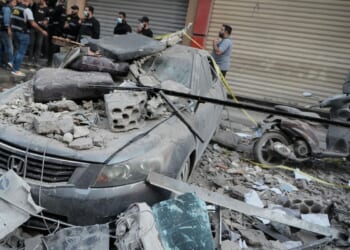
His remarks come mere days after four ambulances belonging to the Jewish Haztola volunteer service, which charitably helps local Jews and non-Jews in need of paramedics, were set on fire in Golders Green. Police understandably remain cautious about assigning a motive, but the Iranian terror proxy “Harakat Ashab al-Yamin al-Islamiya” quickly claimed responsibility for the attack- the latest in a long line of Islamist plots against Jewish organisations.
This is the grim backdrop against which Britain is still having an oddly timid argument about the IRGC, the financial and strategic backbone of the Islamic Republic’s global and domestic terror apparatus. It is this ideological army that has played a vanguard to Iran’s theocratic regime since the 1979 revolution, and which has played its part not only in overseas attacks but in the slaughter, rape and torture of much of the country’s own population.
For years now, British ministers and officials have warned that Iranian state actors and their proxies pose a real threat on our soil. MI5 director-general Ken McCallum said last year that the service had responded to more than 20 Iran-backed plots in the UK. The point is not that every alarming incident can be pinned on Tehran before the evidence is in. It is that the wider threat picture is already well established. Last Summer our security services foiled an alleged Iranian plot to bomb the Israeli Embassy in Kensington mere hours ahead of time. Earlier this month four Iranians in London were arrested on suspicion of spying on Jewish communities.
A new Labour Friends of Israel paper, launched in the House of Lords on Wednesday, puts the case starkly. The report, authored by senior United Against Nuclear Iran research analyst Jemima Shelley, correctly frames the IRGC as “Iran’s primary exporter of terrorism abroad” and the regime’s “iron fist against domestic dissent”. It also makes a point that ought to embarrass ministers: sanctions may “create friction”, but proscription “creates criminal liability and fundamentally alters operational ability” to root out this dangerous force.
The standard excuse is that the IRGC is part of the Iranian state, and that the Terrorism Act 2000 was not really designed for bodies such as this . Indeed, Joshua Rozenberg KC noted earlier this month that Jonathan Hall KC’s 2025 review concluded Parliament had never intended the 2000 Act’s proscription regime to apply to state entities, which is why Labour promised a new state-threats power instead. The trouble is that, almost 12 months after Yvette Cooper’s commitment to create that new power, there is still no timetable for legislation.
So the government is caught in the worst of both worlds. It says the existing law is the wrong tool, but has not yet produced the replacement tool it promised. This is despite the fact that Labour’s manifesto specifically pledged to ban the group. It is interesting that Sir Keir Starmer seems much more keen to allocate swathes of parliamentary time to the highly controversial Private Member’s Bill on assisted suicide-which was not part of his party’s election platform-than to a clampdown on specific element of the antisemitic, Islamist terror threat that he promised voters he would execute? Perhaps he simply cares much more about the former issue, than he does about the latter, regardless of public opinion?
Even now, Lord Blunkett is arguing that the government could immediately proscribe the IRGC’s external operations arm, the Quds Force, under existing terror laws, while bringing forward legislation to deal with the IRGC in full. He points to Canada’s example: ban the Quds Force first, then move wider later. That feels a great deal more serious than the government’s present position, which seems to consist mainly of saying the matter remains “under review”.
The political pressure is plainly building. On Thursday, The Telegraph reported that retired MI6, MI5 and GCHQ chiefs have taken the uncharacteristic step of publicly criticising Keir Starmer’s failure to proscribe the IRGC, calling it a “necessary step” and warning that continued hesitancy risks leaving Britain yet further “strategically exposed”.
There are, of course, some reasons ministers may hesitate. Proscription would carry diplomatic consequences. It could further narrow Britain’s room for manoeuvre with Tehran, and there are concerns about British nationals who have been arrested in Iran-generally on false charges-and about whatever residual value remains in maintaining channels. But these are arguments about costs, not arguments that the threat is unreal or that endless delay is sustainable.
But as the former intelligence chiefs reportedly argued, Britain’s leverage in today’s Tehran is already minimal, and ministers should have the honesty to say so. We are not calling the shots in the region, nor will we be capable of playing a serious role again if we continue to deplete our military and industrial capacity.
The Tories mulled over a ban and failed to deliver. Labour was happy to condemn that hesitation in opposition, but in power, its approach has been equally lacklustre.
For decades, Britain has tolerated violence intimidation from the IRGC and its proxies within our borders. In 2023, pro-democracy news channel Iran International, whose staff have suffered violent attacks from pro-regime partisans, abandoned its historic London studio because our police could no longer guarantee its safety in a “free” country.
Leaving the IRGC somewhat to its own devices in Britain makes a mockery of our country and puts real people’s lives in danger. The government must either proscribe what they can now and legislate fast for the rest, or explain their cowardice to the public.



![James Carville Admits Democrats Had No Shutdown Endgame, Mishandled Strategy [WATCH]](https://www.right2024.com/wp-content/uploads/2025/11/1763070634_James-Carville-Admits-Democrats-Had-No-Shutdown-Endgame-Mishandled-Strategy-350x250.jpg)