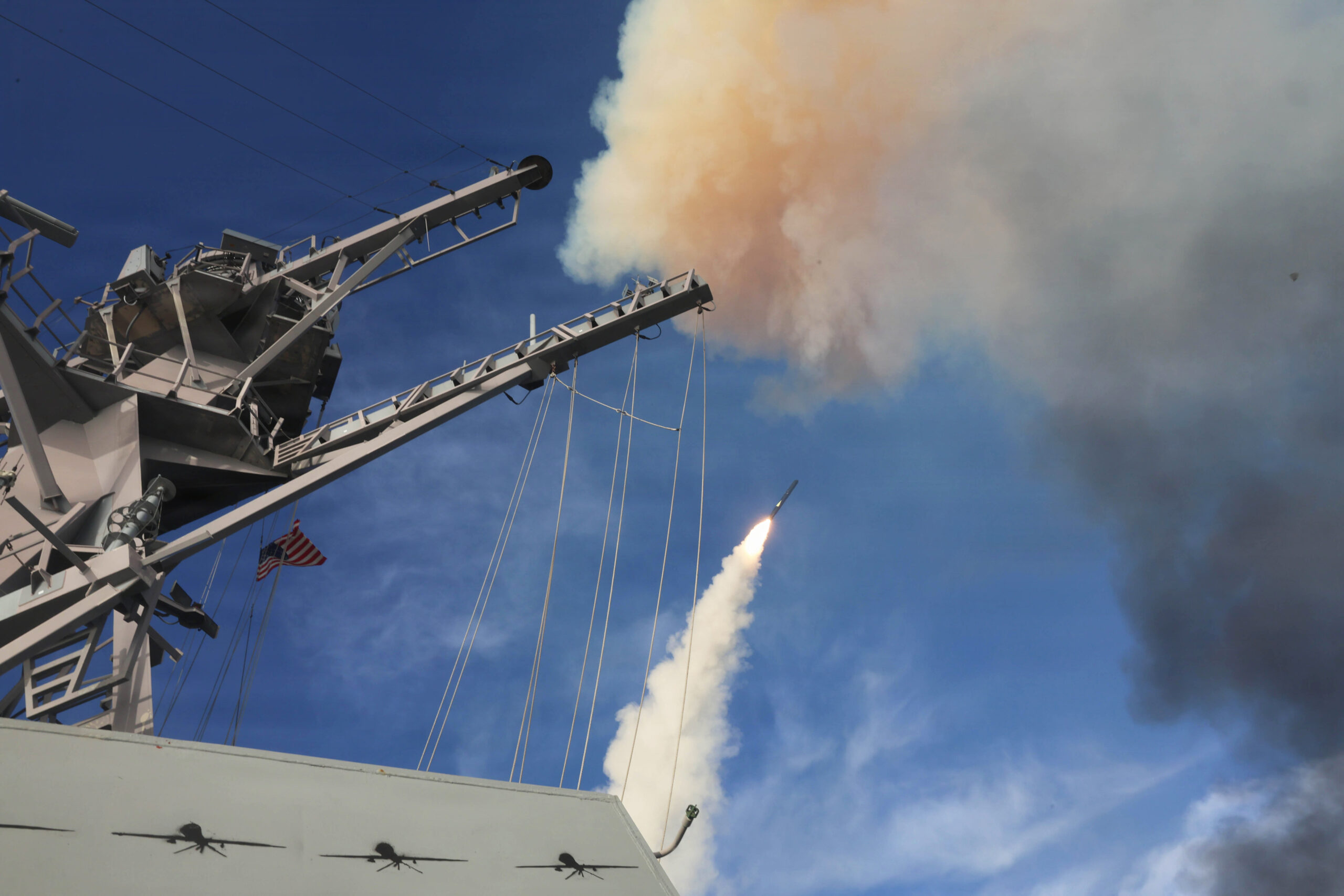
President Trump says he wants to “make a deal” with Iran while moving thousands of Marines and airborne troops to the Persian Gulf.
“There is regime change because I’m talking to different people,” he says. Supreme Leader Ayatollah Ali Khamenei was killed by air strikes during the opening hours of Operation Epic Fury, and the fanatical Islamic Revolutionary Guard has the world at gunpoint, using interlocutors like foreign minister Abbas Araghchi to do their bidding.
IRGC has rejected the 15-point plan for the surrender of its nuclear and ballistic missile programs issued by Trump and presented its own demands: total withdrawal of U.S. military presence from the Gulf region and recognition of Iranian sovereignty over the Strait of Hormuz with rights to toll shipping.
It’s a hostage standoff on a global scale, and Trump may need to seize Iran’s Gulf islands to break the siege.
The main target is Kharg Island, Iran’s only deep-water port, which can accommodate large tankers and is the main terminal for 95 percent of its oil. A group of small islands at the mouth of the Hormuz strait from where gunboats, mine droppers, naval drones, and missile launchers operate, would also need to be seized.
“They will need to take Kharg and the missile and drone sites blocking Hormuz,” a former Marine and ex-CIA officer told The American Spectator.
A Marine Expeditionary Force and the 82nd Airborne Division are being mobilized for what could be the riskiest and most complex island-hopping operations since WWII.
Special Forces would spearhead the seizure of Kharg in a decisive move to cut the Iranian regime’s economic jugular with a series of closely coordinated assaults.
Submarine-inserted SEAL teams and Delta Force units rappelling down from helicopters and delivered by parachute would be followed by battalion-sized units landing by sea and air to occupy the 18-square-mile island lying 15 miles from the Iranian mainland.
“Navy Seals would seize the main control centers and oil terminals,” retired U.S. Special Forces Colonel Ron MacCammon, told the British newspaper, The Sun. The port’s deep waters facilitate the movement of submarines to infiltrate Seals close to shore and block counterattacks by the IRGC, whose navy is already destroyed.
Iranian defenses on Kharg have been decimated by waves of surgical strikes, leaving the oil terminals, storage tanks, and harbor facilities intact. The U.S. objective would be to take control of the oil and the port’s operation.
Rangers would take the airfield at the island’s northern end in a Tactical Airborne Landing Operation combining parachute drops with blacked-out landings by C-130s unloading hundreds of heavily armed paratroopers.
SOAR MH-60 attack helicopters, fighter jets, and Reaper Drones with AI-activated Hellfire missiles instantly locking onto hostile missile or drone launches would provide layers of air cover.
“The problem would be holding Kharg,” says U.S. Army War College professor Evan Ellis. “It could become a drone magnet.”
“They need to bring in a lot of air defense,” says MacCammon, who expects amphibious landings of some 3,000 troops, including units of engineers. “It would be interesting if Saudi units get involved,” he says.
U.S. Marines trained to seize and fortify small beachheads could simultaneously take islands dominating the entrance to the Hormuz strait where IRGC naval drones and mine-laying boats operate from hidden caves and narrow inlets.
B-2 strategic bombers have been pounding IRGC missile bunkers on the barren islands of Qeshm, Larak, Kanash, Abu Musa, and mainland coastal cliffs, with precision-guided 5,000-pound GBU-72 deep penetrator ordnance.
Low-flying Apache helicopters and A-10 attack jets are continuously strafing the area, picking off resistance pockets, naval drones, and mine layers.
The 31st Marine Expeditionary Unit, reaching Hormuz this weekend, has been training for island-hopping operations planned for a potential war with China in the Indo-Pacific.
“It’s a new doctrine designed to secure or deny passage along narrow waterways, deploying small agile units instead of stationing large warships and mass infantry landings vulnerable to current day precision weapons,” said a USMC spokesman.
Advance units of Marine Force Recon Raiders dropped by Sea Stallion helicopters would locate hidden IRGC positions and call in air strikes before V-22 rotary wing Ospreys airlift the main force from the amphibious warfare carrier USS Tripoli. The mothership has been refitted for enhanced air operations to reduce its exposure to anti-ship missiles and sea mines.
The Marine stay on force would install radar systems and HIMARS batteries on the islands to fire lethally accurate ATACMS to neutralize IRGC threats within a 300-mile radius.
Marines could also set up coastal firebases with Fuel Armament and Resupply Posts in Oman and along the Gulf states, with internationally recognized legal rights over the Hormuz Strait.
Despite thousands of missiles and drones targeting their oil and gas refineries, airports, hotels, and financial centers, the Arab kingdoms have stood firm against IRGC terrorism. Saudi Arabia has officially called the group “a long-term threat that must be eliminated.” Crown Prince Mohammed bin Salman is publicly urging Trump to “hit them harder.”
Efforts by Iran and Russia to coerce the shell-shocked Emiratis into a separate peace during the war’s terrifying first days have backfired. There has been a precipitous drop in IRGC missiles since then. About 75 percent of its missile launchers have been taken out, according to CENTCOM.
The IRGC mastermind of operations to choke the Strait of Hormuz, Admiral Tangsiri, reputed to be the brains of the naval drone strategy, was killed by an Israeli air strike on Thursday. He is possibly the 60th IRGC senior commander hit by air strikes directed with pinpoint intelligence systematically collected by Mossad, which has been operating inside Iran for years, deeply penetrating the IRGC.
Resistance cells developed by Israeli agents infiltrated within the massive opposition to the regime among the population could play a decisive role in the coming weeks if they are capable of organizing an internal uprising as U.S. troops move on the Persian Gulf Islands.
According to daily broadcasts by Mahyar Tousi, with regular feeds from opposition sources inside Iran, armed teams of an underground movement known as the Immortal Guard, supported by elements of the regular army, have already conducted armed attacks.
His podcast channel Tousi TV shows clips of drive-by shootings on street checkpoints of the paramilitary Basij militia in charge of internal repression. They are also being targeted by airstrikes that have taken out IRGC arsenals and bases throughout the country. The U.S. has hit more than 10,000 targets according to CENTCOM.
The U.S., in control of Iran’s oil-shipping lanes, could leverage China into pressuring the IRGC to allow surviving government members such as Abbas Araghchi and parliamentary speaker Mohammad-Bagher Ghalibaf to negotiate with Trump.
China gets 35 percent of its oil from Iran. Beijing is reportedly involved in diplomatic contacts between Iranian officials and the Trump administration, conducted through Pakistan, another main recipient of Iranian energy.
Even if the plans work, the IRGC will likely continue operating as a terrorist organization for some time, possibly developing Gaza-type situations in parts of Iran. But its dislodgement from strategic locations by U.S. elite units, while popular rebellions threaten the group’s internal strength, diminishes the level of threat it can present.
READ MORE from Martin Arostegui:





![CNN's Kaitlan Collins Fact-Checks Rep. Jasmine Crockett Over False Trump Ballroom Claim [WATCH]](https://www.right2024.com/wp-content/uploads/2025/10/1761954330_CNNs-Kaitlan-Collins-Fact-Checks-Rep-Jasmine-Crockett-Over-False-Trump-350x250.jpg)
![Two Dead, 14 Injured After Gunfire Erupts Following College Football Game in Alabama [WATCH]](https://www.right2024.com/wp-content/uploads/2025/10/Two-Dead-14-Injured-After-Gunfire-Erupts-Following-College-Football-350x250.jpg)