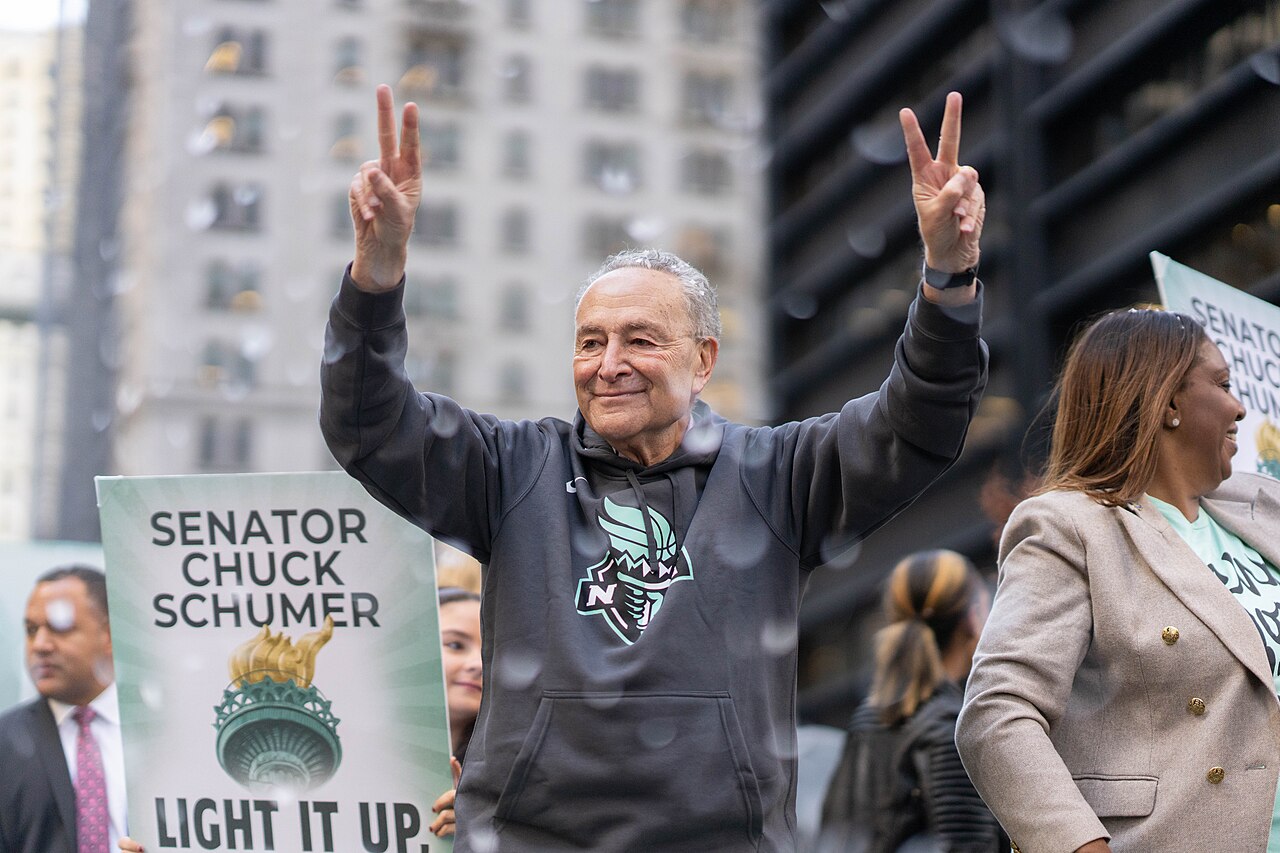
The prospect of congressional Republicans re-elected to the majority after the midterm election is beginning to look grim. According to the latest betting odds, the Democrats have an 85 percent chance of retaking the House, and RealClearPolling has the congressional vote for Democrats at +4.7. Control of the U.S. Senate is less clear. At first glance, it looks like Republicans will hold the majority, but if the past is prologue, you can’t count out a Democratic Senate flip.
Senate Minority Leader Chuck Schumer is optimistic about Democrats winning the U.S. Senate and his chance to be majority leader again. In a recent interview, Schumer boasted that, “We have a clear and strong path to winning back the Senate.” The reality, however, is anything but clear and strong. The current makeup of the U.S. Senate is 53 Republicans, 47 Democrats, and 2 Independents who caucus with the Democrats.
Furthermore, the electoral Senate map gives Republicans a structural advantage over the Democrats, making the path to victory more challenging for Democrats in November.
Historically, the party in power loses the midterm election because it ties itself to the president’s agenda, and the “honeymoon stage” tends to wear off in the new term. The hope for Democrats is that President Trump’s low poll numbers, combined with middling job growth, high living costs, and what Democrats see as an unpopular war with Iran, will propel them to control the upper chamber, as they did in 2006.
Republicans are counting on a strengthening economy, victory over Iran, and President Trump campaigning for Senate candidates nationwide.
If you recall, the 2006 midterm election was a wave election. Democrats had a healthy lead in the congressional ballot races, but it wasn’t until late in the fall that Democrats’ hopes of recapturing the Senate were real.
At that time, President Bush was facing a low approval rating due to the Iraq War, high gas prices, and a poorly perceived response to Hurricane Katrina. Likewise, Republicans were dealing with corruption in Congress from the Jack Abramoff and Mark Foley scandals, which was a decisive issue for voters on exit polls.
Then, Senator Chuck Schumer oversaw the Democratic Senatorial Campaign Committee (DSCC) and recruited the best candidates the Democrats have had in recent memory. Ranging from Sherrod Brown, Jon Tester, and Jim Webb in Ohio, Montana, and Virginia to Bob Casey and Claire McCaskill in the corresponding states of Pennsylvania and Missouri.
Everything that could’ve gone right for the Democrats did. With victories all over the map, like Bob Casey beating Sen. Rick Santorum, the third-highest-ranking Republican Senator, in a landslide by nearly twenty points in the Keystone State.
Then you had Jim Webb defeat Sen. George Allen by a fraction of a percentage point (9,000 votes), knocking Allen out of any presidential endeavors. And Jon Tester squeaked out a 3,500-vote victory over Sen. Conrad Burns in Montana, where President Bush won handily in 2004.
The Democrats, thanks to Chuck Schumer, struck gold in 2006 by winning five Senate seats to reclaim the U.S. Senate and stall President Bush’s legislative agenda for his final two years. In the president’s own words, Republicans took a “thumping.” Can Democrats’ fortunes strike again in 2026?
As it stands, President Trump has a lower approval rating than President Bush did at this time and faces the same foreign and domestic issues, with a majority stating the country is on the wrong track.
However, the country is different from what it was 20 years ago, and so are the political parties. Republicans under Trump are more populist, while Democrats are further to the center-left and progressive. That matters.
For example, Democratic primary voters in Michigan will vote in August from a field of candidates that includes Abdul El-Sayed, a doctor and progressive whose views align with Senator Bernie Sanders. His anti-Trump resistance politics may align with Democratic voters, but give him no allure in the general election against a more moderate Republican like former Rep. Mike Rogers.
Conversely, Senator Schumer has his preferred Senate candidate, former Rep. Mary Peltola, facing incumbent Senator Dan Sullivan of Alaska. Despite Ms. Peltola losing a close re-election in 2024, the Senate race is competitive due to Alaska’s idiosyncratic politics and Senator Sullivan’s declining popularity. The problem, still, is a partisan one, as President Trump won Alaska in 2024 by double digits and has won the state 3 times.
Consider what the election data has proven: 91 percent of Senate elections since 2012 have been won by the party that carried that state in the most recent presidential election, highlighting the shift in voter alignment. In 2018, Democrats retook the House but lost two Senate seats to Republicans. Then in 2022, Republicans gained nine House seats but lost one Senate seat to the Democrats.
Thus, the Ohio Senate election presents a unique challenge for Democrats. Former Senator Sherrod Brown will challenge Senator Jon Husted, the former Lt. Governor, who replaced JD Vance when he was elected vice president. Brown is a household name, and he’s been in Ohio politics since the 70s. He’s the last Democrat to be elected statewide since 2018. He lost a close race in 2024 to political newcomer Bernie Moreno by only 3 points. It was only a few election cycles ago that the Buckeye State was a toss-up state. Now it’s a bright red state with a strong tie to MAGA working-class voters, represented by a conventional, center-right Senator, Jon Husted. Sherrod Brown has his work cut out for him.
Republicans are counting on a strengthening economy, victory over Iran, and President Trump campaigning for Senate candidates nationwide. If conditions fail to improve, Democrats could break with historical precedent, with Chuck Schumer reclaiming control of the Senate. Meanwhile, a second Trump term risks being a lame duck presidency, leaving his MAGA legacy in a fragile position.
READ MORE from Alex Adkins:
Pluribus, Another Vince Gilligan Masterpiece
Mamdani Won, But Socialism Still Lost
The Elusive ‘Conservative Consensus’
Image licensed under Attribution 2.0 Generic.







![Two Dead, 14 Injured After Gunfire Erupts Following College Football Game in Alabama [WATCH]](https://www.right2024.com/wp-content/uploads/2025/10/Two-Dead-14-Injured-After-Gunfire-Erupts-Following-College-Football-350x250.jpg)
![James Carville Admits Democrats Had No Shutdown Endgame, Mishandled Strategy [WATCH]](https://www.right2024.com/wp-content/uploads/2025/11/1763070634_James-Carville-Admits-Democrats-Had-No-Shutdown-Endgame-Mishandled-Strategy-350x250.jpg)