
Elliott Keck is the Campaigns Director for the Taxpayers’ Alliance.
What is going to be the next battleground in local government? In 2023 it was the four-day week, as part-time working practices for full-time pay threatened to engulf a sector struggling with productivity.
The next battleground? It’s looking increasingly like it will be over heavier vehicles, namely family cars, electric vehicles and vans, and their right to park.
Labour-run Cardiff council is planning on bringing in a new system of parking permits. It will divide the city into three zones, the city centre, inner city, and outer city. In the city centre, no parking permits will be provided, with existing ones phased out. In the inner city and outer city, there will be a new weight limit of 2,400kg, falling to 2,000kg after introduction. Vehicles above that limit will have to pay more. Vehicles above 3,500kg will not be eligible for a permit at all.
That will capture all luxury SUVs of course – range rovers, BMWs, Audis, and the like. It will also capture a significant number of relatively ordinary electric vehicles due to the weight of the batteries. But significantly, once the weight limit drops to 2,000kg it will capture many very normal, family cars, including models from Ford, Mazda, Kia, Hyundai and Toyota. Vehicles that aren’t luxuries by any definition of the word; they’re necessities.
The justification for these policies is that larger cars place more pressure on parking due to their size, and cause higher levels of wear and tear on the roads. Their emissions are pointed to as well on occasion. These don’t stand up to scrutiny. Through vehicle excise duty and fuel duty, motorists contribute more than twice as much in tax than is spent by central and local government on road maintenance. Looking at Cardiff specifically, the council already raises £16.5 million, or £104 per household, the highest on both counts of any council in Wales, from motorists through parking charges and bus lane fees. It does not need to squeeze them ever harder, particularly when public transport remains substandard and the roads remain riddled with potholes. And on the point about emissions, it is electric vehicles which tend to be the heaviest.
But zoom out a bit and this policy becomes even harder to justify. The birthrate is at a level which almost guarantees civilisational collapse in the coming generations. Do we really want to make having a third or fourth child that little bit higher by charging family cars more? Looking at the present, with the cost of living heading in the wrong direction, and the tax burden crippling businesses, do we really want to be piling on the pressure by charging tradees more to park their vehicles when they go out on a job? The council’s own report recognises that the new system will disproportionately impact lower-income households.
It hasn’t taken long for others to talk about following Cardiff. The Mayor of London is now also looking at charging larger vehicles more, in his cases citing concerns about safety. A Labour policy which begins in Wales, travels along the Great Western Mainline to London and will no doubt spread from there to other councils seeking to make a quick buck, no matter the impact on motorists in their area. Just ponder what Ed Miliband, or Angela Rayner might think about this policy.
That risk, that Cardiff is less a warning and more a model for certain councils, is why we are campaigning on the issue. We have been to Cardiff three times already, and were joined by representatives from both Reform UK and the Conservatives in the city as we spoke to local residents and gathered signatures for a petition. If this is the next big fight in local government, we, the TPA, as always will be on the frontlines.
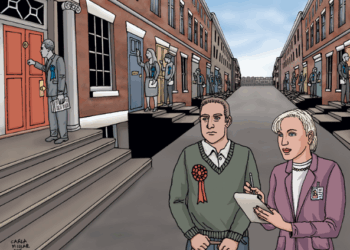
I, however, will be fighting the good fight for local taxpayers from a different vantage point. Because I am standing as the Conservative candidate for the Hyde Park Ward in Westminster at this May’s local elections. As such, I will be leaving the TPA, as it is a strictly non-partisan organisation. That also means, sadly, that I will be giving up this column, a column which I have so much enjoyed writing. Few publications give local government the attention it deserves like ConservativeHome does, and few organisations give local government the scrutiny it deserves like the TaxPayers’ Alliance does. It’s no surprise this has been a partnership which has worked.
So as I sign off, I want to in particular thank Harry Phibbs for being such an excellent editor of the years, and to say keep fighting the good fight. I know the TaxPayers’ Alliance certainly will.





![CNN's Kaitlan Collins Fact-Checks Rep. Jasmine Crockett Over False Trump Ballroom Claim [WATCH]](https://www.right2024.com/wp-content/uploads/2025/10/1761954330_CNNs-Kaitlan-Collins-Fact-Checks-Rep-Jasmine-Crockett-Over-False-Trump-350x250.jpg)

![Two Dead, 14 Injured After Gunfire Erupts Following College Football Game in Alabama [WATCH]](https://www.right2024.com/wp-content/uploads/2025/10/Two-Dead-14-Injured-After-Gunfire-Erupts-Following-College-Football-350x250.jpg)