I am writing on Holy Tuesday. A couple of houses away, the drummers for the processions of my village, in this corner of the Cantabrian coast, are rehearsing their drums. In the church, all the figures that will be carried in procession have their thrones beneath them, awaiting Holy Thursday, Good Friday, Holy Saturday, and Easter Sunday. This morning, I entered the main church of the village to greet the Good Lord, and some ladies were praying the Stations of the Cross: “We adore you, O Christ, and we bless you, because by your holy cross you have redeemed the world.” The account of the Stations of the Cross made me think once again about solitude. The most mysterious hours in the history of humanity are approaching. The solitude of God is approaching.
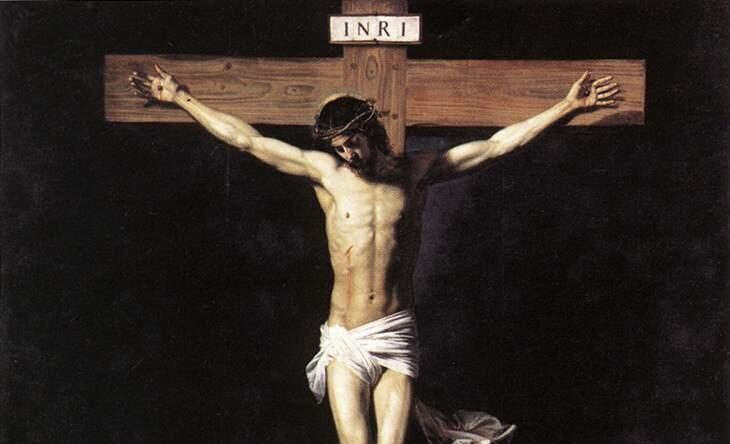
Christ praying in the most agonizing solitude in the Garden of Olives — his disciples had fallen asleep. He was also alone in the unjust and savage trial. He carried the cross alone, with only Simon of Cyrene to help him. He was alone during the scourging, and alone at the end, atop the cross; although it must be acknowledged that the presence of the Virgin Mary — and Saint John and the holy women — was more numerous than any human crowd.
On the cross, Jesus knew himself to be so alone that he even stopped addressing men with words for the first time. It is true that he spoke to the good thief and to the Virgin Mary and her disciple, but the rest of the words spoken on the Cross seemed destined for Heaven, as if they were no longer of this world. Even his “I thirst” can be interpreted only as the final step in fulfilling his promise; but it is to God the Father that he asks why He has abandoned him, to whom he asks forgiveness for his executioners, and to whom he speaks to entrust his spirit into His hands.
It is as if, at that crucial moment in the history of salvation, what truly mattered was now only between the Son and the Father. Even so, Jesus has not forgotten humanity; for each and every one of them, he is receiving this pain. So when a soldier offers him a sponge soaked in vinegar, he drinks from it; it is his silent way of accepting such a pious service in the midst of his agony.
His cries, his gestures, and his words are already reaching Heaven, at the moment of the consummation of the greatest of sorrows, the greatest of injustices, the great sin that suddenly shrouded the earth in darkness; a sin that, moreover, was also yours and mine.
I have always thought that in life we are often surrounded by joy and success, and very alone in pain and hardship. Even when we are surrounded by others in suffering, we will always feel alone in the face of pain, because it is something that isolates us; just as joy can be easily shared, pain is not so easy for others to gauge, and its true intensity is known only to the one who is suffering it.
That is why, in the face of suffering, we lift our eyes to Christ, because we know that no one could understand us better than He.
That is why, in the face of suffering, we lift our eyes to Christ, because we know that no one could understand us better than He. And that is also why those who are unable to find God are driven mad by pain. What human explanation can there be for unjust pain, the most atrocious kind, the kind that includes evil and sin, the most unbearable and cruel? None. Only Christ knows such an experience, because only He, being God, became man to suffer and endure like any other man — indeed more — to be humiliated, abused, scourged, and cruelly and unjustly killed. Only God can give meaning to pain. And what immense meaning there is in the history of Salvation.
We also turn to Christ in our suffering because, in our subconscious, the hope of His resurrection always appears. We saw Jesus suffer. We also saw the apostles themselves hide, paralyzed with fear. And we saw all those who had benefited from His miracles remain silent at His trial, or flee for fear of being crucified as well. Not one of those who had acclaimed him as he entered Jerusalem riding on a donkey remained. Not one. What a profound lesson for life. And yet, from that lonely sorrow, redemption arose, thanks to his resurrection. Christ conquered death.
This Thursday marks the beginning of the Holy Week Triduum, and we Christians once again find ourselves at Christ’s side, in the Garden of Gethsemane, on Calvary, at the gates of the tomb. We love his suffering because in his very wounds, we humans have for centuries hidden our own pain, finding solace in the blessed solitude of Jesus, nailed to a piece of wood and mockingly exposed to humanity. His Passion also helps us not to despair in the face of humanity’s most brutal sins, even in the darkest times of history.
I know — my theologian friends will forgive me — that I offer a partial interpretation of Holy Week. I know that without Easter Sunday, our faith would not exist. And I know that what is important is that the darkness of the cross on Calvary was followed by the light of Christ breaking bread before the disciples on the road to Emmaus. I know. However, perhaps if I had been born an angel, I would have felt deeply moved by the scenes of the Resurrection, but since I was born a man, I confess that what moves me most about Holy Week is the mystery of Christ’s solitude on the cross.
In that solitude of Christ, the enigma of all the pain and injustice of the world throughout history is resolved. By consoling Christ these days on the cross, we humans console ourselves. Since the Passion and Death of Christ, no one will ever be truly alone and abandoned on earth.
READ MORE from Itxu Díaz:
How to Keep Your Job When Robots Take Over









![Kamala Comes Unglued, Makes Bogus Claim About Her Landslide Loss to Trump [WATCH]](https://www.right2024.com/wp-content/uploads/2025/10/Kamala-Comes-Unglued-Makes-Bogus-Claim-About-Her-Landslide-Loss-350x250.jpg)