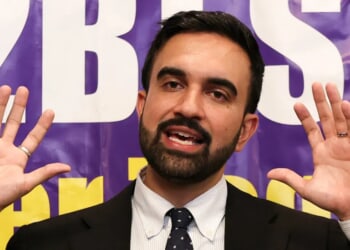
David Swanson is an associate director at Hanbury Strategy.
If you sit on a train in Britain for more than ten minutes, you can watch the whole online safety debate play out right in front of you.
One child is doing a language lesson on a major social media site with a parent leaning in beside them. Another is messaging mates and sending photos from last night’s school trip, while another grapples with the homework set by the ruddy teacher in a user-to-user private chat. A fourth is locked into the now-familiar trance, thumb flicking upwards, face expressionless, scrolling through video after video after video.
These are not the same thing, and our politics should stop pretending they are.
We talk far too loosely about “social media”, as if it is all harmful – which it isn’t. The digital world now includes educational tools, messaging services, gaming servers, chat functionalities, and more.
Some of this is useful, and some of it is time-sapping rubbish. And yet the debate is drifting towards the lazy binary of, either shrug and do nothing, or ban the lot. Conservatives should reject both these premises.
We should be serious about protecting children online. Much of the modern internet has been deliberately engineered to hijack concentration, and turn insecurity into engagement. Children are not imagining that, and neither are parents or teachers.
But we should also be honest that digital life is now part of modern citizenship. It is where young people learn, communicate, organise, socialise and increasingly understand the world around them.
So while our party policy is quite clearly created with good intentions, simply telling an entire generation, “Come back at 16,” is not enough. I am billing the solution as a Conservative third way on online safety: one that ensures the state creates the ideal conditions for young people to become responsible digital citizens. To ensure the power of technology is placed in the hands of the individual, rather than leaving the state to decide arbitrarily when it is appropriate to use. And even though we are clearly focusing on children here, who do require more custodianship than their adult peers, they too deserve protection from an arbitrary state – but in a different way: by creating an internet that allows their curiosity and intellectual confidence to flourish in an age-appropriate environment.
The issue is not access; it is design. It is the endless scroll, the autoplay, the recommendation loops, the constant prompts back onto the app, the little bits of behavioural engineering designed to keep a child online for ten more minutes, and then ten more after that, and sure, why not – let’s watch another. All this, and there is still a very real chance to encounter genuinely harmful material, like pornography, violence, or extreme political material pushed for outrage and engagement.
So while many Conservatives now find themselves backing a blanket ban for under-16s – and with entirely honourable motives – that is not actually where the most serious online safety discussions now are. The strongest campaigners in this space are increasingly more interested in asking why we have allowed powerful firms to build products that are so obviously optimised to hook children in the first place. That is a more serious challenge, and it ought to appeal to Conservatives. If a company has knowingly designed a product to lessen attention, distort self-worth, monetise compulsion, and in some cases pump ideological biases that are antithetical to western values, the answer is not just to tell parents to build a higher fence around it.
The answer is to ask why that product is allowed to function in that way at all.
I think Tom Tugendhat’s instinct on this is worth dwelling on. In his recent appearance on Question Time, he was plainly uneasy with the concept of bans in principle, even while supporting our party policy. He spoke thoughtfully about TikTok’s role in modern society, urging the audience to scrutinise the product itself – which operates as a more educational service in China, with in-built curfews, as opposed to the UK 24-7 doom loop pumping trivial nonsense – rather than access. This tension gets to the heart of the problem and underpins my argument. You don’t need to support the CCP’s internet (or any) policies to recognise that in the West, it’s addictive design – not access – that is undermining young people’s digital citizenship.
The Conservative instinct against broad prohibition is not a weakness here; it is actually the beginning of a better answer. Why ban the whole category when the real damage is being done by a narrower set of harmful features?
Why not say, clearly, that there is a world of difference between a teenager using the internet to learn, message, and participate – in other words, to practise citizenship – and a teenager being fed into an industrialised attention machine designed to keep them passive, insecure, and scrolling?
There is growing evidence that this is the right place to put the pressure. In the United States, Meta has been found to intentionally build addictive social media platforms that harmed a 20-year old’s mental health. That is a significant shift , because once you accept that these companies are active architects of behaviour, the question is not access, but what kind of products these companies should be allowed to build for children in the first place.
As such, I’m basing my third-way concept around three main pledges.
Ban addictive-by-design features for under-16s – target the architecture of harm, not the whole digital world.
Move beyond paper compliance – require companies to prove their products are genuinely age-appropriate and safe in practice, not just compliant on paper.
Embed digital citizenship and media literacy in schools – equip young people with the skills to navigate, question and participate confidently online.
That brings me to the bit Conservatives really need to get right – the Online Safety Act.
We are the party that legislated for it, yet parts of the Right now talk as though its existence is still somehow up for debate – which does an incredible disservice not only to ourselves, but to parents, civil society activists, online safety campaigners, and so many others who put their trust in us to deliver.
The Act should not be scrapped. The real task now is to ensure it is delivered in a way that actually gives parents and young people the protections they were promised.
If we are serious about creating the conditions for digital citizenship to thrive, then Ofcom’s Online Safety Group cannot only focus on the largest and most recognisable platforms. It is almost as though we are punishing success by focusing on reach and visibility over risk. The current emphasis on size and reach in categorisation risks missing where some of the greatest harms to children remain – in smaller, niche, or rapidly growing services that attract less scrutiny, but can still expose children to deeply harmful material, addictive design, or extreme political content that is plainly at odds with the habits of healthy, modern British citizenship.
If we are willing to insist that Meta redesigns parts of its product to better protect children, then that same obligation should apply to every corner of the internet where children are likely to be. And not just because Meta is “bigger” but because the same problems exist everywhere on the internet. People genuinely need that clarity to ensure they can be comfortable to allow a third way idea like mine to become a reality.
Much of the framework is already in place. Companies are now required to conduct risk assessments, tackle illegal content, and take proportionate steps where children are likely to use a service. The regulator has also recently stepped up its game to contact the most popular sites and ask them to prove their feeds are safe. That is right. But Ofcom will only command public confidence if it works more urgently – too often, the instinct of any quango is to drift towards process when the public is asking for outcomes. Parents do not need another consultation cycle or another carefully managed delay. They need to know that where platforms repeatedly expose children to harm, the regulator will act without hesitation.
That is the serious Conservative position. The Online Safety Act was not a mistake, but enforcement now needs to match the ambition. And if the regulator proves too slow in how it uses its powers, Conservatives should be prepared to insist on more.
But it’s not all regulators, it’s legislators too, which brings us to the current stand-off over the online safety amendments in the Children’s Wellbeing and Schools Bill.
Lord Nash and those backing an Australian-style ban for under-16s are responding to a very real concern, and I still believe the policy is built upon good intentions. The problem is, it risks being indiscriminate and out of touch with young people and online safety campaigners. The Government’s amendment is worse, calling for the right to enact unreserved powers to implement whatever measures it likes after the consultation without scrutiny. The House of Lords is right to be sceptical of granting such overt power without the role of Parliamentary scrutiny. Neither feels quite right.
The compromise should be targeting addictive and manipulative design, making high-risk services child-safe by default, and giving Ofcom the powers it needs to act immediately when platforms repeatedly fail. But it should not end there, and Parliament must remain part of this process. If, within twelve months, the platforms and the regulator still cannot get a grip, then Parliament should be willing to go further. That is my difficulty with the Government’s amendment – it asks for trust without building in enough accountability.
Parliament and regulators both have a duty to build upon existing sentiment and legislation to implement a framework where children can actually thrive as digital citizens. We’re already some way there, and we’re already operating on good sentiment. So let this stand-off be the moment where Conservatives lead to genuinely ensure the digital world gives young people the skills, resilience, and freedom to participate safely and confidently in modern citizenship.
I want to still see young people navigating their own digital journeys on trains up and down Britain – and the Conservative Party should play a fundamental role in ensuring that can happen.