Alison Rodwell is a councillor at Bollington Town Council, a former Parliamentary Candidate and founder of Impact the Future which equips business leaders to play an active role in transforming the public sector.
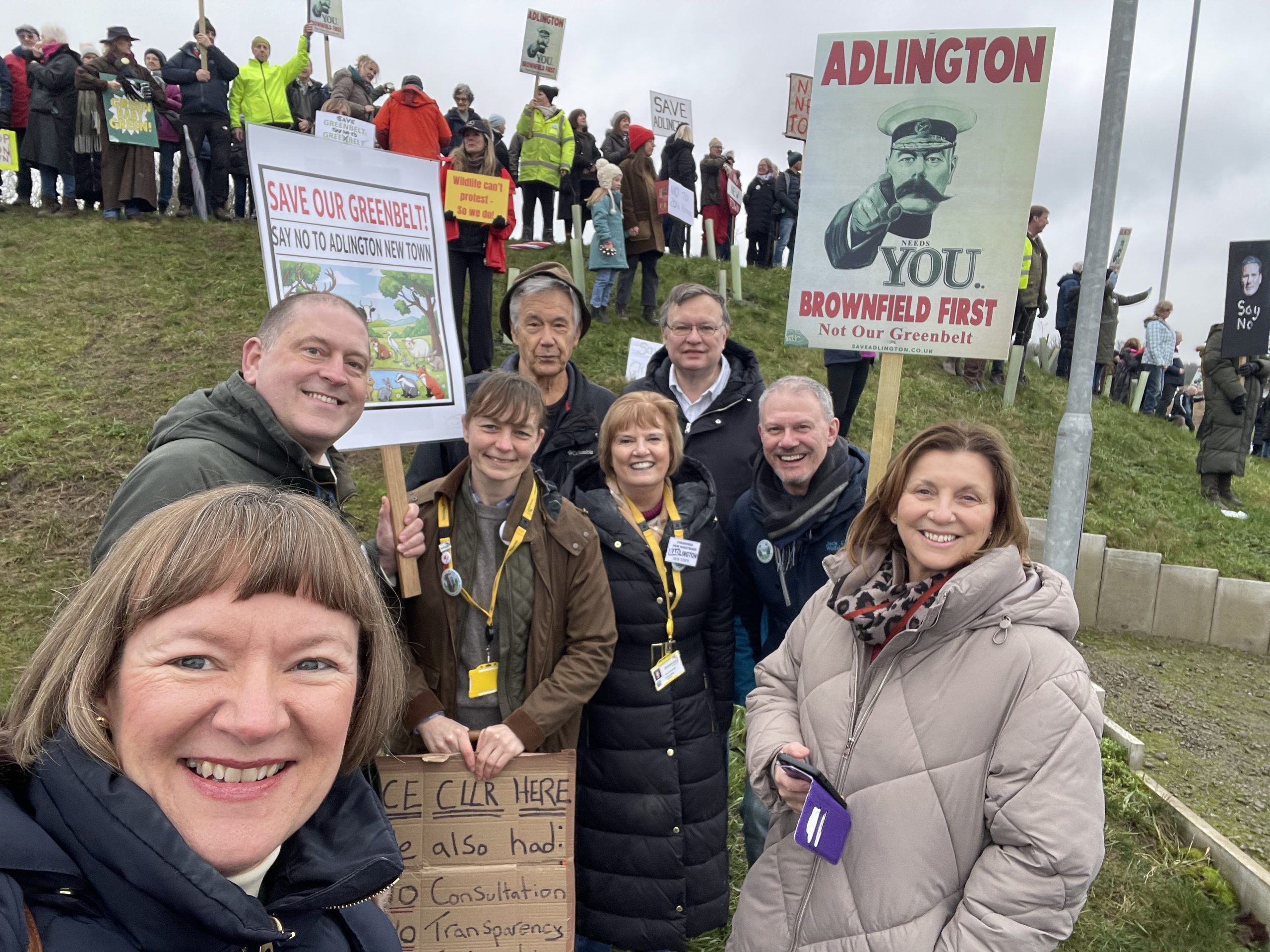
This is a tribute to all the unsung heroes of our campaign to stop Adlington New Town. After rumours which we hardly dared to believe, last week we heard the good news officially. Adlington New Town had been removed from the list of developments being taken forward under Government’s New Towns policy. Originally one of twelve proposed sites, the list has now been reduced to seven. For the local community, this decision has been met with overwhelming relief. We are not naïve enough to think this battle is all over, but that does not diminish the importance of this hard-won victory, closing the door on Adlington New Town and opening the door for brownfield regeneration of our existing towns supported by Ben Fletcher, our Mayoral Candidate for Cheshire & Warrington.
Adlington New Town was a proposed large-scale development of up to 20,000 homes, designed to accommodate around 50,000 people. The site covered extensive greenfield land, including areas of greenbelt, farmland and ancient woodland, effectively forming a continuous urban corridor between Cheshire towns and villages and the outskirts of Greater Manchester.
Unlike other proposals, this scheme was being promoted by a private developer, Belport, rather than in partnership with the local authority, following the purchase of the 970 hectare Adlington Hall Estate in 2023. A Development Corporation would have been established, by-passing local planning and leaving local communities without a say. It represented a fundamental transformation of the local landscape and identity, with significant implications for infrastructure, the environment, and community life.
Opposition to the scheme was not rooted in resistance to development itself. Indeed, the unitary authority, Cheshire East, has 178 brownfield sites which are far more suited to development. There is a clear and widely recognised need for new housing, particularly for younger people wanting to get on the housing ladder. However, this proposal raised many critical concerns.
First, it was fundamentally the wrong development in the wrong location. The scale of the scheme far exceeded local housing need and appeared to be designed primarily as a commuter settlement for Greater Manchester, rather than to serve the needs of existing communities.
Second, the type of housing proposed did not align with local demand. So-called “affordable” housing – defined as up to 80 per cent of market value – would still have been out of reach for many local residents. There was also a lack of suitable provision for first-time buyers and older residents seeking smaller or more accessible homes.
Third, the environmental impact would have been profound. The development threatened greenbelt land and ancient woodland, as well as the distinct separation between towns and villages that defines this part of Cheshire. Tenant farmers had been served notice and many working farms threatened with closure.
Finally, the absence of supporting infrastructure was a major concern. There were no clear plans for additional hospitals, schools, or GP services, despite existing systems already being under strain. Local roads and transport networks were also ill-equipped to absorb such a significant population increase and flooding was a risk.
The community was in shock when the potential New Towns list was published on 28th September 2025. Shock and disbelief gave way to anger and then mobilisation. The local Labour MP found himself in the awkward position of having voted for the enabling legislation with provisions to build on greenbelt but did later come out in support of our campaign.
The success of the campaign was the result of coordinated, determined action across the community. Four key steps were instrumental:
- Grassroots Community Mobilisation. Many local residents organised protests, created campaign materials, and built a strong online presence. Regular demonstrations grew steadily in size, including local farmers on their tractors, attracting regional and national media attention, with coverage from major broadcasters and newspapers.
- Parish and Town Council Collaboration: Bollington Town Council joined forces with six neighbouring parish councils, including Adlington Parish Council, to form a coordinated response under the banner of S.A.N.T, Stop Adlington New Town. A shared fund enabled the commissioning of expert reports including environmental impact, transport and infrastructure needs. In addition, they engaged legal counsel for advice on how to challenge the national planning decision. Many worked tirelessly behind the scenes on detailed work.
- Evidence Gathering through Freedom of Information Requests. Of the many unsung heroes were Conservative Councillors who undertook detailed Freedom of Information requests to establish the extent of prior discussions and work between Cheshire East and the developer. This brought much-needed transparency to the process, holding those responsible to account. The local Labour/Independent led unitary authority originally denied all knowledge and involvement in the proposal. However, it later transpired that the Leader and Deputy had signed a letter of support in June 2025, without which the proposal would never have made it to the original list.
- Support from Environmental and Advocacy Groups Organisations such as Campaign to Protect Rural England and Cheshire Wildlife Trust played a crucial role in raising awareness, mobilising supporters, and providing specialist input on environmental impacts.
This campaign has demonstrated the strength and effectiveness of local democracy. Parish and town councils, often overlooked, proved to be vital in coordinating action, representing residents, and ensuring that community voices were heard. We also benefited with support from our Mayoral Candidate, whose vision for regeneration of our towns resonated with the community.
Above all, it highlighted the power of a united community. This was a David versus Goliath fight. People from all backgrounds came together with a shared purpose: to protect our farms and greenbelt whilst advocating for the appropriate development that our community needs. The lasting legacy of this campaign will not only be the protection of the local landscape, but also the strengthened relationships and resolute determination within the community itself.





![Kamala Comes Unglued, Makes Bogus Claim About Her Landslide Loss to Trump [WATCH]](https://www.right2024.com/wp-content/uploads/2025/10/Kamala-Comes-Unglued-Makes-Bogus-Claim-About-Her-Landslide-Loss-350x250.jpg)