
The U.S. military, along with Israel’s IDF, has reportedly inflicted significant damage to Iran’s navy over the course of the war. However, lost in the fog of war and the Trump administration’s rhetoric is the fact that Iran’s navy comprises two distinct navies, and one of these has not yet been fully destroyed or decimated to the point that Iran can no longer maintain its chokehold on the Strait of Hormuz.
Concerning the state of Iran’s “navy,” admin officials have made somewhat disjointed statements. Trump has claimed the Iranian Navy is obliterated. Vice President JD Vance said March 26, “They don’t have a navy. They don’t have the ability to hit us like they could have even a few weeks ago.” (RELATED: Trump Focused On Iran‘s Nuclear Weapons, Doesn’t Think About Reopening Strait Of Hormuz)
But there have been subtle shifts in Secretary of State Marco Rubio’s comments, suggesting their naval capacities are not destroyed. (Emphasis mine.)
Here’s Rubio on March 26: “[President Trump] defined very clearly on the first night of this operation what the goal was. We were going to destroy Iran’s navy, and that is happening…”

US Secretary of State Marco Rubio gestures as he speaks to the press following a G7 Foreign Ministers’ meeting with Partner Countries before his departure at the Bourget airport in Le Bourget, outside Paris, on March 27, 2026. Foreign ministers from the G7 will take part part in a two-day meeting with European nations and allies seeking to narrow differences with the US on the Middle East war while keeping other crises like Ukraine and Gaza high on the agenda. (Photo by Brendan SMIALOWSKI / POOL / AFP via Getty Images)
Rubio on March 31: “We were going to destroy their air force; we have largely done that. We were going to destroy their navy, which we have largely achieved that.”
When the administration touts the “navy” as destroyed or on the verge of total annihilation, in this slightly shifty manner, it’s important to remember that there are two distinct Iranian navies and these navies serve two entirely different purposes.
On the one hand, the Islamic Republic of Iran Navy “employs a more conventional doctrine and focuses on forward presence and naval diplomacy” with submarines and a surface fleet of older warships, according to a report from the Office of Naval Intelligence. On the other hand, the Islamic Revolutionary Guard Corps Navy (IRGCN) is a different beast, relying on very small boats and drones, and swarming attacks.
“The IRGCN’s doctrine reflects classical irregular warfare principles historically used by revolutionary forces,” the report states. “These principles include the use of surprise, deception, speed, flexibility and adaptability, decentralization, and highly mobile and maneuverable units.”
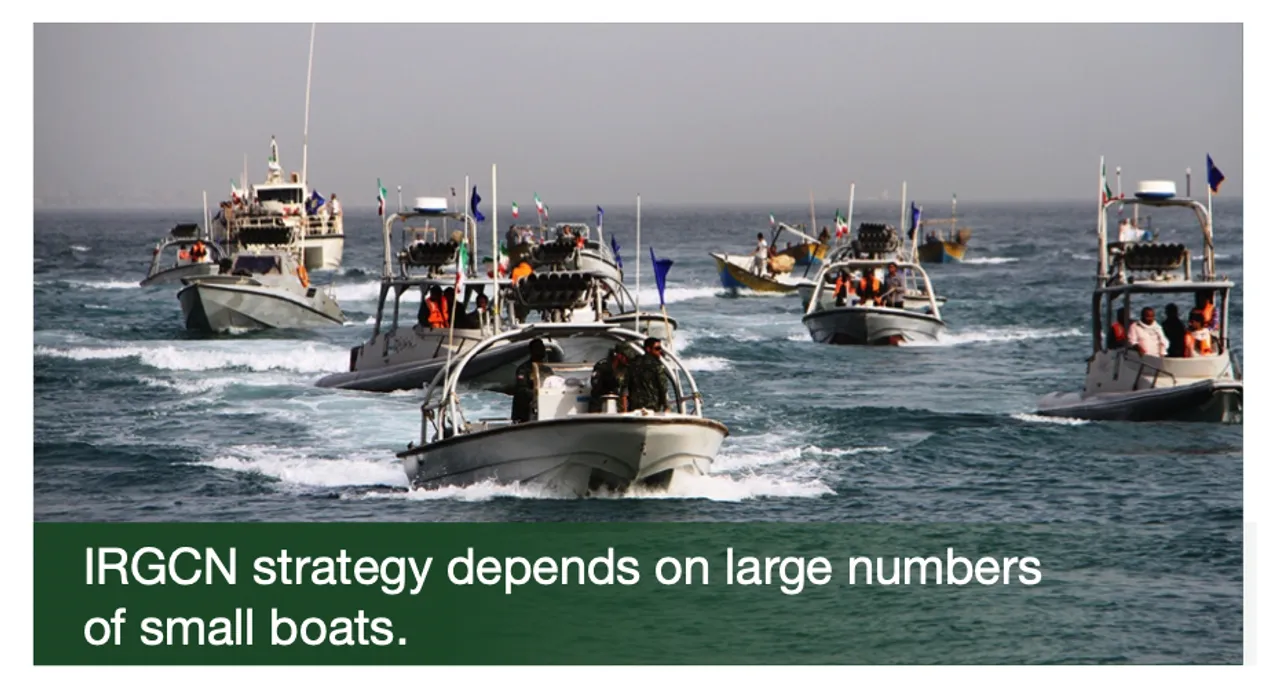
Office of Naval Intelligence
The report goes on, “The doctrine manifests itself as hit-and-run style surprise attacks, or the amassing of large numbers of unsophisticated weapons to overwhelm the enemies’ defense. The amassing of naval forces is often described as a swarm of small boats.”
Future Warfare Magazine published a report March 26 outlining all the confirmed damage done to Iran’s naval assets, which include surface ships, minelayers, missile-launching ships, and drone-launching ships. The outlet also noted the damage inflicted on IRGCN’s “naval dust cloud” forces, some of which include these small boats and amphibious units that can be rigged with mines. Although the IRGCN has suffered hits, the Strait of Hormuz remains closed as of April 3, showing the effectiveness of this asymmetric strategy. (RELATED: Attack Of The Drones: How Iran’s ‘Asymmetric Warfare’ Could Send Shockwaves Through The Cloud)
It also leads one to ask some important, and perhaps uncomfortable, questions about the war and Iran’s strategy. How many assets does the IRGCN still have in its naval dust cloud? Considering they could have thousands of these small boats ready to harass ships, are the losses they’ve suffered so far even that significant? Do the Iranians even care that the conventional surface ships and submarines were destroyed, or were they always banking on the asymmetric strategy this whole time? Did they want the U.S. and Israel to waste time and munitions on the surface fleet ships to buy more time?
The answers may not be so straightforward. What’s clear, though, is that the distinction between Iran’s two navies has been largely blurred by the media, the Trump administration, and top officials.








![Kamala Comes Unglued, Makes Bogus Claim About Her Landslide Loss to Trump [WATCH]](https://www.right2024.com/wp-content/uploads/2025/10/Kamala-Comes-Unglued-Makes-Bogus-Claim-About-Her-Landslide-Loss-350x250.jpg)