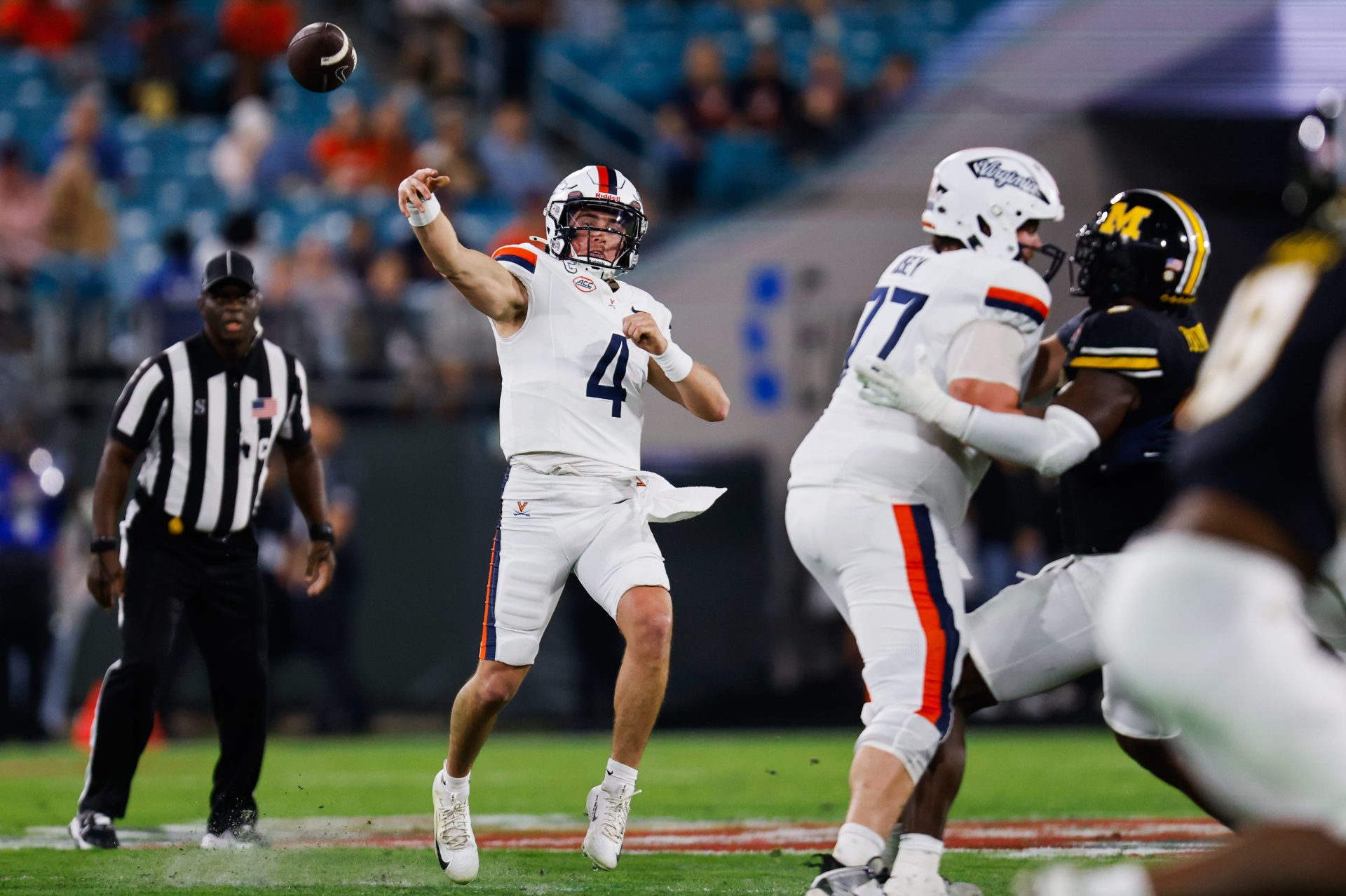
Virginia quarterback Chandler Morris lost his latest attempt to secure one more year of college football on Thursday when a Virginia circuit court judge denied his request for a preliminary injunction, closing the door for now on his push to play a seventh season in 2026.
The ruling came in Charlottesville Circuit Court, where Morris had sued the NCAA in February after the organization denied both his extension of eligibility waiver and his appeal. Morris, 25, had been trying to return for another season after a winding college career that took him through Oklahoma, TCU, North Texas and Virginia. By the time the case reached court, the issue had become part of a much larger national fight over NCAA eligibility rules, waiver requests and the growing number of athletes taking those disputes to court instead of just taking no for an answer.
Morris’ case centered on his 2022 season at TCU. His attorneys argued that he was wrongly denied a waiver tied to that year after he suffered a knee injury in the Horned Frogs’ season opener. According to the lawsuit, the injury significantly affected Morris’ mental health. His legal team said he later returned to appear in three more games as a backup, including the College Football Playoff national championship game, as part of a medically prescribed mental health treatment plan. They argued that the NCAA ignored mental health documentation submitted on his behalf when it denied the waiver.
Here’s What They’re Not Telling You About Your Retirement
The NCAA took the opposite position and said Virginia had failed to prove Morris experienced what the organization considers an “incapacitating physical or mental circumstance.” In its filing opposing the injunction request, the NCAA said Morris had been medically cleared to return in October of that season and had gone on to participate in games. The NCAA also argued that the treatment notes submitted regarding Morris’ mental health did not meet its standards because they were not provided by a licensed psychologist.
After the ruling, the NCAA issued a statement backing the decision and defending its eligibility framework. “The NCAA is pleased by the court’s decision today, which protects the integrity of collegiate competition,” the organization said. “As additional lawsuits challenging common-sense, academically-tied eligibility rules are filed, the NCAA will continue to defend against attempts to rob high school students across the nation of the opportunity to compete in college and experience the life-changing opportunities only college sports can create.” The NCAA added, “The NCAA and its member schools are making changes to deliver more benefits to student-athletes, but the patchwork of state laws and inconsistent, conflicting court decisions make partnering with Congress essential to provide stability for all college athletes.”
The timing is especially notable because Morris was coming off the best season of his college career. In 2025, he led Virginia to 11 wins and an appearance in the ACC championship game. He threw for 3,000 yards and 16 touchdowns in his lone season with the Cavaliers, giving the program a major lift and putting himself back into the spotlight after stops at three previous schools. He played six seasons overall and started 35 games across his career.
The decision also leaves Virginia moving ahead without him. The Cavaliers have already brought in two transfer quarterbacks this offseason, Missouri’s Beau Pribula and Pitt’s Eli Holstein, after Morris’ waiver request was denied. That made it pretty clear the program was preparing for this possibility long before Thursday’s ruling put it in black and white.
This Could Be the Most Important Video Gun Owners Watch All Year
Morris still has options, though they no longer appear to include another fall in Charlottesville unless something changes on appeal. He did not participate in the NFL combine or Virginia’s pro day last month, but he could still pursue the NFL draft, which begins April 23. That now looks like the cleaner path unless another court step changes the direction of the case.
The ruling is also another important courtroom win for the NCAA as it continues to fight a wave of eligibility lawsuits. According to the NCAA, preliminary injunctions have been denied in 33 of 71 eligibility lawsuits filed against the organization. The NCAA said 13 injunctions have been granted, 12 cases are still pending in lower courts, and 13 were voluntarily dismissed before a decision. The broader legal fight remains active across the country. In February, a Tennessee judge denied quarterback Joey Aguilar’s request for a preliminary injunction. Last week, Ole Miss quarterback Trinidad Chambliss was cleared to return in 2026 after the Mississippi Supreme Court denied the NCAA’s appeal. Oklahoma linebacker Owen Heinecke and Cal defensive lineman Aidan Keanaaina have also sued in hopes of gaining another year.
The opinions expressed by contributors and/or content partners are their own and do not necessarily reflect the views of LifeZette. Contact us for guidelines on submitting your own commentary.



![Two Dead, 14 Injured After Gunfire Erupts Following College Football Game in Alabama [WATCH]](https://www.right2024.com/wp-content/uploads/2025/10/Two-Dead-14-Injured-After-Gunfire-Erupts-Following-College-Football-350x250.jpg)
![CNN's Kaitlan Collins Fact-Checks Rep. Jasmine Crockett Over False Trump Ballroom Claim [WATCH]](https://www.right2024.com/wp-content/uploads/2025/10/1761954330_CNNs-Kaitlan-Collins-Fact-Checks-Rep-Jasmine-Crockett-Over-False-Trump-350x250.jpg)