“The Risen One is not where we left him; he goes before us.”
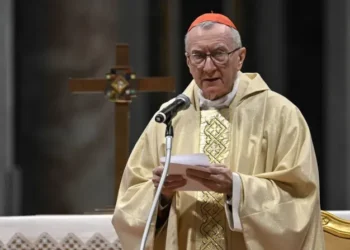
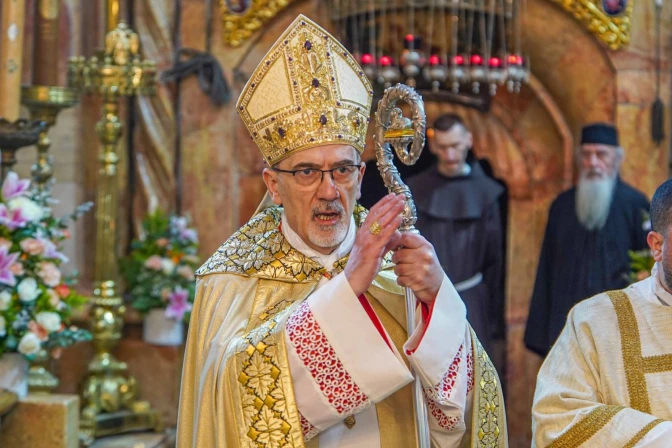
With this affirmation, the Latin patriarch of Jerusalem, Cardinal Pierbattista Pizzaballa, proclaimed in the the Church of the Holy Sepulchre that Easter does not confirm human certainties but rather unsettles them to open the believer to a living faith.
From the very place where Jesus conquered death, the cardinal said: “Here, inside this sepulcher, we are not facing a symbol: We are facing a real emptiness. An emptiness that is not an absence but a proclamation.”
He explained that the Gospel account depicts Mary Magdalene confronting uncertainty, uttering the first expression of authentic faith: “We do not know where they have laid him.”
“God does not allow himself to be possessed. The Risen One is not where we expected him to be. He is not confined by the boundaries of our certainties,” he emphasized, pointing out that “it is not we who protect God; it is God who sets us free.”
In his reflection, the patriarch warned against a comfortable or routine religiosity. “We, on the other hand, would like a kind of faith that does not turn our world upside down,” he said, noting that in the Resurrection, “God does something we did not ask for: He withdraws. Not to flee, but to save us from a misunderstanding — that faith is something to be possessed.”
Reflecting on the empty tomb, the cardinal said that signs such as the folded burial cloths indicate that the Resurrection is not a magical act but a manifestation of freedom: “Death is no longer a garment that conceals but a garment that has been carefully set aside, no longer needed.”
The cardinal also linked the Easter message to the current political reality in the Holy Land, which is marked by conflict. “We know all too well that many stones remain sealed around us,” he lamented, referring to “hatred, violence, and retaliation.”
In that context, he issued a warning: “It seems that we place the Lord back in a tomb every time we believe that death has the final word over history.”
In light of this, he affirmed that Easter “is not a distant dogma but a defiance of resignation. It is the only hope that can still open, here and now, the gates of peace.”
The patriarch further emphasized the universal character of Christianity, reminding people that “God shows no partiality” and that “no life is ‘too lost’ to be sought.”
He maintained that Christianity is not reduced to contemplation but rather consists of actually following Christ: “The Risen One is not an object of worship; he is a person who calls. He is not merely to be contemplated; he is to be followed.”
Likewise, he warned of the risk of stripping Christian life of its meaning: “Even holy places can become museums if they do not become an exodus [a going forth] … the liturgy can become routine if it does not lead to conversion.”
Finally, Pizzaballa called for living out Easter concretely in daily life, saying that “stepping out [of the empty tomb] means choosing forgiveness when it would be easier to harden our hearts; choosing truth when it would be more comfortable to conform; choosing hope when everything suggests the opposite.”
“Easter is not a phrase to be repeated; it is a door to be walked through. The stone has been rolled away. The passage is open. But we must decide whether to stay inside or go out,” he affirmed.
The patriarch concluded with the central proclamation of the Christian faith: “The Lord is risen! And precisely because he has risen, we will never find him where we left him. We will find him standing before us, calling us out.”
This story was first published by ACI Prensa, the Spanish-language sister service of EWTN News. It has been translated and adapted by EWTN News English.