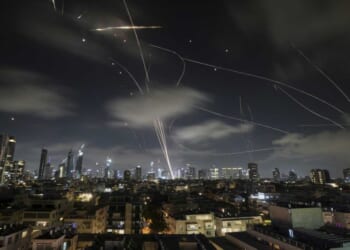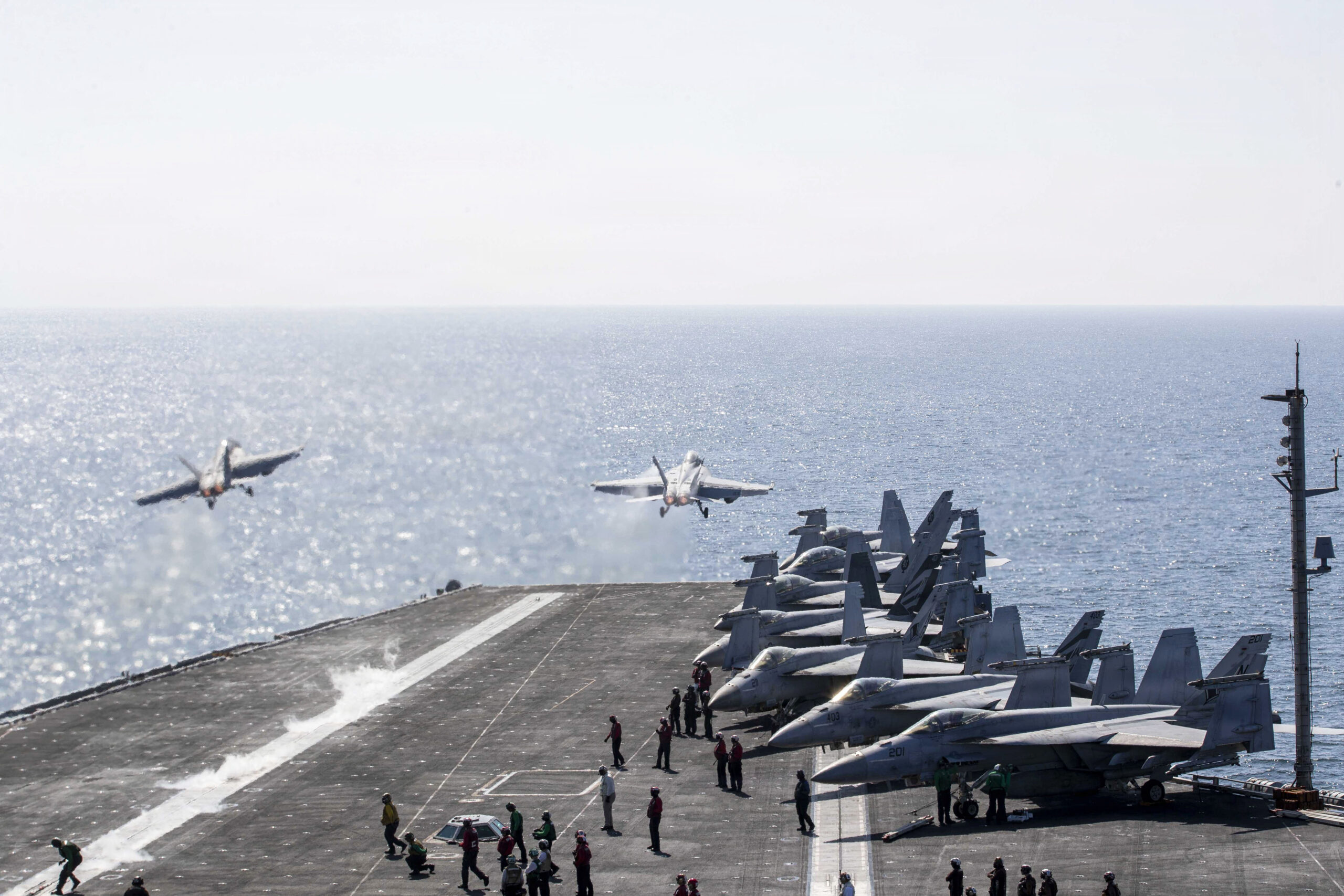
A front-page story in the March 1 New York Times called the American/Israeli attack on Iran “the ultimate war of choice” — according to the Times’s account (questionable), Iran was farther from having nuclear weapons, thanks to the U.S./Israeli attack on its nuclear facilities last June, than it had been for several years. The story complained that President Trump had launched the attack without spending months “building a case” for it, and wondered why we chose this target amid “the pantheon of threats” such as nuclear-armed North Korea and “the expanding nuclear arsenals and territorial ambitions of Russia and China.” (RELATED: Americans Are Skeptical of the Iran Strikes. That’s a Good Thing.)
Of course, by the Times’s reasoning, the June attack must also have been a war of choice, since Trump hadn’t demonstrated the imminence of an Iranian attack despite evidence of the near-completion of the capacity for making nuclear weapons, and the ayatollahs’ repeated threats of “death to America” ever since they took power in 1979. (And the question of why the U.S. didn’t choose instead to attack already nuclear-armed antagonists would seem to answer itself.)
If France and England had challenged Adolf Hitler’s 1935 rearmament of the Rhineland in violation of the Versailles treaty, Hitler would likely have been overthrown by his military…
In truth, in today’s world, the distinction between wars of necessity and of choice, popularized by former National Security official Richard Haass (who used it to distinguish between the first and second Iraq wars), is essentially arbitrary. If France and England had challenged Adolf Hitler’s 1935 rearmament of the Rhineland in violation of the Versailles treaty, Hitler would likely have been overthrown by his military, and there would have been no World War II and Holocaust.
Although America’s 2023 attack on Saddam Hussein’s regime did not uncover the nuclear facilities we expected him to have developed (that attack had been supported by leading Democratic and Republican politicians, including Bill Clinton, on the basis not only of intelligence reports), but because Saddam had previously constructed a nuclear facility in Osirak, Syria, destroyed by Israel in 1981, and had repeatedly evaded Western sanctions designed to prevent him from renewing his program of developing weapons of mass destruction, and had taken steps to interfere with Allied inspections. And indeed, in the years immediately preceding the attack, pressure from our Western allies had led U.S. Secretary of State Powell to propose substituting “smart sanctions,” less demanding, as the only way to keep the allies on board as well. Is there any reason to think that, once the sanctions and inspections were relieved or removed, this practitioner of mass murder (and aggressor against both Kuwait and Iran) would not have resumed his quest for WMD?
And as a final example of the dangers of deferring action against a potential aggressor until it’s too late to stop him, consider America’s failure to destroy North Korea’s nuclear weapons in their construction phase during the 1990s — leading to a situation wherein this murderer’s capacity to threaten the world as he continues developing his nuclear arsenal can no longer be halted?
As Henry Kissinger points out in his classic Diplomacy, a nation typically finds itself in the position of having to make military decisions on the basis of imperfect information (unless it has already been attacked). This entails, as I’ve suggested, the necessity of launching preemptive strikes against well-armed potential aggressors — especially those like Hitler, Stalin, Saddam, and the ayatollahs, who have openly declared their plans to subjugate other nations (and in the Iranian case, have already killed thousands of Americans). While there may be regrettable consequences if we launch an attack against a country that has not (yet) constructed the arsenal it needs to accomplish its aggressive aims, the consequences of not acting in time may be far worse. (RELATED: War With Iran: Justified Strike, Uncertain Horizon)
Nonetheless, the Times’s complaint was immediately echoed by Democratic Senator Tim Kaine, a member of the Foreign Relations Committee, who claimed that if only Trump hadn’t withdrawn the U.S. from the Joint Comprehensive Plan of Action (JCPOA), which purported to set limits on Iran’s development of weapons-grade nuclear materials in return for the relaxation of Western sanctions, in 2018, there wouldn’t have been an Iranian nuclear program to worry about at all. (The ayatollahs had already blocked inspection of their most critical facilities, making the agreement a dead letter. The JCPOA also set no limits on Iran’s development of a huge arsenal of missiles, which could be used for either nuclear or non-nuclear purposes, with terrible effects even in the latter case.) And while Kaine celebrated the “incredible” concessions the Ayatollah had made to Trump following the start of the American–Israeli attack, all he offered was a reduction in his regime’s level of nuclear enrichment while vowing never to give up that capacity, which could easily have been restored to weapons-grade in not a long time. (Ostensibly, the enrichment was just for “medical research” purposes.) (RELATED: US and Israel Continue to Degrade the Islamic Republic)
The daily headlines offer many similar complaints from Democratic pols, sympathetic journalists, and some Republicans about Trump’s precipitancy. After all, as the Times editorial board wrote on March 2, Trump failed to act as a “reasonable” American president would have done by first clearly explaining to the public a “justification for attacking [Iran] now, even though Iran does not appear close to having a nuclear weapon.” (If the latter were true, it would be the result of the joint Israeli–American attack on the country’s nuclear facilities last June — a fact unacknowledged by the editorial. But in fact, evidence has grown that following the attack, the ayatollahs immediately set about constructing a new nuclear facility even deeper underground than its predecessors, thus less susceptible to destruction.) Much as we might “hope” that decapitating Iran’s regime would “lead to the end of Iran’s theocracy,” the editors warned, such an attack also contains “long-term risks for both Iran and the United States.” Yet just after pooh-poohing the urgency of an attack on Iran, the editorial goes on to warn that the regime already “maintains an arsenal of missiles capable of overwhelming defense systems,” having just hit a U.S. Navy base, along with the possible capacity “of launching cyber-attacks and proxy strikes against American forces and allies.” So this is a reason not to attack the regime just now??
Here is a more general conclusion: contrary to Haas, and to many of Trump’s critics, the contemporary world, at least as it concerns the citizens of nondespotic regimes, does not lend itself to any clear distinction between “wars of necessity” and “wars of choice.” Human history, of course, records a vast number of “wars of choice,” from the conquests of Alexander the Great, Genghis Khan, and Napoleon, to the disastrous Athenian expedition aimed at subjugating Sicily during the Peloponnesian War. But in the post-World War II and post-colonial era, Western liberal democracies, and similar regimes like Japan, are highly unlikely to “choose” wars for what appear purely arbitrary reasons like glory or religious salvation. The reason is that the citizens of such regimes (along with some others, from much of South America to even, possibly, today’s Vietnam) are far more interested in the gains that can be achieved through peaceful economic activity; lack interest in sacrificing their lives purely to enhance their nation’s fame; and no longer believe in gods who command them to destroy unbelievers. And finally, in the age of weapons of mass destruction, the consequences of a major war are likely to be much deadlier than they were in the past.
The real “choice” that free and pacific nations face today, then, is not whether to “choose” to fight wars that don’t seem essential to their survival as self-governing peoples. It is rather whether to launch pre-emptive attacks against aggressive and militarily powerful regimes that threaten to destroy them if they don’t act first. And that is a decision that must be based on prudential judgment, based on the fullest possible information, but also with the awareness that, as Machiavelli put it in The Prince, wars (against such potential aggressors, I add) are postponed only to the future aggressors’ advantage. Just as a prudent adult would not set aside worries about his family’s future by adopting the attitude of Charles Dickens’s Mr. Micawber (“something will turn up”), no prudent nation can afford to kick the can of massive nuclear, chemical, or missile attack by a declared enemy down the road by saying “well, they won’t be able to do it for a few more years.”
READ MORE from Daniel Lewis Schaeffer:







![Donald Trump Slams Chicago Leaders After Train Attack Leaves Woman Critically Burned [WATCH]](https://www.right2024.com/wp-content/uploads/2025/11/Trump-Torches-Powell-at-Investment-Forum-Presses-Scott-Bessent-to-350x250.jpg)