Suddenly Something Clicked: The Languages of Film Editing and Sound Design
By Walter Murch
Faber & Faber, 368 pages, $45
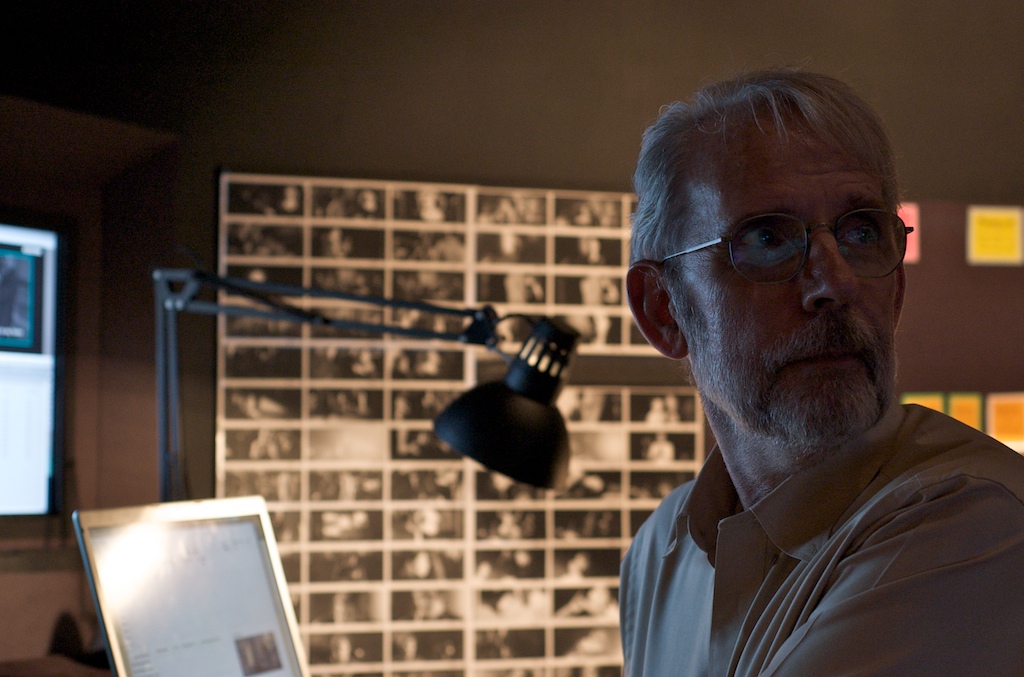
Now 82 years old, Walter Murch is the Hollywood legend you’ve never heard of. He was the film editor on Julia, the sound editor on Godfather, Godfather II, and American Graffiti, and both film and sound editor on Apocalypse Now, The Conversation, Godfather III, Ghost, The English Patient, The Talented Mr. Ripley, and Cold Mountain, among many other movies. He’s won Oscars in both categories. And now he’s the author of a fun, fascinating book about these often neglected aspects of filmmaking entitled Suddenly Something Clicked: The Languages of Film Editing and Sound Design.
Murch’s title comes from the Russian author Maxim Gorky, who in 1896, at age 28, attended a screening in Nizhny Novgorod by the Lumière brothers, the French cinematic pioneers whose Cinématographe, a combined camera and projector, enabled them to share the short films they’d made with audiences hither and yon. Cinema was then in its infancy — the brothers had been exhibiting their work publicly for just a year or so — but at first Gorky wasn’t impressed by their revolutionary moving images. What did finally thrill him was something that we would now take entirely for granted: a cut. The brothers’ film had been capturing a street scene in Lyon, and then, as Gorky later wrote, “suddenly something clicks, everything vanishes and a train appears on the screen. It speeds straight at you — watch out! It seems as though it will plunge into the darkness in which you sit.”
Indifferent to the magic of film, in short, Gorky was dazzled by the magic of film editing.
Before it was tried, observes Murch, there was no reason to take it for granted that film editing would even “work.” In other words, it might well have turned out that the human brain was not wired in such a way as to process sudden shifts from one moving image to another. Happily, however, “audiences not only quickly grasped the grammar of continuity, but came to enjoy, and then hunger for, those sudden and often delightfully surprising juxtapositions — visual chord changes, so to speak.”
There are, Murch points out, two basic ways of thinking about film editing. In the Romance and Slavic languages, the words for film editing — montage, montaggio, montaje, монтаж — “emphasise the architectural aspects of our work: a plumber will monte together the pipes of a house, just as a film editor will plumb together the shots of a film.” By contrast, the English, German, and Scandinavian words — editing, Schnitt, redigering — “highlight instead the cutting-down and reorganisation of a pre-existing assembly.”
Film editing, of course, involves both construction and cutting down, but the ultimate goal is to put something together. Hence Murch prefers the word montage to editing. After all, as he puts it, the word “editor” suggests that a film editor’s task, like that of book or newspaper editors, “is to cut down and rearrange a work created by someone else”; but in reality it’s the film editor “who produces the first version, painstakingly constructing it over many weeks (or months!) from thousands of shots, guided by the screenplay and the director’s notes. This is shown to the director, who suggests changes. And then it is the film editor who makes those changes, producing a second version, which is shown to the director, who suggests further amendments, and so on.”
If you think there’s not much of interest to say about film editing and sound editing, Murch proves you wrong on every page.
If you think there’s not much of interest to say about film editing and sound editing, Murch proves you wrong on every page. He proffers glimpses of history: “Carl Dreyer’s classic The Passion of Joan of Arc (1928) was reassembled out of initially rejected takes after the original cut negative was destroyed by fire at a laboratory in Germany.” He covers technical advances: thanks to the limitations of the optical soundtrack (which was located “just inside the sprockets on every 35mm film print”), film sound was no better in 1970 than in 1940 — but improved radically with the advent of Dolby stereo, first used on Star Wars.
Murch reminds us that in some cases, the film editor’s job is a lot bigger than in others. “During Hollywood’s ‘golden age’ (1930–60),” he writes, the shooting ratio — that is, the proportion of exposed film to the amount used in the final cut — “averaged 10:1.” But the number can vary widely: “Many of Alfred Hitchcock’s films had an amazingly low ratio of 3:1. On Zinnemann’s Julia, which I edited in 1977, it was 34:1, ten times Hitchcock’s proportion. On Apocalypse Now the ratio ballooned to 95:1, Mad Max: Fury Road (2015) was 240:1, while on Coup 53 it was 266:1, almost a hundred times that of Hitchcock.”
But the most engaging parts of the book are the anecdotes drawn from Murch’s own career. He explains in rich detail how, given a week to overhaul an unsatisfactory edit of Francis Ford Coppola’s 1974 masterpiece The Conversation, he managed — by removing certain sequences and moving various bits and pieces around — to achieve “a quicker alternation” between the scenes focused on character and those focused on advancing the narrative, and thereby dramatically alter the film’s rhythms, increase the tension, add resonance, and highlight the film’s “moral dilemma.”
On to The Talented Mr. Ripley, whose producer, Harvey Weinstein, was notorious not only for abusing actresses but, Murch tells us, “for taking versions of the films he was financing back to his editing room in Connecticut to see how he could ‘improve’ them.” This happened with Ripley, whose director, Anthony Minghella (fresh off an Oscar win for The English Patient), “was so outraged that he ‘fired’ Harvey.” The conflict concerned the movie’s last 20 minutes: should Ripley get away with his final murder, or not? In the end, Murch and Minghella came up with an ambiguous ending in which they “fracture[d] the time sequence so that the audience never saw the murder take place, hearing instead its delayed soundtrack, while Ripley, stone-faced and alone in his cabin, was multiply reflected in the slowly swinging mirrored doors of his closet.” Weinstein was satisfied enough with this ending — which was, in fact, perfect — to back off.
Murch has another cool Ripley anecdote, this one about the sound. Remember when Ripley (Matt Damon) first meets Dickie (Jude Law) and does a great imitation of Dickie’s father, Herbert Greenleaf (James Rehborn)? When Minghella first shot the scene, “Matt did a workmanlike imitation, but it was not good enough to justify Dickie’s amazed ‘Uncanny!’ reaction.” So during the looping process, a recording of Rebhorn reading Matt’s line was “fed into Matt’s headset” so he could “take those phrases and then convolute his own vocal cords into an astonishing imitation of Rebhorn’s voice.” Alas, the result was so good that Minghella feared cinema-savvy audiences would think it was Rebhorn’s own voice, dubbed in as a cheat. The solution: syllable by syllable, some parts of Matt’s imitation were replaced with earlier takes, making it “less convincing,” and thus, “[i]n a paradoxical way,… more convincing.”
Then there’s Murch’s story about restoring Orson Welles’s 1948 classic Touch of Evil. As with many of Welles’s films, the studio — Universal, in this case — had denied him the final cut and released a version that he loathed. Four decades later, Universal changed its mind. Presented with the negative of the final cut, a preview print including missing footage, and a magnetic master of the original soundtrack — as well as with a memo by Welles explaining in detail how he’d re-edit the final cut — Murch was asked to restore the film to match Welles’s vision. Murch recounts this process in exciting detail. I’ll limit myself here to his work on the famous opening shot, which shows Charlton Heston and Janet Leigh walking in a shabby U.S.-Mexico border town and which ends with a car bomb exploding.
In the released film, the shot, which was run under the opening titles, had no sound other than the Henry Mancini score; but when Murch stripped away the score from the magnetic masters, “something was revealed that had been hidden for forty years: the sound effects track for this opening scene. It was a complete surprise to us that it even existed, buried as it was under the score.” The track was awash in ambient sound — laughter, sirens, Latin music, goats bleating — and, significantly, the sound of rock ‘n’ roll playing on the radio of the car containing the bomb. As the car kept moving in and out of the shot, the rock ‘n’ roll, too, came and went, enabling the audience to “track the progress of the car with the ticking bomb in it.” Murch’s restoration of this original track ramped up the tension like crazy: “When the opening shot had titles and music on it, the audience would ‘know’ subconsciously that the bomb will not explode until the titles are over. In the new version, there is the possibility that the bomb could go off at any time.” Brilliant.
I could read a whole book by Murch about the sound design of The Godfather and The Godfather Part II, scene by scene. Readers of Suddenly Something Clicked will have to be content with somewhat less than that. Remember the “rumbling and piercing metallic scream just before Michael Corleone kills Sollozzo and McCluskey”? Yes, the viewer understands that it’s an elevated train. But we don’t see the train. So for an instant, and “perhaps only subconsciously,” we’re taken aback, perhaps even confused, by the sound — and “precisely because it is so detached from the image, the metallic scream works as a clue to the state of Michael’s mind at that moment — the critical moment before he commits his first murder and his life turns an irrevocable corner. It is all the more effective because Michael’s face appears so calm and the sound is played so abnormally loud.” See what I mean about wanting an entire book about this stuff?
But let’s not be greedy. The book in hand is far more than any cineaste could dare ask for. Immensely learned, consistently enthralling, and splendidly written, Suddenly Something Happened is a marvel, its 350 large-format pages incorporating an abundance of photos and graphs, plus a snazzy space-age bonus: a hundred or so marginal QR codes linking to documents, videos, and audio files of interest that illustrate matters discussed in the text. But this volume, remarkably, isn’t Murch’s last word. As he explains in the introduction, the present opus will be succeeded by an even longer one focusing on “the script, the casting and the vision of the director.” I can’t wait.
READ MORE from Bruce Bawer:
Guess What the New Yorker Thinks of the Kennedy Center’s New Name?
Can Being Charlie Tell Us Anything About the Reiner Murders?
![Scott Bessent Explains The Big Picture Everyone is Missing During the Shutdown [WATCH]](https://www.right2024.com/wp-content/uploads/2025/11/Scott-Bessent-Explains-The-Big-Picture-Everyone-is-Missing-During-350x250.jpg)





![Florida Files Supreme Court Case After Illegal Immigrant Truck Driver Kills Three [WATCH]](https://www.right2024.com/wp-content/uploads/2025/10/Florida-Files-Supreme-Court-Case-After-Illegal-Immigrant-Truck-Driver-350x250.jpg)