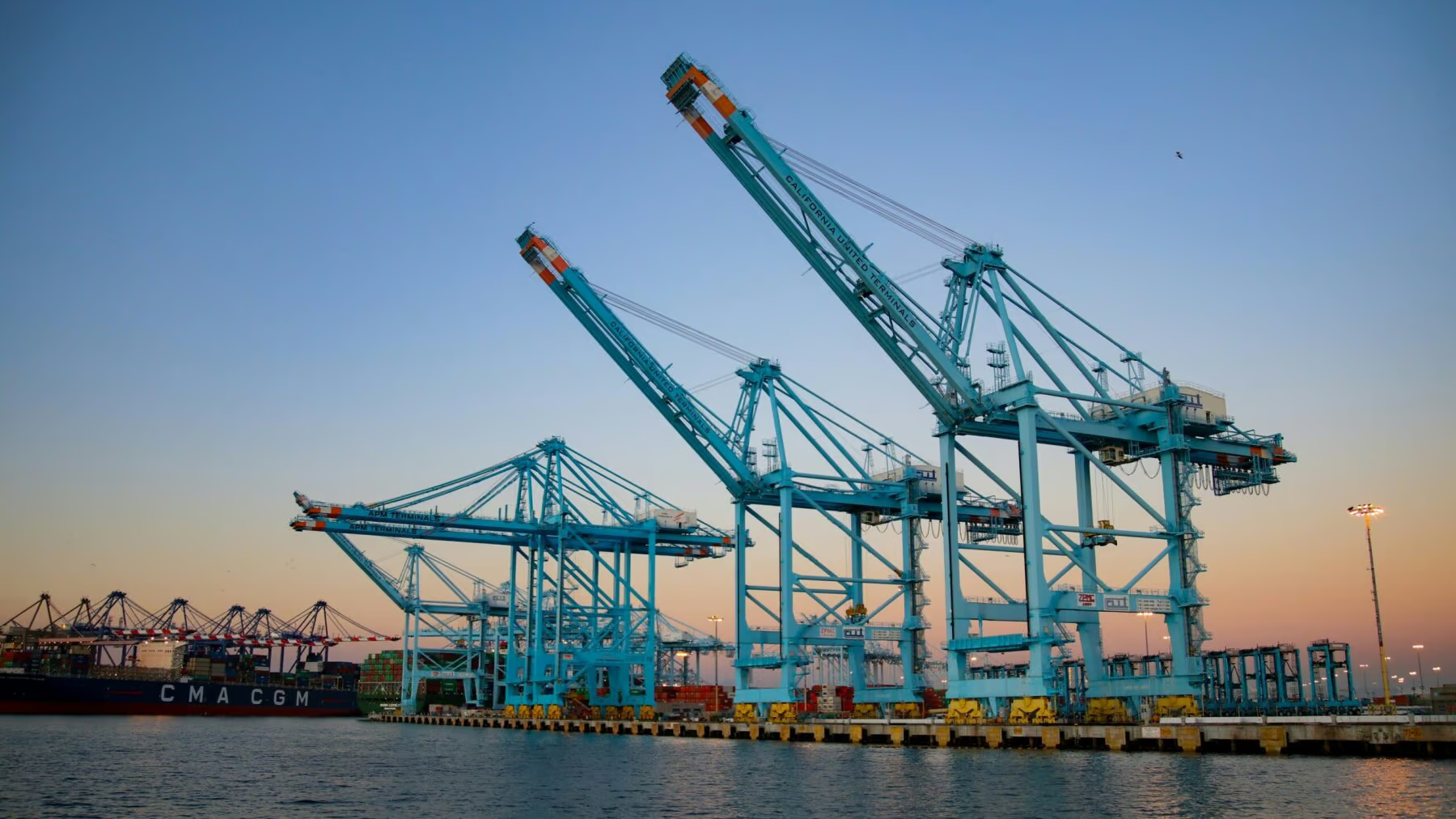
For years, Americans assumed China’s loan diplomacy stopped at dusty ports in Africa or half-built rail lines in South Asia. The Belt and Road Initiative (BRI) was something that happened “over there.” A distant problem. Someone else’s crisis. But the newest data tells a different story — a darker, more unsettling one. The United States, the richest nation on earth, is now the single largest recipient of Chinese lending. (RELATED: Foreign Affairs Features a Recipe for Defeat in Cold War II)
More than $200 billion has flowed from Beijing into nearly 2,500 American projects, according to AidData’s sweeping report. Critical infrastructure. Energy. Data centers. High-tech acquisitions. Port terminals. Even Fortune 500 giants have latched onto China’s bottomless bankroll. What once felt like an abstract geopolitical contest suddenly lands on American soil with a deafening thud. (RELATED: America’s Strategic Blind Spot in the Global Chip Race)
The question is no longer how China influences developing countries. The question is how far into America this influence already runs.
China never gives anything away. Not money. Not materials. Not “partnerships.” Every yuan comes with a string, and every string is part of a chain. Once that chain tightens, it does not loosen voluntarily.
China understands something American politicians often forget: control the infrastructure, and you control the nation.
This is why Beijing’s move into wealthy nations matters more than anything it has built in the developing world. When China bankrolls an airport terminal in Los Angeles, a natural-gas project in Texas, or a data center in Northern Virginia, it gains something far more valuable than profit. It gains presence. It gains leverage. And slowly, almost invisibly, it gains power over the pipes, ports, grids, and digital arteries that keep the United States alive. (RELATED: Some Dare Call It Treason)
China understands something American politicians often forget: control the infrastructure, and you control the nation.
These loans do not simply finance construction. They shape dependency. Imagine a future scenario in which U.S. policymakers attempt to crack down on a Chinese tech giant siphoning American data. Beijing would not need to threaten war. It could quietly remind U.S. officials how many major projects — pipelines, energy terminals, transportation hubs — rely on Chinese capital or Chinese contractors. (RELATED: How To Beat China in the Great Power Competition)
And history shows how China uses this leverage. Countries from Sri Lanka to Montenegro learned too late that Chinese financing is not a gift but a mortgage, one backed not by goodwill but by state power. Ports end up leased for 99 years. National budgets buckle. Surveillance tools appear in “pilot programs” that never seem to end. Chinese security firms arrive to “manage risk.” Before long, a sovereign country must ask Beijing’s permission to move inside its own borders.
Now imagine that template placed atop the United States. Data centers funded by Chinese state lenders. Supply chains tied to Chinese creditors. High-tech firms acquired with significant Chinese backing. Airports whose major expansions were paid for by the same country that funnels fentanyl precursors to criminal networks in Mexico. Energy corridors built with money from a Communist Party that openly says it intends to surpass — and, when possible, weaken — the United States. (RELATED: Trump’s Intel Holding: Will It Help US Defeat China, Inc.?)
Once you accept the money, you accept the leverage. Money is never neutral, and China never plays for second place.
China’s strategy is simple: If you can’t conquer a country, bankroll it. If you can’t beat America militarily, bind it financially. A superpower leaning on foreign cash is already halfway compromised.
This isn’t paranoia, but pattern recognition.
There is also a cultural cost. A country that outsources its ports, pipelines, data centers, and high-tech assets is a country outsourcing not just infrastructure, but independence. Great nations are built on self-reliance. The more China bankrolls American essentials, the more America resembles a client state pretending to be sovereign.
This path leads somewhere dark. Imagine a decade from now. China escalates pressure over Taiwan. The U.S. considers sanctions or naval deterrence. Beijing responds not with missiles but with ledgers. It signals that freezing Chinese assets, blocking Chinese firms, or restricting Chinese technology may trigger defaults on American projects financed with Chinese credit. Jobs would be threatened. Supply chains disrupted. Energy grids destabilized. U.S. officials, fearing domestic chaos, hesitate. And that hesitation becomes victory for Beijing without firing a shot.
This is how modern conflict unfolds: subtle at the start, a stranglehold at the end
Breaking this chain will not be easy, but it is still possible.
America must ban Chinese financing in critical infrastructure. No exceptions. No loopholes disguised as “private partnerships.” If it powers the country, moves the country, feeds the country, fuels the country, or stores the country’s data, it must not be backed by Beijing.
Next, Washington must rebuild what it allowed to decay. Ports, pipelines, semiconductor plants, rare-earth supply chains — these must be American-built with American capital or from trusted allies who share its security concerns,
Transparency is essential. Every American should know which companies depend on Chinese credit. Every state should know how much of its grid, freight, or broadband relies on Beijing’s banks.
Finally, Congress must treat economic security as national security. Because it is. America cannot remain free if its infrastructure is rented, its supply chains borrowed, and its digital backbone indebted to an authoritarian rival.
If the chain is broken now, the nation keeps its footing. It stays sovereign, steady, and capable of resisting outside pressure. But if nothing changes — if the loans pile up, the leverage deepens, and the illusion persists that a superpower can borrow from its chief rival without consequence — then the next crisis will not arrive with troops or missiles. It will arrive through contracts, debts, and obligations accepted because they seemed easy in the moment.
Armies seldom bring nations down. Bad decisions do.
And China is banking on a few more bad decisions being made.
READ MORE from John Mac Ghlionn:
Trump’s Third-World Ban Misses the One Thing That Actually Matters
Why Is Italy Killing Its Women?
A PSA to Women: This Type of Man Won’t Save You When It Counts






![Trump, Hegseth to Get Troops Paid Despite Dems Voting Against it Eight Times [WATCH]](https://www.right2024.com/wp-content/uploads/2025/10/Trump-Hegseth-to-Get-Troops-Paid-Despite-Dems-Voting-Against-350x250.jpg)
![Keith Ellison Caught Promising to Fight State Agencies for Somali Fraudsters [WATCH]](https://www.right2024.com/wp-content/uploads/2026/01/Keith-Ellison-Caught-Promising-to-Fight-State-Agencies-for-Somali-350x250.jpg)