Dr Austen Morgan is a barrister at 33 Bedford Row Chambers. He is the author of: Pretence: why the United Kingdom needs a written constitution, London 2023.
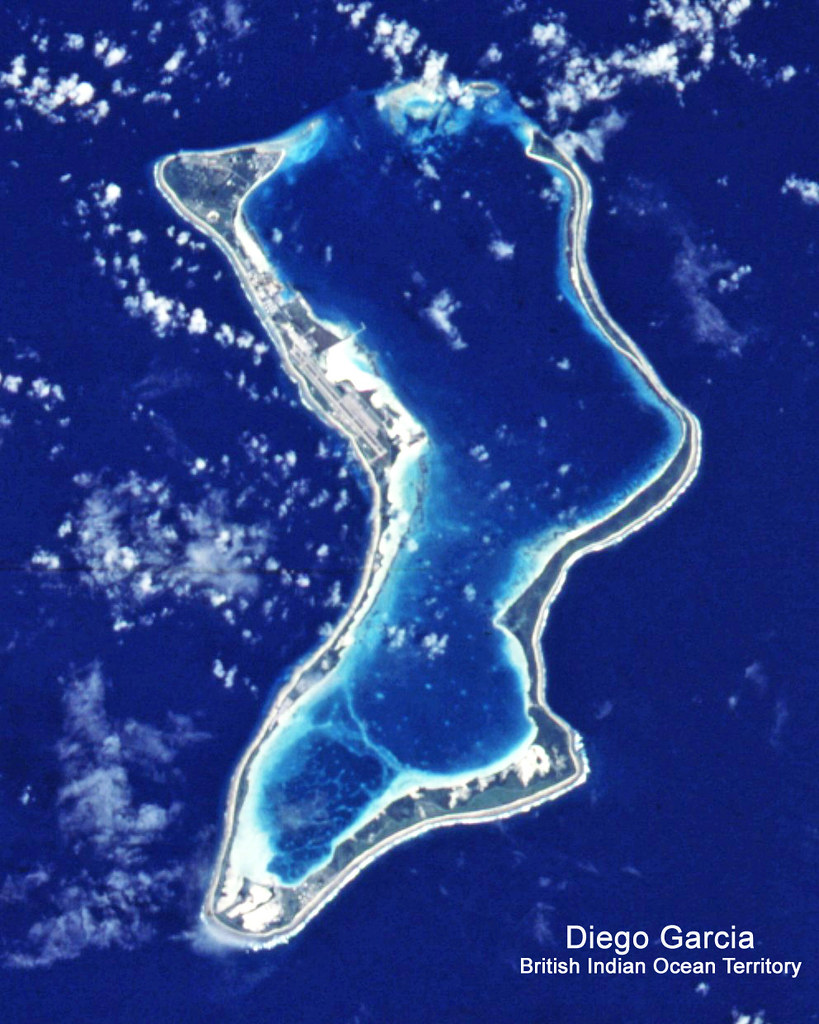
With US launching attacks on Iran, the crisis over Diego Garcia – the formally joint UK/US military base on the Chagos Archipelago, part of our overseas territory or colony (the British Indian Ocean Territory [‘BIOT’] established in 1965) – is becoming global.
The argument over Britain not allowing its use to the US for the initial airstrikes last weekend has amplified it.
When the UK granted Mauritius its independence eventually in 1968, the country’s leaders – in return for financial payments – agreed to the hiving off of BIOT. That did not stop Mauritius’s later leaders playing the decolonization card: the February 2019 advisory opinion of the International Court of Justice (which did not bind the UK); and the May 2019 resolution of the UN general assembly (which is not part of international law).
Prof Philippe Sands KC of Matrix chambers represented Mauritius over the years. His head of chambers became Richard Hermer KC, now the attorney general. And the latter had been led, at Doughty Street chambers, by Keir Starmer KC, the just about hanging on prime minister. These three musketeers share a – incorrect – view of the rule of law as dominated by international lawyers and judges.
It was the labour government of Harold Wilson which ordered the expulsion of the Chagossians from the Archipelago (1968-73), to the Seychelles and to Mauritius, where they were treated badly (as I learned on a visit in 2023). Many of the Mauritian Chagossians now live as British citizens in Crawley, near Gatwick.
Supporters of the Chagossians, those who believe in the rule of law, and those concerned with international security (particularly the threat of growing Chinese influence in Mauritius), have had to contend with Jonathan Powell, now the national security adviser in the cabinet office, and a Sinophile, the architect of the May 2025 – leaseback – UK/Mauritius treaty, which is mercifully well and truly stalled in parliament.
Faced with a fickle and unpredictable Donald Trump, who is being pushed hither and thither whilst pushing back himself, opponents of the current labour government’s Chagos sellout would be advised to concentrate upon three legal issues.
First, the direct action by Misley Mandarin, the unrecognized first minister of the Chagos, in settling on L’Île du Coin (120 miles from Diego Garcia). Sir Keir issued a removal notice within 24 hours, and the Chagossians secured an interim injunction from the BIOT chief justice, James Lewis KC, a London barrister.
A claim is waiting to be made in the administrative court in London, against the second threatened expulsion of Misley Mandarin’s elderly father, under whatever basis the government is relying. This will involve questions of international law, turning on the British passports of the occupying Chagossians on sovereign UK territory.
Second, the 1966 US/UK agreement, which established the Diego Garcia base (and on which the UK must rely in an English court): including, in clause (2), ‘those administrative measures that may be necessary to enable any such defence requirement to be met’, subject to seemingly the duty of the commissioner of the territory to take account of ‘the welfare of the inhabitants’ but only ‘in emergency circumstances requiring temporary use of an island or part of an island’.
It is clause (1) which should interest the US the most: ‘The territory shall remain under United Kingdom sovereignty.’ That is what the UK promised in 1966. And the US is entitled – under the 1969 Vienna convention on the law of treaties – to rely upon that permanent feature.
President Trump, therefore, has to do nothing but rest on these legal laurels. Under the Jonathan Powell scheme, he would have had to have agreed to delete clause (1) of the 1966 agreement.
And third – a point well spotted by English supporters of the Chagossians – the 1983 UN convention on the law of the sea (or ‘UNCLOS’). In 2010, Philippe Sands had represented Mauritius in an arbitration against the UK’s marine protection area around the Chagos Archipelago. He succeeded in part, but the award included that the arbitrators did not have the power under UNCLOS to determine sovereignty.
Nevertheless, when David Lammy, as our hapless foreign secretary, being forced to concede that the international court of justice had only produced an advisory opinion, the scare was raised about a second (hypothetical) judgment, from this time the international tribunal for the law of the sea.
Section 2 of UNCLOS defines the concepts limiting territorial seas. But article 298 comprises ‘optional exceptions to applicability of section 2’. Paragraph 1 reads: ‘When signing, ratifying or acceding to this Convention or at any time thereafter, a State may, without prejudice to the obligations arising under section 1, declare in writing that it does not accept any one or more of the procedures provided for in section 2 with respect to one or more of the following categories of disputes’.
Sub-paragraph (b) includes ‘disputes concerning military activities, including military activities by government vessels and aircraft engaged in non-commercial services…’.
In conclusion, the focus should be on legally challenging the second labour expulsion of the Chagossians. And, as regarding the ninnies in our foreign policy establishment (frightened no doubt by the seemingly all powerful attorney general), the UK should execute a declaration that the joint Diego Garcia military base does not fall under UNCLOS.





![Donald Trump Slams Chicago Leaders After Train Attack Leaves Woman Critically Burned [WATCH]](https://www.right2024.com/wp-content/uploads/2025/11/Trump-Torches-Powell-at-Investment-Forum-Presses-Scott-Bessent-to-350x250.jpg)
![CNN's Kaitlan Collins Fact-Checks Rep. Jasmine Crockett Over False Trump Ballroom Claim [WATCH]](https://www.right2024.com/wp-content/uploads/2025/10/1761954330_CNNs-Kaitlan-Collins-Fact-Checks-Rep-Jasmine-Crockett-Over-False-Trump-350x250.jpg)