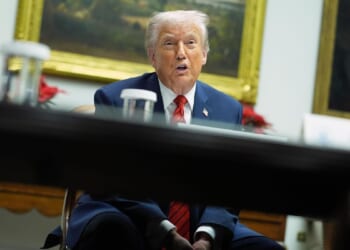
Treasury Secretary Scott Bessent addressed questions about the U.S. government’s decision to lift sanctions on Iranian oil stored on tankers during a recent exchange with NBC’s Kristen Welker, outlining the administration’s reasoning and disputing claims about the financial impact of the move.
The discussion centered on the Treasury Department’s action announced Friday, which allows previously sanctioned Iranian oil to enter the market under certain conditions.
Critics have raised concerns that the move could generate billions in revenue for Iran.
Here’s What They’re Not Telling You About Your Retirement
Welker questioned the policy during the interview, asking about its implications.
“Talk about your announcement this past week, on Friday, the Treasury Department lifted sanctions on Iranian oil stored on tankers, a move that would effectively allow Iran to get more than $14 billion of oil revenue. Why is the US helping to fund a country that it’s currently at war with?” Welker said.
Bessent responded by challenging the premise of the question and describing the broader market context.
“Again, Kristen, why don’t we have good facts here that Iranian oil was always going to be sold to the Chinese. It was going to be sold at a discount. So which is better, Kristen? If oil prices spiked to $150 and they were getting 70% of that, or oil prices below 100, it’s better to have them where they are now,” Bessent said.
This Could Be the Most Important Video Gun Owners Watch All Year
He explained that the administration had anticipated the situation and incorporated it into its planning.
“And to be clear, we have always planned for this contingency. About 140 million barrels are out on the water,” Bessent said.
Bessent described the approach as a strategic effort to limit Iran’s leverage in global oil markets while maintaining visibility over where the oil is sold.
“In essence, we are jiu-jitsu-ing the Iranians. We are using their own oil against them,” he said.
According to Bessent, the decision allows the Treasury Department to better track the movement of Iranian oil and monitor financial transactions associated with its sale.
“We have a much better line of sight to be clear at Treasury, when this oil goes to if it goes to Indonesia, if it goes to Japan, if it goes to Korea, we have a much better line of sight, and are able to block accounts that the oil goes into, when it goes into China, it completely gets recycled,” Bessent said.
He also disputed the reported financial impact of the policy, specifically addressing estimates that Iran could receive more than $14 billion in revenue.
“So the fort to be clear that 14 billion number is grossly overstated,” Bessent said.
The opinions expressed by contributors and/or content partners are their own and do not necessarily reflect the views of LifeZette. Contact us for guidelines on submitting your own commentary.



![Donald Trump Slams Chicago Leaders After Train Attack Leaves Woman Critically Burned [WATCH]](https://www.right2024.com/wp-content/uploads/2025/11/Trump-Torches-Powell-at-Investment-Forum-Presses-Scott-Bessent-to-350x250.jpg)