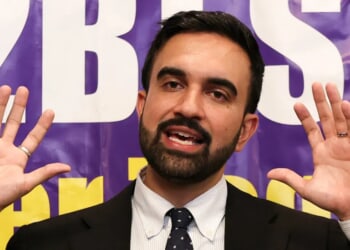
Dr Bob Seely MBE is a former MP who sat on the Foreign Affairs Select Committee and is the author of The New Total War.
When I did academic work, I would try to avoid reading ‘doctrine’ documents like the plague. They were always dull as dishwater and often said little. However, they are important. They help set a nation’s policy, and policy – what a nation does – is the outcome of what it thinks.
The US released its National Security Strategy last week. It’s very blunt, a lot more readable than most official documents, probably because it’s not written by foreign policy experts, but by ‘tech bros’ with strong links into the White House. There is a lot of brouhaha about it, perhaps too much. Some – especially on the left – may need smelling salts to revive them after the slating handed out to the EU and European ‘civilisational collapse’.
I have read it – several times – so you don’t have to. In it there is good, bad and ugly, but it is going to shape the world for the next few years.
So, what does it say?
First, China is the competitor and the US gearing up for economic competition and conflict which will define the century. Second, the US’s own backyard is critical. Third, whilst it wants a partnership with Europe, it simultaneously despairs of its defeatism and decline. Finally, it is worrying neutral on Russia.
Its core message to the US allies is, and I quote: “The days of the United States propping up the entire world order like Atlas are over.” Our allies are rich, it says, they can pay their own way.
The good?
There is actually a fair amount here, especially on critical but under-reported economic battles which will shape this century. When Trump says wealth is power, he’s not wrong. It focuses on the strategic battles with China and specifically on economic rivalry. It wants a common front with allies to ensure future prosperity. It wants onshoring of industry fuelled by cheap energy – and God are we missing the plot on that one – and it wants control over critical supply chains to stop China dominating them. Thank God someone in the West is thinking about this, given that UK and European leaders are next to useless on it. So far so good.
The bad?
It says morally and militarily worrying things about the Ukraine war which, if the come to pass, will damage US power and strengthen Putin – a man who wants to destroy the West. It says, “as a result of Russia’s war in Ukraine … many Europeans regard Russia as an existential threat.” Well, no secret as to why! The strategy’s answer is to implicitly argue that the US will have to help manage European relations with Russia to reduce the risk of conflict – the US as an honest broker between a Russian dictator and European democracies? That’s a major change, and an uncomfortable one. – although there is perhaps a hard, amoral point being made here. The best that can be said of this is that it is likely to be nuanced into something very different by Congress and the State Department. As it stands, it plays into the Russian agenda of separating Europe and the US, something it has tried and failed to do since the end of World War II.
The ugly?
There are some painful but timely lessons that it’s difficult not to have some sympathy with.
First, Trump is prioritising stability over the promotion of democracy, especially in the Middle East. The era of lecturing others has, at least in the US, ended. Whilst this may not sound pretty, it is understandable reaction against the liberal internationalism of the 1990s that morphed, thanks in part to 9/11, into a form of liberal imperialism. He does not accept the liberal shibboleth that all nations are equal in international relations, but instead that “the outsized influence of larger, richer, and stronger nations is a timeless truth of international relations.”
Welcome to a new era of harder realism; superpowers, great powers, regional powers and also rans. This is the era of the nation state, not international institutions. This is foreign affairs in the pursuit of national interest, more like our adversaries such as China and Russia. Whilst being mindful of our global network of alliances and our value systems, our own Foreign Office could do with a moderate dose of this. Too often it has behaved like a glorified NGO, promoting a ‘decolonising’ idea of international law over our national interest. International institutions have their place, but so does our national interest.
But it’s on Europe that US strategy doesn’t hold back. It is rare to see so undiplomatic a diplomatic document. Some will love it, some hate it. Europe’s real problems, it says, eclipse just “economic stagnation” or low military spending, but amount to “civilisational erasure,” caused by mass immigration and a loss of its traditional value system. And boy, do the authors hate the EU. I’ll quote the whole paragraph:
The larger issues facing Europe include activities of the European Union and other transnational bodies that undermine political liberty and sovereignty, migration policies that are transforming the continent and creating strife, censorship of free speech and suppression of political opposition, cratering birthrates, and loss of national identities and self-confidence.
This is US-style euroscepticism laid on with a trowel.
The US wants, it says, to restore “Europe’s civilizational self-confidence and Western identity,” and it’ll do that by working with what it calls “patriot parties.” The US goal will be to help Europe change course. This will not go down well with the continent’s political establishments. However, given that Europe gave up on protecting itself a generation ago, it has little choice but to take the verbal brickbats – at least for the moment. It still needs Washington’s military umbrella. So it will doff its caps and sneer under its breath.
Britain and Ireland get a special mention because of the US’ sentimental attachment to them. The character of the UK is important. The US needs allies it can count on. “We want to work with aligned countries that want to restore their former greatness.”
That’s quite an accusation, and quite an offer.
In the UK, we have been so brow-beaten by our leftwing legal, political and media elite, drunk on the self-righteousness of self-loathing, that we have forgotten how remarkable we used to be. To hear other leaders demand that we be proud of what we were and what we are is, at very least, food for thought.
The beating up of Europe, justified or not, do risk the eventual breakdown of the Atlantic Alliance that has kept us safe and our Western civilisation dominant. If it is more than rhetorical theatre, then there are dangers ahead. There’s also, I’d suggest, a good dollop of psychological displacement here given the Latin Americanisation of parts of the US, but Trump’s administration is serious about securing borders and ending global mass immigration, and his strategy wants – practically demands – that Europe is as well.
For us in the UK, what does this all mean?
Well, we need to relearn the art of strategy.
To have the same influence in global affairs, we are going to have to think much more carefully about how we apply power, and we will need to acquire more hard power. Unless we spend more on defence, we will become too irrelevant to be a junior partner to the US, and not capable to providing a leadership role in Europe. We are at a dangerous crossroads.
So, this US strategy is good on China, bad on Russia and ugly – justified or not – on Europe. But make no mistake, Trump is extending his civilisational battle here.
Labour will be asked about their plans to abolish trial by jury, or on two-tier justice, or freedom of speech issues. They will be asked why, despite all the talk, it has yet to increase expenditure on defence, apart from handing over billions to give away our own strategic base of Diego Garcia.
Trump’s agenda is clear. For MAGA, read MEGA – Make Europe Great Again.
Whether Europe wants that is another matter.

![Donald Trump Slams Chicago Leaders After Train Attack Leaves Woman Critically Burned [WATCH]](https://www.right2024.com/wp-content/uploads/2025/11/Trump-Torches-Powell-at-Investment-Forum-Presses-Scott-Bessent-to-350x250.jpg)