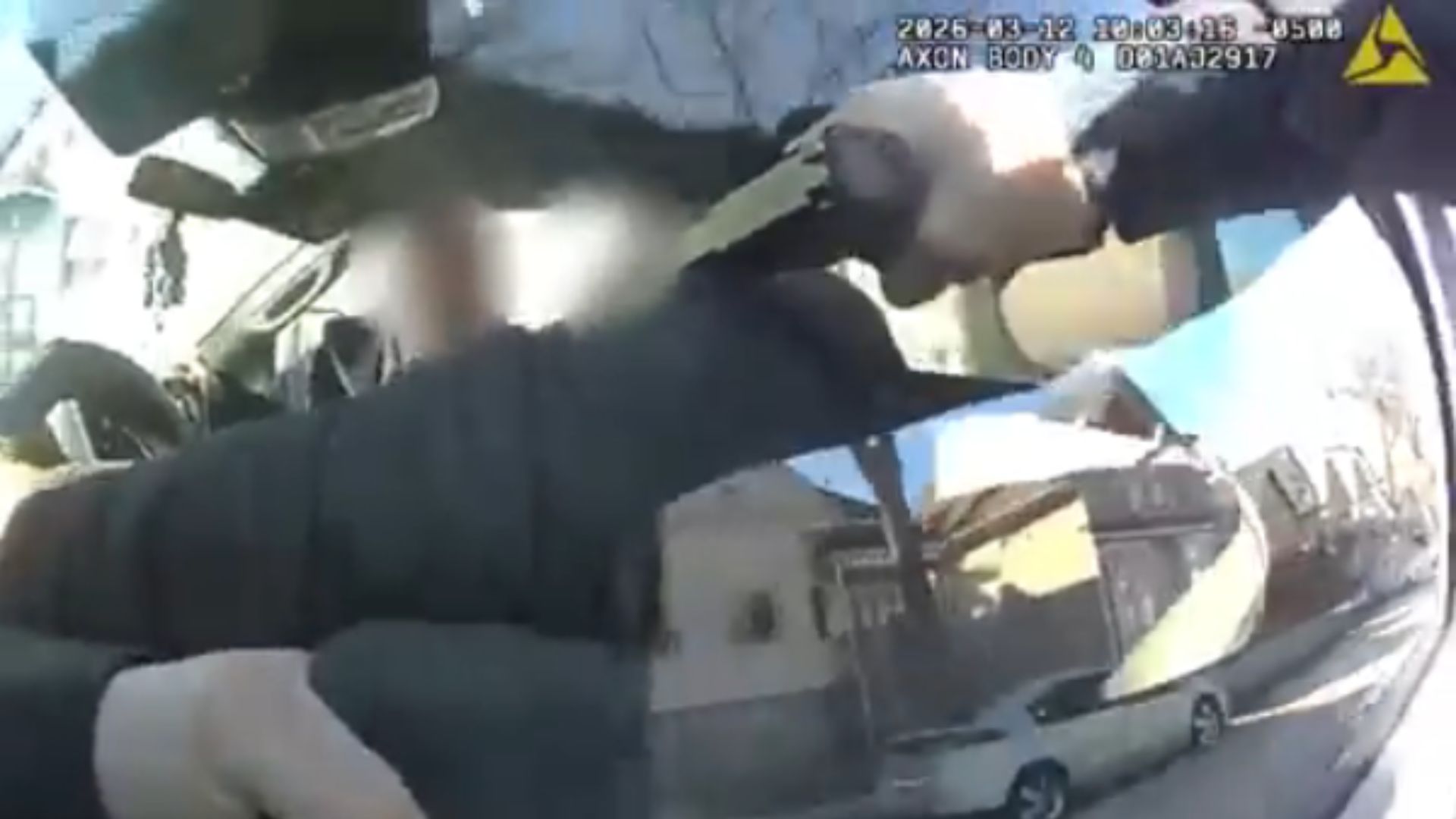
Newly released police body camera video shows a March 12 incident in Milwaukee in which a police officer clung to a moving tow truck before shooting the driver, identified as 35-year-old Jonathan Otto, in the head. Otto was pronounced dead following the encounter.
According to the Milwaukee Police Department, the incident began when an officer approached Otto’s tow truck to contact him regarding a parole violation.
The Department of Corrections said Otto had missed two parole appointments, and days earlier officials had learned of assault and strangulation allegations involving him.
Here’s What They’re Not Telling You About Your Retirement
The body camera video shows Otto starting the truck and attempting to drive away as the officer approached.
The officer then jumped onto the running board of the vehicle and grabbed Otto’s sleeve while the truck was moving.
Otto’s girlfriend, identified as Emily, was in the passenger seat during the incident.
She can be heard on the video repeatedly shouting for the officer to get off the truck.
This Could Be the Most Important Video Gun Owners Watch All Year
According to Emily, Otto did not speak during the encounter.
She told CBS 58 shortly after the shooting, “Johnathan didn’t say a word. The officer, all he told him was, ‘I’m going to f***ing kill you.’ And took out his gun and shot him in the head.”
The body camera footage captures the officer issuing commands to Otto multiple times.
The officer ordered Otto to stop the truck at least 15 times and told him to get out of the vehicle at least five times.
The officer also warned Otto at least twice that he would shoot him.
The incident has drawn ongoing debate. Some have argued that Otto should have complied with the officer’s commands, while others have questioned the officer’s decision to remain on the moving vehicle rather than disengage.
Dr. De Lacy Davis, an expert in use of force and community police relations, provided analysis of the situation.
Davis, a retired New Jersey police sergeant and former police academy instructor with more than 20 years of experience, said, “The officer has to make that decision in real time, but it’s a real-life decision, because you’re now putting yourself in harm’s way.”
Davis also stated, “Certainly, the simplest thing to do, as I’m sure people have said, is that Mr. Otto could have complied.”
He noted that once Otto did not comply, the officer chose to get onto the vehicle.
Davis said an alternative approach could have been to step back and pursue the suspect through other means.
“We know who it is. You get a warrant for his arrest. Now when you go back, you go back with a tactical unit,” Davis said.
Milwaukee Police Department policy outlines guidelines for the use of force in situations involving moving vehicles. Policy 460.40 A. 1 states: “A police member shall not discharge a firearm at the driver or occupant(s) of a moving vehicle, or the vehicle itself, unless deadly physical force is being used against the police member or another person by means other than a moving vehicle. This is not intended to restrict an officer’s right to discharge their firearm at the operator of a vehicle when it is reasonably perceived that the vehicle is being used as a weapon against the officer or others, and the moving vehicle poses an imminent and ongoing threat of substantial physical harm to the police member or another person from which there is no reasonable means to escape.”
Davis said the presence of a passenger adds additional risk.
“The passenger is a bystander. And so now they’re in harm’s way when you discharge that weapon inside of the cab of a truck,” he said.
Additional policy guidance under 460.40 A. 2 states: “Police members shall not intentionally place themselves to either the front or the rear of a moving vehicle’s path. If they find themselves in danger from a moving vehicle, they shall attempt to move out of the way.”
Davis said, “There were times when the vehicle slowed down. Disengage!”
Policy 460.40 A. 4 states: “Police members shall not reach into or place any part of their bodies inside a driver occupied vehicle during a traffic stop or field interview.”
Davis emphasized the difficulty of such situations, stating, “It’s a split-second decision, which, from my lens and from a reformist perspective, my argument is they don’t get on the vehicle at all. That’s the decision that I would’ve wanted an officer under my command to make.”
The officer involved in the shooting is a 46-year-old with more than 21 years of service, according to the Milwaukee Police Department.
He sustained non-fatal injuries during the incident, was treated at a local hospital, and has been placed on administrative leave, which is standard procedure following an officer-involved shooting.
The West Allis Police Department is leading the investigation into the incident.
Davis said investigators will examine the officer’s mindset at the time and determine whether there was a valid threat to his life.
Davis added that in some cases, officers may be cleared of criminal wrongdoing but still face internal discipline for violating department policies.
The opinions expressed by contributors and/or content partners are their own and do not necessarily reflect the views of LifeZette. Contact us for guidelines on submitting your own commentary.







![Kamala Comes Unglued, Makes Bogus Claim About Her Landslide Loss to Trump [WATCH]](https://www.right2024.com/wp-content/uploads/2025/10/Kamala-Comes-Unglued-Makes-Bogus-Claim-About-Her-Landslide-Loss-350x250.jpg)
![James Carville Admits Democrats Had No Shutdown Endgame, Mishandled Strategy [WATCH]](https://www.right2024.com/wp-content/uploads/2025/11/1763070634_James-Carville-Admits-Democrats-Had-No-Shutdown-Endgame-Mishandled-Strategy-350x250.jpg)