Welcome to the holiest week of the year.
Holy Week begins with Palm Sunday. In the Roman Catholic Church, as well as some others, the Palm Sunday reading is the Passion narrative. This year, it’s Matthew’s Gospel, sections 26:14-27:66. I’m always shaken by these passages. Who wouldn’t be? They chronicle Jesus’ journey to death on the cross, beginning with Judas’ betrayal, selling out his Savior for thirty pieces of silver. It will not be the first time in history that a righteous person is condemned by a lesser for sheer greed, power, or whatever motivation. When the injustice happens, the victim should always bear in mind that it also happened to none other than the Son of God. (RELATED: The Mysterious Solitude of Christ in His Passion and Death on the Cross)
The pivotal moment of Judas’s betrayal is dramatic and dark, literally. Judas takes the morsel from Jesus at the Last Supper and — as John’s Gospel puts it — “Satan entered him … and he left at once. And it was night.”
He scurried into the darkness, away from the Light, to do his dirty deed. But ultimately, there’s no rejoicing for Judas, no happy ending. There never is for those who instead serve the Son of Darkness. After receiving his payment, a despondent Judas flees and hangs himself. Satan really had entered him. So much so that Judas couldn’t conceive of Christ’s ocean of mercy. Rather than following the Prince of Peace, he took the way of the Prince of Darkness.
Judas’s betrayal is one of many that unravel in the Passion narrative. Jesus is betrayed repeatedly. The very people who watched him perform miracles and shouted hosannas just days before during his triumphant entrance into Jerusalem now demand, “Crucify him!” When Roman Governor Pontius Pilate offers them a choice between the man of miracles and a murderer, they demand the latter.
“Give us Barabbas!” they insist.
“He deserves to die!” shouts the mob.
From Judas to the mob, from high priests Caiaphas and Annas, they demand death for the Author of Life.
This sordid scene plays out all the way to Calvary. It never ceases to sadden and sicken. Christians who today lament their own sorrows, “Why do bad things happen to good people?” should ponder their namesake’s Via Crucis. They should stop and stare at the Crucified One. Their own Savior was treated badly. Terribly. Egregiously. Oh, and he did tell them (lest they forget) that if they wanted to follow Him, they needed to pick up their cross, too.
Every follower of Christ must pick up the cross.
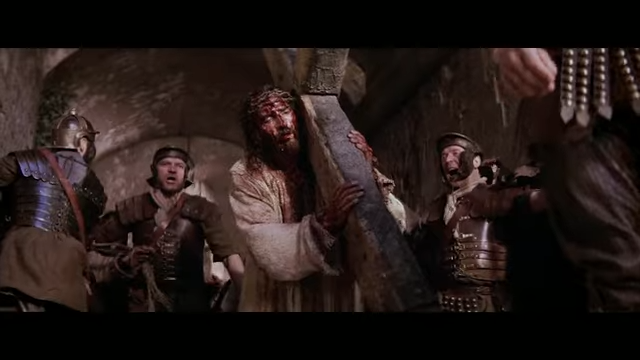
Reading the Passion narrative every Holy Week reminds us. So do good film representations. I would recommend several, including the 1977 all-star cast TV series Jesus of Nazareth by Franco Zeffirelli, the 2016 film Risen, the 1951 epic Quo Vadis, and the best of all, Mel Gibson’s stunning The Passion of the Christ.
I also strongly recommend the insights and images of a woman who inspired many scenes in Gibson’s masterpiece, as well as Zeffirelli’s work: Anne Catherine Emmerich (1774-1824). The incredible German mystic and stigmatist is officially recognized by the Catholic Church as a blessed. And Blessed Anne Catherine Emmerich is also considered one of the greatest visionaries in the history of the Church.
Let me be clear to believers and non-believers, and to Catholics and Protestants alike, that Emmerich’s visions fall in the category of what her Church categorizes as private revelation. They do not rise to the authority of sacred Scripture. Readers should deal with them with caution. We cannot accord them the same weight as Holy Scripture, though they are faithful to the Bible, just as viewers must do with popular modern works like The Chosen series.
Nonetheless, Emmerich’s visions, published in her The Dolorous Passion of Our Lord Jesus Christ, were so detailed, so extraordinary, that many read them each Holy Week for an added inspiration as to what transpired 2,000 years ago. Readers are spellbound by details that the Scriptures don’t reveal but which we can easily imagine, such as Emmerich’s description of the piercing of the side of Jesus by the Roman soldier, the terrified reaction to the consuming darkness and the earthquake at the time of Christ’s expiration, and the shocking apparitions of the dead rising from their tombs in Jerusalem. One cannot help but nod and say, “Surely, yes, I can picture it happening this way.”
Backing up to the start of this article, to Jesus’s path from the Last Supper to Calvary, one is stirred by Emmerich’s vivid descriptions of Gethsemane, Jesus’s awful interrogation by Annas and Caiaphas, Peter’s denials, Claudia’s dreams, the Savior being flogged and crowned and crucified between the two thieves, and more. Here is but one example:
“Shall I crucify your king?” asked Pilate. “We have no king but Caesar!” responded the high priests and the crowd. Emmerich’s account conforms to the New Testament account, but she added details like these, which surely seem conceivable: “I looked up again and saw the cruel [mob] almost devouring their victim with their eyes, the [Roman] soldiers standing coldly by, and multitudes of horrible demons passing to and fro and mixing in the crowd.” The demons egged on the bystanders, helping to whip the mob into its frenzy. As Emmerich watched this spectacle she was “overcome” by the “ferocious joy of the executioners,” the “cowardice and duplicity of this despicable being [Pontius Pilate],” the “triumphant countenances of the High Priests,” the “cunning and duplicity” and “infernal joy” of Annas, the “agonizing grief” of the Blessed Mother, and of course, the cruel injustice inflicted upon the sinless One stoically bearing the sins of them all.
Alas, circling back to Judas Iscariot, she described his unbearable torment after betraying his Savior. She saw him running frantically about the countryside, pursued “by many devils” tormenting him as he succumbed to “black despair” and hung himself. Mel Gibson captures this dramatically in The Passion.
We all have our Bibles, but they don’t contain photos. They offer limited details. Fuller images are left to our imaginations, as well as to filmmakers or even the rare mystic like Anne Catherine Emmerich. Many of these vivid accounts cannot help but put one closer to the suffering Christ. They help us more deeply appreciate what our Savior went through in his sacrifice for us on his knees and on the cross.
And that’s where every follower of Christ should be every Holy Week.
READ MORE from Paul Kengor:




![James Carville Admits Democrats Had No Shutdown Endgame, Mishandled Strategy [WATCH]](https://www.right2024.com/wp-content/uploads/2025/11/1763070634_James-Carville-Admits-Democrats-Had-No-Shutdown-Endgame-Mishandled-Strategy-350x250.jpg)